Short notes › Grade 10 · සිංහලෙන්

Grade 10 Equations: Short Notes

10 ශ්‍රේණිය · 2 වාරය · 14 පරිච්ඡේදය · සමීකරණ

91%

of Grade 10 term tests include it (49 of 54)

873

marks in past papers (148 questions)

12 min

full lesson with quick checks

🎯 What you'll learn

  • Solve linear equations with algebraic fractions
  • Solve simultaneous equations with unequal coefficients
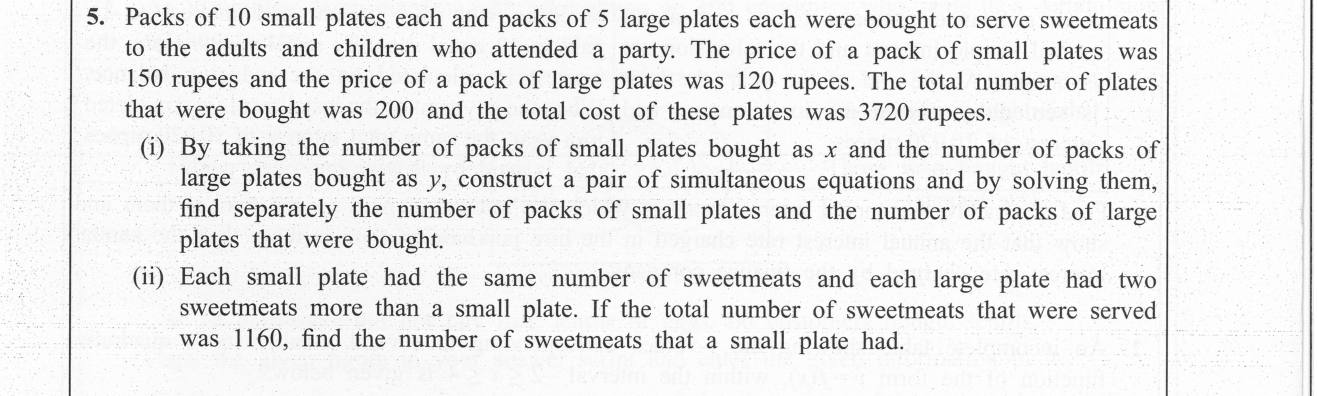
  • Form simultaneous equations from a word problem and check the answer
  • Solve quadratic equations by factorising
  • Form and solve quadratic equations from area and Pythagoras problems

Buns and tea

At a Kandy bakery, 2 fish buns and 3 cups of tea cost Rs 330. Your friend pays Rs 370 for 3 fish buns and 2 cups of tea. What does one bun cost? You could guess all day, or write two equations and know in a minute.

Fractions? Clear them first

An equation like x/3 + x/4 = 7 has algebraic fractions.1. Find the LCM of the denominators (here 12).2. Multiply every term on both sides by it, so no fractions are left.3. Expand brackets and solve as usual.4. Check by putting your answer back into the original equation.

✏️ A first fraction equation

Solve x/3 + x/4 = 7.
  1. 1LCM of 3 and 4 is 12. Multiply every term by 12.
  2. 24x + 3x = 84
  3. 37x = 84, so x = 12.
  4. 4Check: 12/3 + 12/4 = 4 + 3 = 7 ✓

✅ x = 12

✏️ Watch the minus sign

Solve (x + 1)/2 − (x − 2)/3 = 2.
  1. 1Multiply every term by 6: 3(x + 1) − 2(x − 2) = 12
  2. 2Expand: 3x + 3 − 2x + 4 = 12 (−2 × −2 = +4)
  3. 3x + 7 = 12, so x = 5.
  4. 4Check: 6/2 − 3/3 = 3 − 1 = 2 ✓

✅ x = 5

⚠️ The minus belongs to the whole top

In − (x − 2)/3, the minus sign multiplies the whole numerator. Writing −2x − 4 instead of −2x + 4 is the most common slip in these questions. Put the numerator in brackets before you multiply out, then expand carefully: −2(x − 2) = −2x + 4.

Simultaneous equations

Two unknowns need two equations. To solve them, make the coefficients of one unknown equal (ignoring sign):• Multiply one or both equations by suitable numbers.• Same signs → subtract the equations; different signs → add them.• One unknown disappears. Solve, then substitute back to find the other.• Check in both original equations.

From words to equations

Most marks are for forming the equations, not just solving them.1. Say what each letter stands for: "Let one bun cost Rs b."2. Turn each fact into one equation.3. Solve.4. Answer the actual question in words, with units, and check it fits the story.

⚠️ Solving is only half the job

Examiners see this every year: students can't turn the story into a pair of equations, or they form them and then make a sign error when subtracting. Write down what each letter means, line the equations up neatly, and substitute your answers into both original equations. If one doesn't work, look for the slip.

Quadratic equations: use zero

A quadratic equation has an x² term, e.g. x² − 5x − 14 = 0.Key fact: if a × b = 0, then a = 0 or b = 0.1. Bring every term to one side so the other side is 0.2. Factorise.3. Set each factor equal to 0.A quadratic usually has two roots; give both unless the story rules one out.

⚠️ Don't divide by x, and get 0 first

• x² = 3x: dividing by x gives only x = 3 and loses x = 0. Instead: x² − 3x = 0, x(x − 3) = 0, so x = 0 or 3.• (x − 2)(x + 3) = 6: x − 2 = 6 is wrong. The zero rule works only when one side is 0. Expand to x² + x − 12 = 0, then factorise.

📌 Remember

• Fractions: multiply every term by the LCM of the denominators.• A minus before a fraction changes the sign of the whole numerator.• Simultaneous: equalise one coefficient; same signs subtract, different signs add. Check in both equations.• Quadratic: make one side 0, factorise, set each factor = 0.• Reject roots that make no sense (negative lengths, people, prices).

🧾 Quick revision sheet

First step for x/3 + x/5 = 8?Multiply every term by the LCM, 15: 5x + 3x = 120.
Expand −3(x − 4)−3x + 12
Simultaneous equations: when do you add, when do you subtract?After matching coefficients: same signs → subtract; different signs → add.
How do you check a solution of simultaneous equations?Substitute both values into both original equations.
If (x − a)(x − b) = 0, then…x = a or x = b
Roots of x² − 4x = 0x(x − 4) = 0, so x = 0 or x = 4
A quadratic gives a side as −6 or 4. Which do you keep?4: a length can't be negative.

Now test yourself: 5 quick checks and 4 more worked examples

The full lesson checks your answers as you go, and Gedara Sir tracks which parts you've got.

Past paper questions on Equations

More Grade 10 notes