Short notes › Grade 9 · සිංහලෙන්

Grade 9 Fractions: Short Notes

9 ශ්‍රේණිය · 1 වාරය · 4 පරිච්ඡේදය · භාග

95%

of Grade 9 term tests include it (38 of 40)

372

marks in past papers (85 questions)

10 min

full lesson with quick checks

🎯 What you'll learn

  • Add and subtract fractions and mixed numbers
  • Multiply and divide fractions using cancelling and reciprocals
  • Use 'of' and the correct order of operations
  • Simplify expressions with brackets and mixed numbers
  • Solve word problems with 'a fraction of the remainder'

Sharing the Avurudu bonus

Amma gets a Rs 12 000 Avurudu bonus. A quarter goes on new clothes, two-thirds of what is left on kavum, kokis and the family feast, and the rest is saved. How much is saved? Fractions answer it in four lines, once you know the rules.

Adding and subtracting

Make the denominators equal first, then add or subtract the numerators only.2/3 + 1/4 = 8/12 + 3/12 = 11/12With mixed numbers, change them to improper fractions (or deal with the whole numbers separately):2 1/2 − 1 2/3 = 5/2 − 5/3 = 15/6 − 10/6 = 5/6

⚠️ Never add tops and bottoms

In term tests the most common wrong answer to 2/3 + 1/4 is 3/7: numerators added, denominators added. Check it: 3/7 is less than 2/3 alone, so it can't be right. Always find a common denominator (here 12) first.

Multiplying and dividing

• Multiply: numerator × numerator, denominator × denominator. Cancel common factors first to keep numbers small.• Divide: multiply by the reciprocal (flip the second fraction): ÷ 7/15 becomes × 15/7.• Change mixed numbers to improper fractions before multiplying or dividing: 1 4/5 = 9/5.

'Of' and the order of operations

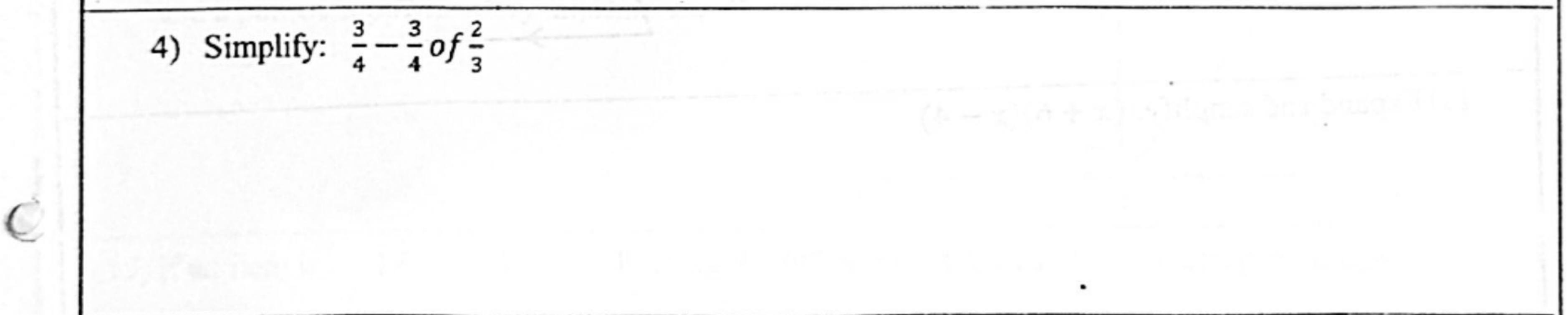
'Of' means multiply: 3/4 of 8/9 = 3/4 × 8/9 = 2/3.Order to follow:1. Brackets2. 'Of'3. Division and multiplication4. Addition and subtractionSo in 4 2/3 − 1 1/4 × 2 2/5, the × is done before the −.

✏️ Multiply before you subtract

Simplify 4 2/3 − 1 1/4 × 2 2/5.
  1. 1Multiply first: 5/4 × 12/5 = 12/4 = 3
  2. 2Then subtract: 4 2/3 − 3 = 1 2/3

✅ 1 2/3

⚠️ Left to right is not the rule

Many students work 4 2/3 − 1 1/4 first and then multiply, getting a wrong answer. Before you start, circle the ×, ÷ and 'of' parts and do those first; only then add or subtract. Brackets always come first of all.

✏️ Brackets, 'of' and division

Simplify (3/4 of 8/9) ÷ (2/3 − 1/6).
  1. 1First bracket: 3/4 × 8/9 = 24/36 = 2/3
  2. 2Second bracket: 4/6 − 1/6 = 3/6 = 1/2
  3. 3Divide: 2/3 ÷ 1/2 = 2/3 × 2/1 = 4/3 = 1 1/3

✅ 1 1/3

A fraction of the remainder

Word problems often say 'a fraction of the remainder'.1. Take the whole as 1.2. Remainder after the first share = 1 − first share.3. Next share = fraction × remainder (multiply).4. What's left = 1 − all shares.Only at the end turn the fraction into rupees, kilograms or acres.

📌 Remember

• + and −: make denominators equal first; never add tops and bottoms.• × : multiply across, cancel first. ÷ : multiply by the reciprocal.• Turn mixed numbers into improper fractions before × or ÷.• Order: brackets, 'of', ÷ and ×, then + and −.• 'Of the remainder' means multiply the fraction by what is left.

🧾 Quick revision sheet

Reciprocal of 2 1/33/7 (2 1/3 = 7/3, then flip)
What does 'of' mean?Multiply.
Dividing by a fractionMultiply by its reciprocal: ÷ a/b = × b/a.
Order of operationsBrackets, 'of', ÷ ×, then + −.
2/3 + 1/411/12
Write 3 2/5 as an improper fraction17/5
2/3 of Rs 900Rs 600
If 3/8 of a sum is Rs 600, the whole is…Rs 1600 (600 ÷ 3/8)

Now test yourself: 5 quick checks and 1 more worked examples

The full lesson checks your answers as you go, and Gedara Sir tracks which parts you've got.

Past paper questions on Fractions

More Grade 9 notes