Short notes › Grade 10 · සිංහලෙන්

Grade 10 Constructions: Short Notes

10 ශ්‍රේණිය · 27 පරිච්ඡේදය · නිර්මාණ

89%

of Grade 10 term tests include it (48 of 54)

551

marks in past papers (89 questions)

12 min

full lesson with quick checks

🎯 What you'll learn

  • Name and draw the four basic loci
  • Locate a point using two loci
  • Construct perpendicular bisectors, perpendiculars, angle bisectors and angles of 60°, 30°, 90°, 45°, 120°
  • Construct a triangle from given sides and angles
  • Construct a line through a point parallel to a given line

Where should the well go?

Two brothers in Kurunegala share a coconut land. They want one well exactly the same distance from both their houses, and 6 m from the line joining the houses. With only a ruler and a pair of compasses you can find the exact spot. That is what constructions are for.

What is a locus?

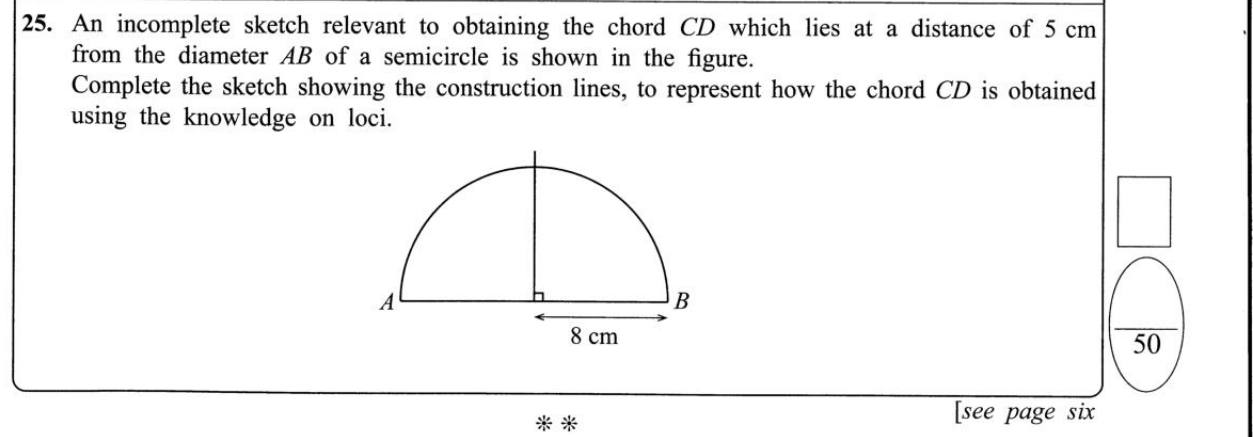
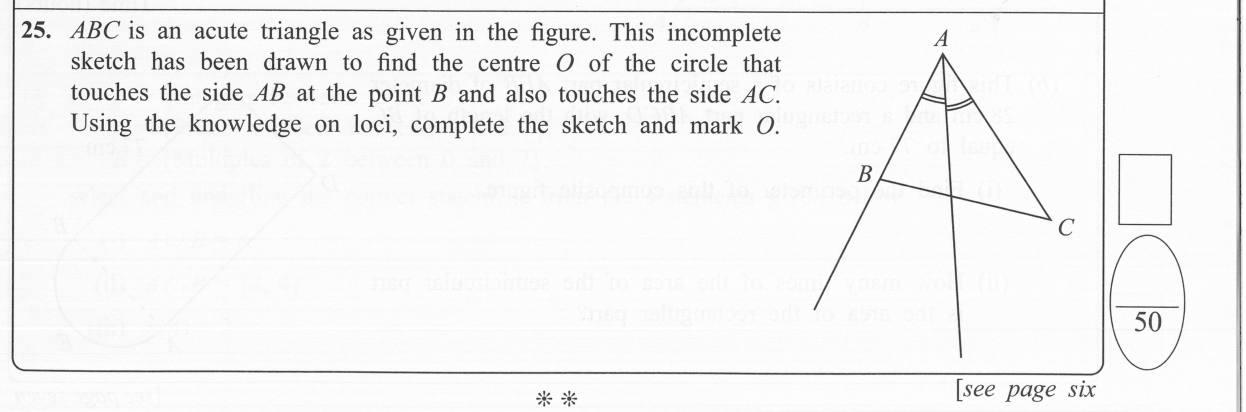
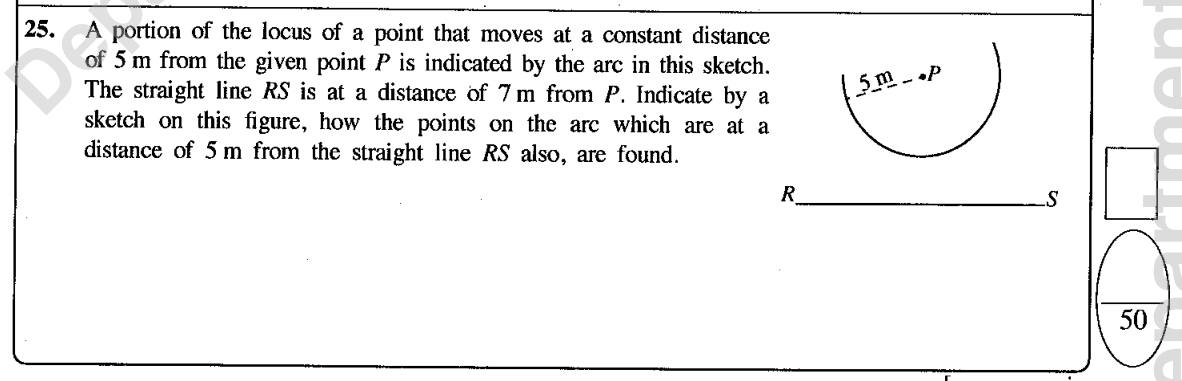
A locus is the set of all points that obey a rule. Four basic loci:1. A fixed distance r from a point O → a circle, centre O, radius r.2. A fixed distance d from a line l → two lines parallel to l.3. Equidistant from two points A and B → the perpendicular bisector of AB.4. Equidistant from two intersecting lines → the bisector of the angle between them.

The four basic loci

The dashed blue lines are the loci: 1 circle, 2 parallel lines, 3 perpendicular bisector, 4 angle bisector.
1234OrldAB

Perpendicular bisector of AB

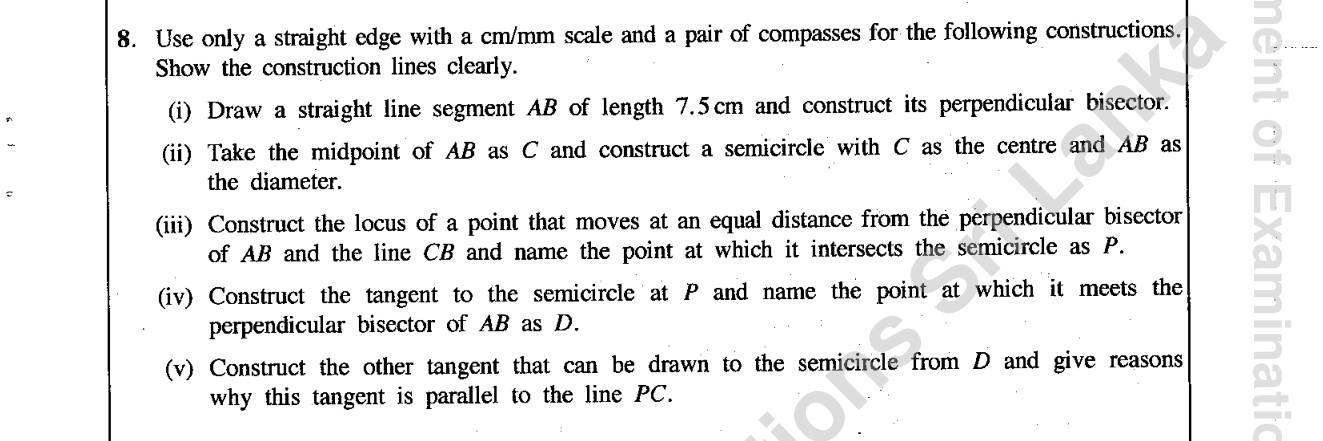
Use only a straight edge and compasses, and never rub out your arcs: they are your working.1. Open the compasses to more than half of AB.2. With centre A, draw arcs above and below AB.3. With the same radius and centre B, draw arcs cutting the first two.4. Join the two crossing points. This line cuts AB in half at 90°.

Bisecting angles and special angles

Angle bisector: arc from the vertex cuts both arms; from those two points draw equal arcs that cross; join the vertex to the crossing.60°: arc from O cuts the line at A; same radius from A cuts the first arc at B; join OB.Then: 30° = bisect 60°, 120° = 60° + 60°, 90° = perpendicular, 45° = bisect 90°.

60°, then 30°

OA = AB = OB, so triangle OAB is equilateral and ∠AOB = 60°. Equal arcs from A and B meet at C; OC bisects it, giving 30°.
OABC30°60°

Perpendicular from a point to a line

P is outside line l:1. Centre P, draw an arc cutting l at X and Y.2. Centres X and Y, same radius, draw arcs that cross on the other side of l, at Q.3. Join PQ. It is perpendicular to l.If P is on l: mark X and Y on l equally either side of P, then construct the perpendicular bisector of XY.

⚠️ Perpendicular from an outside point

Examiners report this again and again: students cannot drop a perpendicular from a point outside a line, so they lose the incircle or the distance part too. Many just draw it by eye or use a set square. Practise the 3 steps above until they are automatic. The arc from P must cut the line twice.

Constructing a triangle

Draw a rough sketch with the data first. Then:• Three sides: draw one side; arcs from its ends with the other two lengths meet at the third vertex.• Two sides and the angle between: draw one side, construct the angle at its end, mark the second side with compasses.• Two angles and a side: draw the side and construct both angles at its ends.

✏️ A right-angled triangle

Construct triangle PQR with QR = 8 cm, ∠PQR = 90° and PQ = 6 cm. Then find the length of PR and check it by calculation.
  1. 1Draw QR = 8 cm with a ruler.
  2. 2At Q construct a 90° angle (extend RQ, then use the perpendicular-at-a-point method).
  3. 3With centre Q, radius 6 cm, mark P on the perpendicular.
  4. 4Join PR and measure it: about 10 cm.
  5. 5Check: PR² = 6² + 8² = 100, so PR = 10 cm.

✅ PR = 10 cm

A parallel line through a point

To draw a line through P parallel to AB:1. Draw any line from P to a point Q on AB.2. Arc from Q cuts QB and QP; same-radius arc from P.3. Measure the opening of the angle at Q with compasses and copy it at P on the other side of PQ.4. Join P through the new point. Equal alternate angles make the lines parallel.

Copying an alternate angle

The shaded angles at Q and P are equal alternate angles, so line l through P is parallel to AB.
ABPQl

⚠️ No protractors, no eyeballing

Using a protractor for a 60° or 30° angle, or sliding a set square to draw a parallel, earns no construction marks. Examiners also see many wrong copied angles: keep the same radius at Q and at P, and copy the angle on the correct side so the angles are alternate (or corresponding).

✏️ Two loci together: the well

Back to the brothers. Houses A and B are 16 m apart. The well W is equidistant from A and B and 6 m from line AB. Locate W and find its distance from each house.
ABWW'86?
  1. 1Equidistant from A and B → perpendicular bisector of AB.
  2. 26 m from AB → two lines parallel to AB, 6 m away on each side.
  3. 3They cross at W (and W' on the other side): two possible positions.
  4. 4Half of AB = 8 m. WA² = 8² + 6² = 100, so WA = WB = 10 m.

✅ 10 m from each house

📌 Remember

• Four loci: circle (from a point), parallel lines (from a line), perpendicular bisector (two points), angle bisector (two lines).• To locate a point, draw two loci; it lies where they cross.• Straight edge and compasses only; keep all arcs.• 60° from an equilateral triangle; bisect for 30°, 45°.• Parallel through P: copy an alternate or corresponding angle.

🧾 Quick revision sheet

Locus: fixed distance from a pointA circle with that point as centre.
Locus: fixed distance from a lineTwo lines parallel to it, one on each side.
Locus: equidistant from points A and BThe perpendicular bisector of AB.
Locus: equidistant from two intersecting linesThe bisector of the angle between them.
How to get 30° and 120°30° = bisect 60°; 120° = 60° + 60°.
Which equal angles give a parallel line?Alternate angles or corresponding angles.
Tools allowed in constructionsStraight edge (ruler) and compasses only.

Now test yourself: 5 quick checks

The full lesson checks your answers as you go, and Gedara Sir tracks which parts you've got.

Past paper questions on Constructions

More Grade 10 notes