Short notes › Grade 10 · සිංහලෙන්

Grade 10 Inverse Proportion: Short Notes

10 ශ්‍රේණිය · 1 වාරය · 9 පරිච්ඡේදය · ප්‍රතිලෝම සමානුපාත

85%

of Grade 10 term tests include it (46 of 54)

372

marks in past papers (77 questions)

9 min

full lesson with quick checks

🎯 What you'll learn

  • Recognise when two quantities are inversely proportional
  • Use xy = k (x₁y₁ = x₂y₂) to find a missing value
  • Solve work problems using man-days
  • Solve food-supply problems when the number of people changes
  • Handle part of a job done and find how many more workers are needed

Harvest before the rain

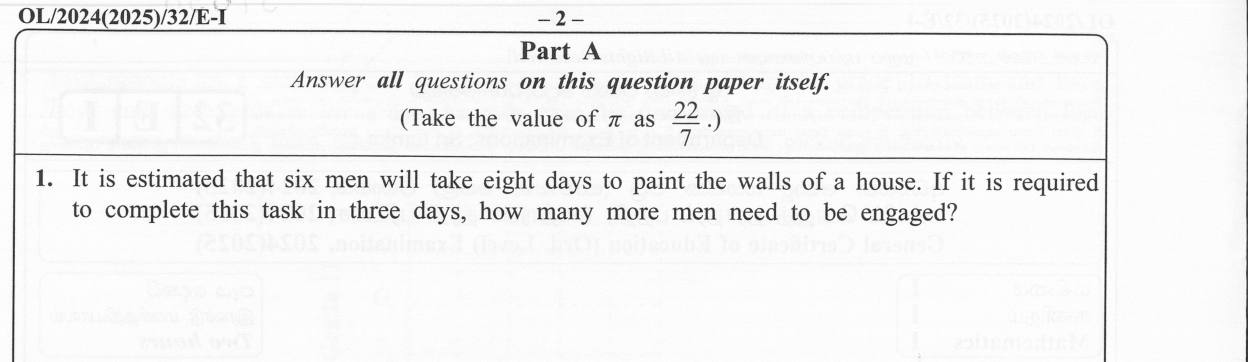
In Polonnaruwa, 8 workers can harvest a paddy field in 6 days. The monsoon is coming, so the farmer hires 12 workers. Will it take 9 days? 4 days? More people means less time. That 'more gives less' pattern is inverse proportion.

What is inverse proportion?

Two quantities are inversely proportional if, when one is multiplied by a number, the other is divided by the same number.Workers: 1, 2, 3, 4, 6Days: 12, 6, 4, 3, 2Double the workers, halve the days. The product never changes: 1 × 12 = 2 × 6 = 3 × 4 = 12.

The graph is a curve

Plot workers (x) against days (y): every point has xy = 12. The curve gets close to the axes but never touches them. Direct proportion gives a straight line through the origin; inverse proportion does not.
xy2468126123(2, 6)(3, 4)(4, 3)(6, 2)xy = 12

🧮 The key rule

k is a constant. If you know one pair of values (x₁, y₁), the product gives k, and k gives any missing value.

x × y = k ⇔ x₁y₁ = x₂y₂ ⇔ y = k/x

✏️ Bus to Kandy

A bus at an average speed of 40 km/h takes 3 hours for a trip. How long would it take at 60 km/h?
  1. 1Speed and time are inversely proportional, so speed × time is constant.
  2. 2k = 40 × 3 = 120
  3. 3Time = 120 ÷ 60 = 2 hours. Faster bus, less time ✓

✅ 2 hours

Work as man-days

For a job, total work = workers × days, measured in man-days (or man-hours, machine-hours).8 workers for 6 days = 48 man-days. That number is the size of the job; it doesn't change when the team changes.So: days = man-days ÷ workers, workers = man-days ÷ days.

✏️ Back to the paddy field

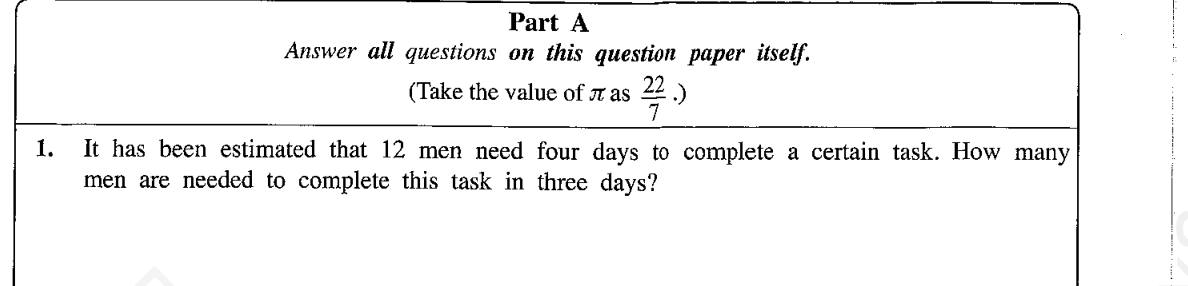
8 workers harvest a field in 6 days. How many days will 12 workers take, working at the same rate?
  1. 1Total work = 8 × 6 = 48 man-days.
  2. 2Days for 12 workers = 48 ÷ 12 = 4 days.
  3. 3Sense check: more workers, fewer days ✓

✅ 4 days

⚠️ More workers, MORE days?

Examiners keep seeing this: 6 × 12/8 = 9 days, as if workers and days were directly proportional. 12 workers can't be slower than 8!Always find the total man-days first, then divide. Then ask: does my answer go the right way?

⚠️ Fractions and 'how many more'

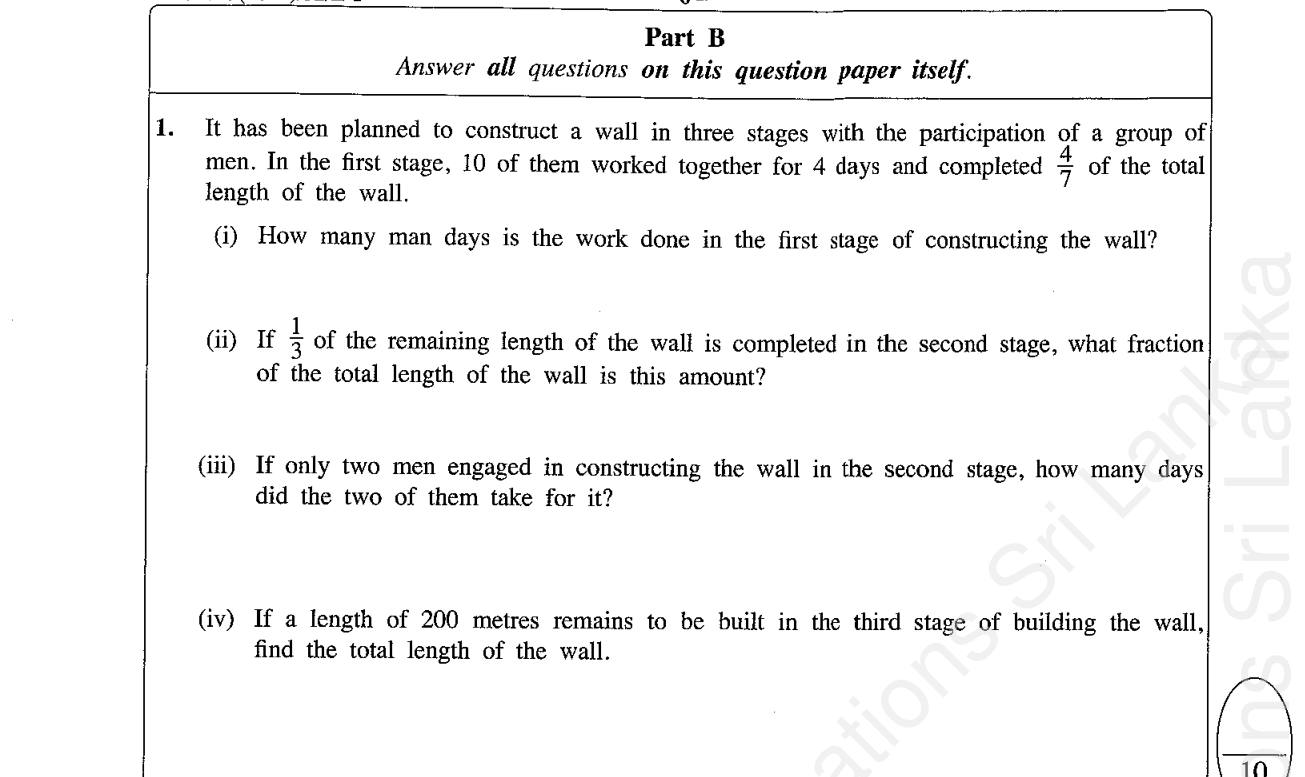
Two traps in these questions:• The man-days given are often for part of the job. Scale up to the whole job before anything else.• 'How many more workers' means new total minus the workers already there. Writing 15 instead of 9 loses the mark.

📌 Remember

• Inversely proportional: one × n, the other ÷ n. Their product is constant: xy = k.• Speed–time, workers–days, people–days food lasts are classic pairs.• Total work = workers × days (man-days). Find it first.• Scale part of a job up to the whole; answer exactly what is asked ('how many more').• Sense check: more workers must mean fewer days.

🧾 Quick revision sheet

Inverse proportionWhen one quantity is multiplied by n, the other is divided by n; xy = k.
Direct vs inverse: graph shape?Direct: straight line through the origin. Inverse: a curve that never meets the axes.
Total work in man-daysworkers × days
If x₁y₁ = x₂y₂, how do you find y₂?y₂ = x₁y₁ ÷ x₂
5 men do 1/4 of a job in 6 days. Whole job?5 × 6 × 4 = 120 man-days
Food for P people for D days, then more people come. First step?Find the food left in person-days: P × (days remaining).

Now test yourself: 5 quick checks and 2 more worked examples

The full lesson checks your answers as you go, and Gedara Sir tracks which parts you've got.

Past paper questions on Inverse Proportion

More Grade 10 notes