Short notes › Grade 10 · සිංහලෙන්

Grade 10 Rate: Short Notes

10 ශ්‍රේණිය · 2 වාරය · 21 පරිච්ඡේදය · ශීඝ්‍රතාව

70%

of Grade 10 term tests include it (38 of 54)

274

marks in past papers (65 questions)

11 min

full lesson with quick checks

🎯 What you'll learn

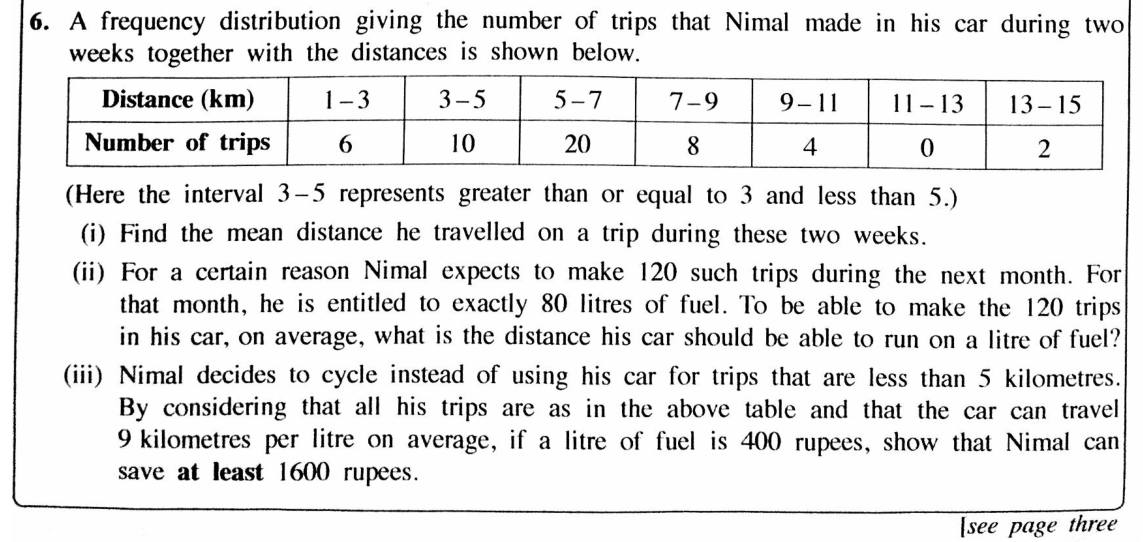
  • Find and use a rate (an amount per unit of time) with the unitary method
  • Use speed = distance ÷ time in all three arrangements, with correct units
  • Find average speed for a journey with several stages
  • Read speeds and stops from a distance-time graph
  • Solve rate-of-flow problems for filling and emptying tanks

Expressway or Galle Road?

A highway bus reaches Galle from Makumbura in about 1½ hours. The Galle Road bus takes nearly 4 hours for a similar trip. At home, the motor fills your roof tank while you finish your homework. All three questions are about the same thing: how much happens in each unit of time. That is a rate.

What is a rate?

A rate compares two different quantities, usually 'something per unit of time'.• 60 km per hour (km/h)• 25 litres per minute (L/min)• 40 words per minute when typingTo use a rate, first find the amount for one unit (the unitary method), then multiply for any number of units.

✏️ A tap at the well

A tap fills a 45 L barrel in 3 minutes at a steady rate. (i) Find the rate of flow. (ii) How much water flows in 10 minutes?
  1. 1(i) Rate = 45 L ÷ 3 min = 15 L/min.
  2. 2(ii) In 10 minutes: 15 × 10 = 150 L.

✅ (i) 15 L/min (ii) 150 L

🧮 Speed, distance and time

S = speed, D = distance, T = time. Speed is the rate of travel. Picture a triangle with D on top and S × T below; cover the one you want. Units must match: km and hours give km/h; m and seconds give m/s.

S = D ÷ T D = S × T T = D ÷ S

✏️ A long-distance bus

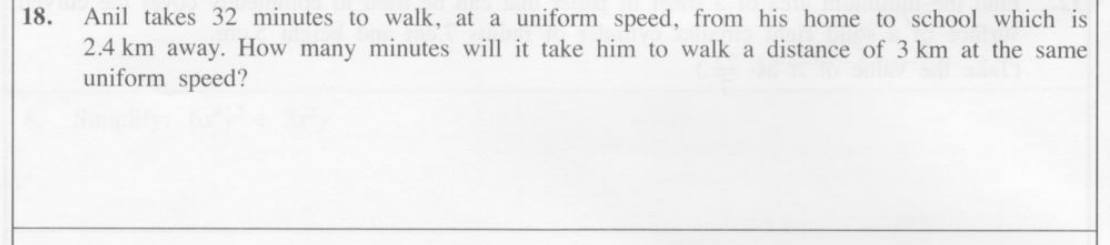
A bus travels 150 km in 2½ hours at a uniform speed. (i) Find its speed. (ii) At the same speed, how long will it take to travel 210 km?
  1. 1(i) Speed = 150 ÷ 2.5 = 60 km/h.
  2. 2(ii) Time = 210 ÷ 60 = 3.5 hours.
  3. 30.5 h = 30 minutes, so 3 hours 30 minutes.

✅ (i) 60 km/h (ii) 3 h 30 min

⚠️ Minutes are not hours

In a recent O/L paper only about 1 in 4 candidates found a speed in km/h correctly: most divided kilometres by minutes. Convert first: 45 min = 45/60 = ¾ h, 20 min = ⅓ h.To change km/h to m/s, multiply by 1000/3600 = 5/18. Always write the unit with your answer.

Average speed

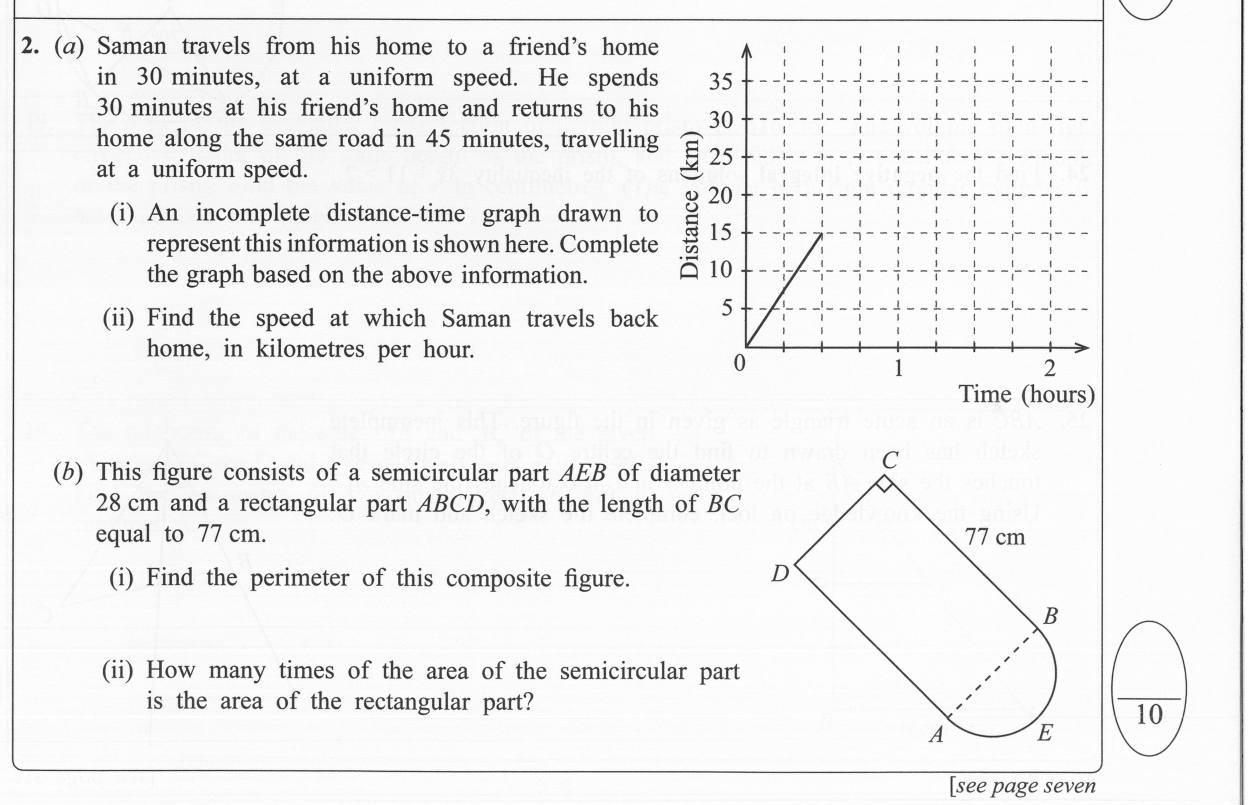
Real journeys speed up, slow down and stop.Average speed = total distance ÷ total timeInclude the time spent at stops in the total time. Do not just average the speeds of the stages: the stage that lasts longer counts for more.

Reading a distance-time graph

Steeper line = faster. Speed = rise in distance ÷ time taken. A horizontal line means the vehicle is stopped (here from 2 h to 2.5 h). First stage: 80 km in 2 h = 40 km/h.
123404080120160t (h)d (km)170

Rate of flow

For pipes, taps and pumps the rate is volume per unit time, e.g. L/min.• Time to fill = capacity ÷ rate• Volume = rate × timeUseful conversions:1 L = 1000 cm³ and 1 m³ = 1000 L.If water flows in and out together, use the net rate = rate in − rate out.

⚠️ Multiply or divide?

Examiners keep seeing students multiply when they should divide: capacity × rate, or distance × speed. Check with units: L ÷ (L/min) leaves min, and km ÷ (km/h) leaves h. If your units come out as L²/min or km²/h, you multiplied by mistake. A quick sense check helps too: a faster pump must give a shorter time.

📌 Remember

• A rate is an amount per unit (often per unit of time). Find the rate for one unit first.• Speed = distance ÷ time; convert minutes to hours for km/h.• Average speed = total distance ÷ total time, including stops.• On a distance-time graph, steeper = faster, flat = stopped.• Filling time = volume ÷ rate; use net rate if water also flows out.

🧾 Quick revision sheet

Speed formulaspeed = distance ÷ time
Time from distance and speedtime = distance ÷ speed
Average speedTotal distance ÷ total time (stops included)
km/h to m/sMultiply by 5/18 (e.g. 36 km/h = 10 m/s)
1 m³ = ? litres1000 L (and 1 L = 1000 cm³)
Horizontal line on a distance-time graphThe object is stopped (distance not changing).
Time to fill a tankCapacity ÷ rate of flow
45 minutes in hours¾ h = 0.75 h

Now test yourself: 5 quick checks and 2 more worked examples

The full lesson checks your answers as you go, and Gedara Sir tracks which parts you've got.

Past paper questions on Rate

More Grade 10 notes