Short notes › Grade 10 · සිංහලෙන්

Grade 10 Scale Diagrams: Short Notes

10 ශ්‍රේණිය · 3 වාරය · 31 පරිච්ඡේදය · පරිමාණ රූප

69%

of Grade 10 term tests include it (37 of 54)

358

marks in past papers (47 questions)

10 min

full lesson with quick checks

🎯 What you'll learn

  • Read and use a scale such as 1 : 500
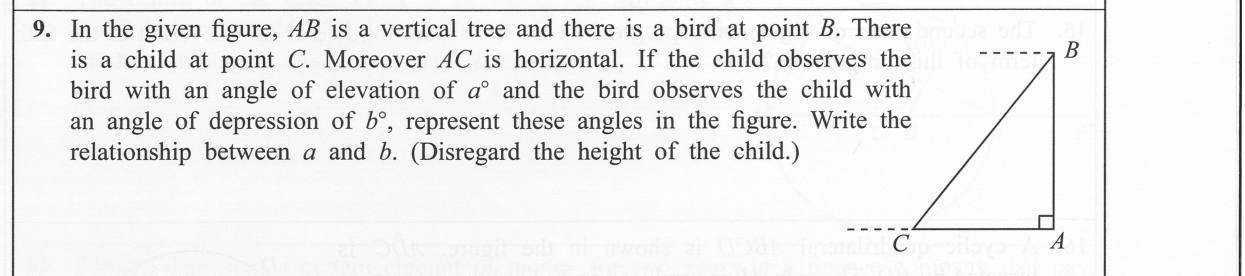
  • Identify the angle of elevation and the angle of depression
  • Describe a location using a distance and an angle of elevation or depression
  • Draw a rough sketch, then a scale diagram in a vertical plane
  • Find real heights and distances from a scale diagram

How tall is that coconut tree?

There's a tall coconut tree at the end of your garden in Chilaw. You can't climb it with a measuring tape. But you can stand back, measure how far away you are and the angle you look up at. A neat drawing on paper does the rest.

What a scale means

A scale diagram is an accurate drawing where every length is shrunk by the same amount.Scale 1 : 500 means 1 cm on paper stands for 500 cm = 5 m in real life.• Paper → real: multiply by the scale (3 cm → 15 m)• Real → paper: divide (40 m → 8 cm)Angles are not scaled: a 40° angle stays 40°.

Looking up, looking down

Both angles are measured from the horizontal line through the observer's eye.• Angle of elevation: you look up at something. It is the angle between the horizontal and your line of sight.• Angle of depression: you look down at something. Again, from the horizontal down to your line of sight.Never measure from the vertical, the wall or the tree.

The two angles are equal

The angle of depression of Q from P equals the angle of elevation of P from Q. The horizontal at P is parallel to the ground, so they are alternate angles.
PQθθ

⚠️ Up or down, and from where?

Examiners often see these two slips: calling an angle of depression an angle of elevation, and marking the angle from the post or the wall instead of the horizontal at the observer. Draw the dashed horizontal first, at the eye of the person looking. Then mark the angle between it and the line of sight.

Solving with a scale diagram

1. Draw a rough sketch and mark every given length and angle on it.2. Choose a scale that fits your page (e.g. 1 cm for 2 m).3. Draw accurately with a ruler and protractor.4. Measure the length you need in cm.5. Convert it back with the scale.6. Add the observer's eye height if the angle was measured from the eye.

✏️ The coconut tree

Nimal stands 12 m from the foot of a coconut tree. The angle of elevation of the top is 40° and his eye is 1.5 m above the ground. Use a scale of 1 : 200 to find the height of the tree.
40°12 m1.5 mTEH?
  1. 1Scale 1 : 200 means 1 cm stands for 2 m. EH = 12 m → 6 cm.
  2. 2Draw EH = 6 cm, a 40° angle at E, and a perpendicular at H to meet the line of sight at T.
  3. 3Measure HT: about 5.0 cm.
  4. 4Real HT = 5.0 × 2 = 10 m.
  5. 5Add the eye height: 10 + 1.5 = 11.5 m.

✅ About 11.5 m

⚠️ Scale and unit slips

With 1 : 500, 1 cm stands for 500 cm, which is 5 m, not 500 m. Examiners report students misreading the scale and mixing up cm and m. Convert to metres once, at the start, and write 'm' with your answer.And if the angle was measured at someone's eye, the drawing gives the height above the eye: add the eye height.

✏️ Looking down from a building

From the top P of a 30 m building in Colombo, the angle of depression of a car C is 35°. Using a scale of 1 : 500, find how far the car is from the foot F of the building.
35°35°30 mPFC?
  1. 11 cm stands for 5 m, so PF = 30 m → 6 cm.
  2. 2Depression 35° at P equals elevation 35° at C (alternate angles).
  3. 3Draw PF = 6 cm vertical, the horizontal at P, and a line 35° below it to meet the ground at C.
  4. 4Measure FC: about 8.6 cm, so FC = 8.6 × 5 = 43 m.

✅ About 43 m

📌 Remember

• 1 : 500 means 1 cm stands for 500 cm = 5 m. Angles are not scaled.• Elevation = looking up, depression = looking down, both from the horizontal at the observer.• Depression of B from A = elevation of A from B.• Rough sketch first, then the accurate drawing, measure, convert.• Add the eye height when the angle is measured from the eye.

🧾 Quick revision sheet

Scale 1 : 1000: 1 cm stands for?1000 cm = 10 m
Angle of elevationThe angle from the horizontal up to the line of sight of an object above you.
Angle of depressionThe angle from the horizontal down to the line of sight of an object below you.
Elevation of P from Q vs depression of Q from PEqual: they are alternate angles.
Does a scale change angles?No. Only lengths are scaled; angles stay the same.
First step in any scale diagram questionA rough sketch with all the given data marked on it.

Now test yourself: 4 quick checks and 1 more worked examples

The full lesson checks your answers as you go, and Gedara Sir tracks which parts you've got.

Past paper questions on Scale Diagrams

Paper II Part B Q7 · 10 marks

Trigonometry · Scale Diagrams

G.C.E. O/L 2025

🔁 Asked in 16 of 16 O/L papers🔥 16 years in a row

Bearing and right triangle: distance, travel time, and an angle by tangent
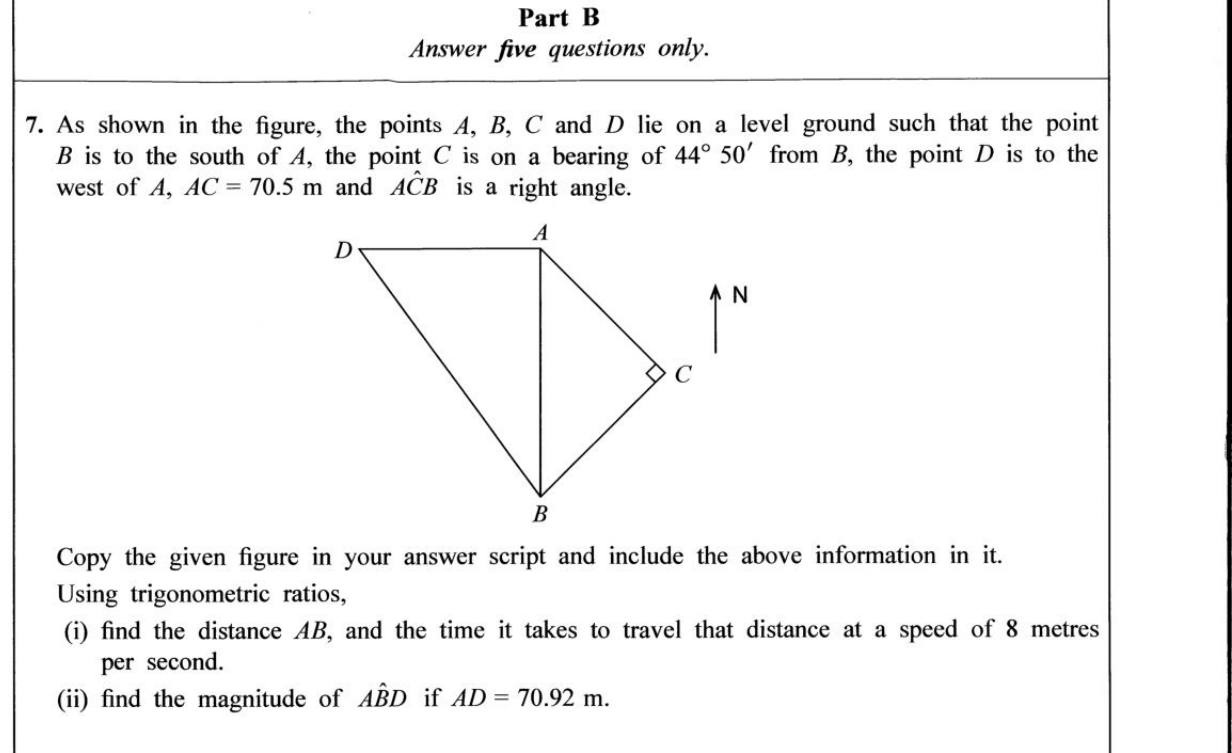
Paper II Part B Q7: Bearing and right triangle: distance, travel time, and an angle by tangent🔒 Answer & steps: try it free in Gedara Sir→

Paper II Part A Q4 · 10 marks

Trigonometry · Scale Diagrams

G.C.E. O/L 2022

🔁 Asked in 16 of 16 O/L papers🔥 16 years in a row

Height of a tree from a kite string; Amal's elevation angle; who is closer
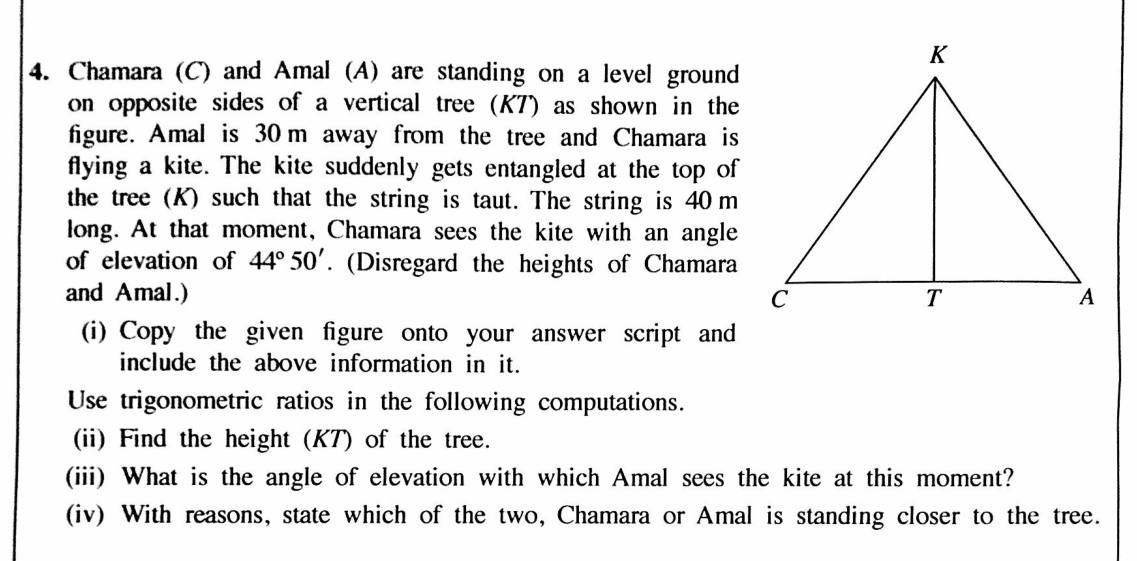
Paper II Part A Q4: Height of a tree from a kite string; Amal's elevation angle; who is closer🔒 Answer & steps: try it free in Gedara Sir→

More Grade 10 notes