Short notes › Grade 10 · සිංහලෙන්

Grade 10 Square Root: Short Notes

10 ශ්‍රේණිය · 2 පරිච්ඡේදය · වර්ගමූලය

91%

of Grade 10 term tests include it (49 of 54)

165

marks in past papers (59 questions)

10 min

full lesson with quick checks

🎯 What you'll learn

  • Explain what a square root is and recall the perfect squares
  • Find the two consecutive whole numbers a square root lies between
  • Find the first approximation of a square root and check it by squaring
  • Find the square root of a perfect square by the division method
  • Use the division method to find a square root to two decimal places

Seeya's vegetable bed

Your seeya in Kurunegala wants a square vegetable bed with an area of exactly 40 m². How long should each side be? 6 m gives 36 m², 7 m gives 49 m². So the answer is somewhere in between, and there's no calculator in the term test. Let's find it.

What is a square root?

The square root of a number is the positive number that, multiplied by itself, gives that number.√49 = 7 because 7² = 7 × 7 = 49.Numbers like 1, 4, 9, 16, 25, 36, 49, 64, 81, 100, 121, 144 are perfect squares: their roots are whole numbers.The square root of a number that is not a perfect square is a decimal, e.g. √40 = 6.32…

Step 1: trap it between two squares

Find the perfect squares just below and just above the number.36 < 40 < 49Take square roots of each part:6 < √40 < 7So √40 is 6 point something. This step alone answers many Part A questions: 'Between which two consecutive whole numbers does √40 lie?'

Step 2: the first approximation

The first approximation is the root to one decimal place.40 is 4 above 36, and the gap from 36 to 49 is 13.4/13 ≈ 0.3, so √40 ≈ 6 + 0.3 = 6.3Always check by squaring: 6.3² = 39.69 and 6.4² = 40.96. 40 is nearer 39.69, so 6.3 is right.

How far along the gap?

40 sits about 0.3 of the way from 36 to 49, so √40 sits about 0.3 of the way from 6 to 7.
x√x364940676.34/13 ≈ 0.3

✏️ First approximation of √55

Find the first approximation of √55.
  1. 149 < 55 < 64, so 7 < √55 < 8.
  2. 255 is 6 above 49; the gap is 64 − 49 = 15. 6/15 = 0.4.
  3. 3Estimate: √55 ≈ 7.4.
  4. 4Check: 7.4² = 54.76 and 7.5² = 56.25. 55 is only 0.24 from 54.76.

✅ √55 ≈ 7.4

⚠️ Use the squares they give you

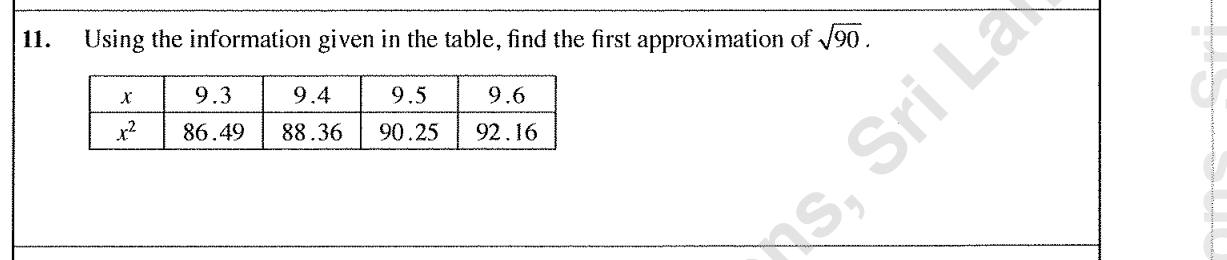
Examiners report two slips: students skip finding the squares on either side, and they don't decide which one is nearer. When the question gives a table of squares, don't start a long method. Find the two values the number lies between, subtract, and pick the closer one.

The division method: set up

For a more exact root, use the division method.1. Pair the digits starting from the decimal point, going both ways: 1849 → 18 | 49, and 12.6 → 12 . 60 | 00 | 002. Find the largest square that fits in the first group, write its root on top and subtract.3. Bring down the next pair. Double the answer so far and find the next digit d so that (that number with d on the end) × d fits.

✏️ √1849 by division

Find √1849 using the division method.
  1. 1Pair the digits: 18 | 49.
  2. 2Largest square in 18 is 16 = 4². Write 4 on top; 18 − 16 = 2.
  3. 3Bring down 49 to get 249.
  4. 4Double 4 = 8. Try 8_ × _: 83 × 3 = 249 exactly.
  5. 5Remainder 0, so 1849 is a perfect square.

✅ √1849 = 43

⚠️ Pairing and rounding slips

Pair digits from the decimal point: 12.6 is 12 . 60, not 1 | 26. A lone decimal digit always gets a 0 added.For two decimal places, work out a third decimal digit before rounding. Stopping at 3.54 and writing it down loses the mark, because the true value 3.549 rounds to 3.55.

🧮 Root of a product

Useful when a number is given as a product of powers. Halve each index: √(2⁴ × 3²) = 2² × 3 = 12. Also √200 = √(100 × 2) = 10√2.

√(a × b) = √a × √b

📌 Remember

• Trap the number between consecutive perfect squares: 36 < 40 < 49 gives 6 < √40 < 7.• First approximation (1 d.p.): how far along the gap, then check by squaring.• Division method: pair digits from the decimal point, double the answer so far, find the next digit.• For 2 d.p., find a third decimal digit, then round.• √(a × b) = √a × √b.

🧾 Quick revision sheet

What is a perfect square?A number whose square root is a whole number, e.g. 1, 4, 9, 16, 25, 36…
Between which whole numbers is √90?81 < 90 < 100, so 9 < √90 < 10.
What is the first approximation of a square root?Its value to one decimal place, e.g. √40 ≈ 6.3.
How do you check a square root estimate?Square it and see how close you get: 6.3² = 39.69 ≈ 40.
Division method: how do you pair 152.7?From the decimal point: 1 | 52 . 70 | 00
Division method: what do you double each round?The answer found so far (ignore its decimal point).
√(a × b) = ?√a × √b, e.g. √(2⁴ × 3²) = 2² × 3 = 12.

Now test yourself: 5 quick checks and 1 more worked examples

The full lesson checks your answers as you go, and Gedara Sir tracks which parts you've got.

Past paper questions on Square Root

More Grade 10 notes