Short notes › Grade 11 · සිංහලෙන්

Grade 11 Indices and Logarithms II: Short Notes

11 ශ්‍රේණිය · 3 පරිච්ඡේදය · දර්ශක හා ලඝුගණක - II

90%

of Grade 11 term tests include it (55 of 61)

546

marks in past papers (57 questions)

12 min

full lesson with quick checks

🎯 What you'll learn

  • Find the logarithm of a number less than 1 in bar form
  • Find the antilog of a bar logarithm
  • Add, subtract, multiply and divide bar logarithms correctly
  • Simplify products, quotients, powers and roots with log tables
  • Use a scientific calculator for logs, antilogs and trigonometric ratios

No calculator, just a table

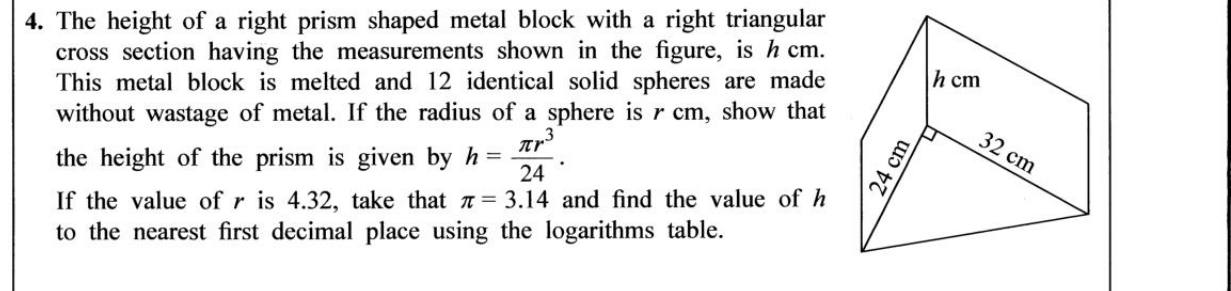
A tinsmith in Kurunegala melts a metal block into a ball and wants its radius: r = ∛(3 × 0.113 ÷ (4 × 3.142)) metres. In the O/L exam hall you get no calculator, only a log table. Logarithms turn ×, ÷, powers and roots into simple +, −, × and ÷, even for numbers smaller than 1.

The laws you already know

lg means log to base 10.• lg(ab) = lg a + lg b• lg(a ÷ b) = lg a − lg b• lg aⁿ = n lg a• lg √a = ½ lg a, lg ∛a = ⅓ lg aSo multiplying becomes adding, dividing becomes subtracting, and a root becomes dividing the log.

Logs of numbers less than 1

Write the number in scientific notation first:0.0347 = 3.47 × 10⁻²The power gives the characteristic: −2, written 2̄ (bar two).The table gives the mantissa for 3.47: 0.5403.So lg 0.0347 = 2̄.5403, meaning −2 + 0.5403.The bar sits only on the characteristic; the mantissa is always positive.

🧮 Characteristic from the power of 10

Use for any number: n is the characteristic (a bar if negative), lg a from the table is the mantissa. 0.582 = 5.82 × 10⁻¹, so lg 0.582 = 1̄.7649.

lg(a × 10ⁿ) = n + lg a, 1 ≤ a < 10

Going back: the antilog

To find the number from its log, use the antilog table on the mantissa, then let the characteristic place the decimal point.Antilog of 2̄.5403: mantissa 0.5403 gives 3.470; characteristic 2̄ means × 10⁻².So the number is 0.03470.Quick rule: n̄ gives (n − 1) zeros straight after the decimal point.

Adding and subtracting bar logs

Work on the mantissa first (it is positive), then the characteristics, carrying as usual.• 2̄.5403 + 1̄.8129: 0.5403 + 0.8129 = 1.3532, carry 1. Characteristic: −2 − 1 + 1 = −2. Answer 2̄.3532.• 1̄.2041 − 0.6990: borrow 1: 1.2041 − 0.6990 = 0.5051. Characteristic: −1 − 1 − 0 = −2. Answer 2̄.5051.

✏️ A product with a small number

Use logarithm tables to find the value of 0.0347 × 5.82.
  1. 1lg x = lg 0.0347 + lg 5.82
  2. 2= 2̄.5403 + 0.7649
  3. 30.5403 + 0.7649 = 1.3052: carry 1, so −2 + 1 = −1. lg x = 1̄.3052
  4. 4Antilog: 0.3052 → 2.019, and 1̄ means × 10⁻¹. x = 0.2019

✅ x ≈ 0.2019

⚠️ 1̄.8513 is not 1.8513

A very common slip is dropping the bar and adding 1̄.8513 as if it were 1.8513. The answer then comes out 100 times too big. Remember 1̄.8513 = −1 + 0.8513. Sanity-check the size at the end: 0.0347 × 5.82 must be about 0.03 × 6 ≈ 0.2.

Powers and roots of bar logs

Multiply both parts, then carry: 3 × 1̄.8293 = 3̄ + 2.4879 = 1̄.4879.Divide: first make the characteristic exactly divisible, adding the same to the mantissa.½ × 1̄.6992: write 2̄ + 1.6992, halve: 1̄.8496.⅓ × 1̄.7630: write 3̄ + 2.7630, divide by 3: 1̄.9210.

✏️ The tinsmith's ball

Find r = ∛(0.339 ÷ 12.57) using logarithm tables. (This is the radius in metres of a ball of volume 0.113 m³.)
  1. 1lg r = ⅓ (lg 0.339 − lg 12.57) = ⅓ (1̄.5302 − 1.0993)
  2. 20.5302 − 0.0993 = 0.4309; characteristic −1 − 1 = −2. So 2̄.4309.
  3. 3⅓ × (3̄ + 1.4309) = 1̄.4770
  4. 4Antilog: 0.4770 → 2.999; × 10⁻¹ gives 0.2999.

✅ r ≈ 0.300 m (30 cm)

⚠️ Forgetting the root

In many answer scripts the log is never divided by 3 for a cube root (or by 2 for a square root), so the 'radius' comes out huge. Write the ⅓ or ½ in front of the bracket on your very first line, and don't take the antilog until you have divided.

Using a scientific calculator

• log gives lg directly: log 0.0347 = −1.4597. That is the same as 2̄.5403, because −2 + 0.5403 = −1.4597.• 10ˣ gives the antilog.• xʸ, √, ∛ for powers and roots.• For sin, cos, tan, check the screen shows D (degree mode) first.

📌 Remember

• For a number below 1, write a × 10⁻ⁿ: lg = n̄ . (mantissa of a).• Only the characteristic is negative; the mantissa stays positive.• Add/subtract mantissas first, then characteristics with the carry.• To divide a bar log, make the characteristic divisible first.• Calculator: log, 10ˣ, and degree mode for sin, cos, tan.

🧾 Quick revision sheet

lg(ab)lg a + lg b
lg ∛a⅓ lg a
What does 2̄.5403 mean?−2 + 0.5403 (= −1.4597)
Characteristic of lg 0.00493̄, since 0.0049 = 4.9 × 10⁻³
Antilog of 1̄.30100.2 (2.000 × 10⁻¹)
½ × 1̄.6992Write 2̄ + 1.6992, halve: 1̄.8496
Calculator key for antilog10ˣ (usually SHIFT then log)
Before sin/cos/tan on a calculator…make sure it is in degree mode (D).

Now test yourself: 4 quick checks and 1 more worked examples

The full lesson checks your answers as you go, and Gedara Sir tracks which parts you've got.

Past paper questions on Indices and Logarithms II

More Grade 11 notes