Short notes › Grade 11 · සිංහලෙන්

Grade 11 Real Numbers: Short Notes

11 ශ්‍රේණිය · 1 වාරය · 1 පරිච්ඡේදය · තාත්වික සංඛ්‍යා

31%

of Grade 11 term tests include it (19 of 61)

168

marks in past papers (28 questions)

12 min

full lesson with quick checks

🎯 What you'll learn

  • Tell rational from irrational numbers using their decimals
  • Convert a recurring decimal into a fraction
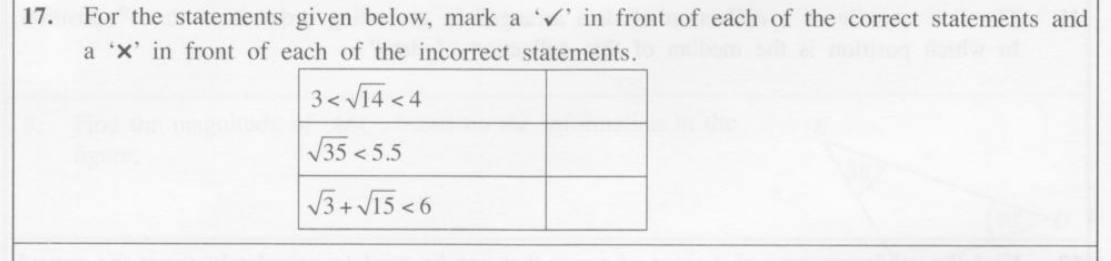
  • Place irrational numbers such as √2 on the number line
  • Write surds in simplest form and as entire surds
  • Add, subtract, multiply and divide surds
  • Rationalise a denominator of the form √b

The carpenter's diagonal

A carpenter in Moratuwa makes a square table top 1 m by 1 m. The diagonal is √2 m. His calculator shows 1.41421356… and the digits never stop and never repeat. Numbers like this aren't fractions at all. This chapter sorts every number into its family.

Rational numbers

A rational number can be written as p/q, where p and q are integers and q ≠ 0. Examples: 3/4, −5, 0.2.As a decimal it either terminates: 3/8 = 0.375or recurs (a block repeats forever):2/3 = 0.666… = 0.6̇5/11 = 0.4545… = 0.4̇5̇The dots mark the repeating block.

✏️ Recurring decimal to fraction

Write 0.4̇5̇ (= 0.4545…) as a fraction in its simplest form.
  1. 1Let x = 0.4545…
  2. 2Two digits repeat, so multiply by 100: 100x = 45.4545…
  3. 3Subtract: 100x − x = 45, so 99x = 45
  4. 4x = 45/99 = 5/11

✅ 5/11

Irrational and real numbers

An irrational number cannot be written as p/q. Its decimal never ends and never repeats: √2, √3, √5, π.Rational and irrational numbers together make the real numbers. Each real number is one point on the number line.ℕ ⊂ ℤ ⊂ ℚ ⊂ ℝ

Putting √2 on the number line

Draw a unit square on 0 to 1. Its diagonal is √2 (Pythagoras: 1² + 1² = 2). Swing the diagonal down with compasses centred at 0: it lands exactly at √2 ≈ 1.41.
012√2√2

⚠️ 22/7 is not π

22/7 is a fraction, so it is rational. π is irrational; 22/7 is only a handy approximation (3.142… against 3.14159…).Also: a long decimal is not automatically irrational. 0.1̇2̇ = 12/99 is rational because its block repeats.

Surds in simplest form

A surd is a root that is irrational, like √2 or √50.Use √(ab) = √a × √b with the largest perfect square factor:√50 = √(25 × 2) = √25 × √2 = 5√2√48 = √(16 × 3) = 4√3Working backwards gives an entire surd: 3√5 = √(9 × 5) = √45.

Adding like surds

Treat √2 like a letter x: 3√2 + 5√2 = 8√2, just as 3x + 5x = 8x.Only like surds (the same number under the root) combine.If they don't look alike, simplify first:√12 + √27 = 2√3 + 3√3 = 5√3√2 + √3 cannot be combined.

⚠️ √2 + √3 is not √5

Test it: √2 + √3 ≈ 1.41 + 1.73 = 3.14, but √5 ≈ 2.24. Roots of a sum don't split.O/L examiners also report answers left unsimplified, like 2√18 instead of 6√2, and students not using √(ab) = √a × √b. Always pull out the biggest square.

✏️ Simplify and collect

Simplify √50 + √18 − √8.
  1. 1√50 = √(25 × 2) = 5√2
  2. 2√18 = √(9 × 2) = 3√2
  3. 3√8 = √(4 × 2) = 2√2
  4. 4All like surds: 5√2 + 3√2 − 2√2 = 6√2

✅ 6√2

Multiplying and dividing

Numbers outside multiply together; numbers inside multiply together.2√3 × 5√6 = 10√18 = 10 × 3√2 = 30√2√a × √a = a, so √7 × √7 = 7.Dividing works the same way: 6√10 ÷ 3√2 = 2√5.

🧮 Rationalising the denominator

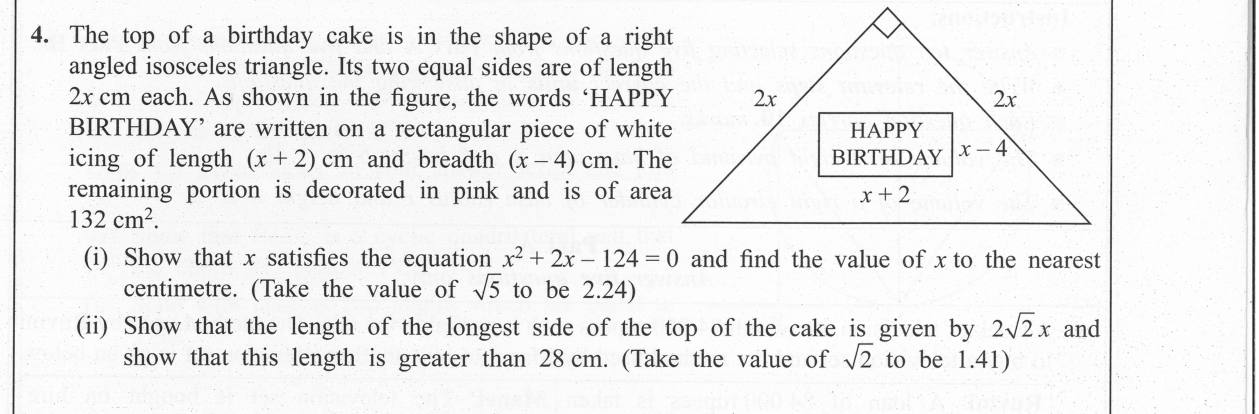
Multiply top and bottom by the surd in the denominator. The bottom becomes a whole number, which makes the value easy to find from a given root such as √3 = 1.732.

a/√b = (a × √b)/(√b × √b) = a√b/b

📌 Remember

• Rational = p/q; its decimal terminates or recurs. Use 10x, 100x… and subtract to turn a recurring decimal into a fraction.• Irrational: never ends, never repeats (√2, π). Rational + irrational = real.• Simplest surd: take out the largest square, √50 = 5√2.• Only like surds add.• Rationalise: a/√b = a√b/b.

🧾 Quick revision sheet

What is a rational number?A number that can be written p/q, with p, q integers and q ≠ 0.
Decimal of an irrational number?Never ends and never repeats, e.g. √2 = 1.41421…
0.6̇ as a fraction?2/3
√(ab) = ?√a × √b
√75 in simplest form?√(25 × 3) = 5√3
Like surds?Surds with the same number under the root, e.g. 2√5 and 7√5.
How do you rationalise a/√b?Multiply top and bottom by √b: a√b/b.
Is 22/7 rational?Yes. It is only an approximation of π, which is irrational.

Now test yourself: 6 quick checks and 1 more worked examples

The full lesson checks your answers as you go, and Gedara Sir tracks which parts you've got.

Past paper questions on Real Numbers

More Grade 11 notes