Short notes › Grade 11 · සිංහලෙන්

Grade 11 Inequalities: Short Notes

11 ශ්‍රේණිය · 20 පරිච්ඡේදය · අසමානතා

2%

of Grade 11 term tests include it (1 of 61)

10

marks in past papers (1 questions)

11 min

full lesson with quick checks

🎯 What you'll learn

  • Check whether a point satisfies an inequality in x and y
  • Draw the boundary line correctly as solid or dashed
  • Shade the region for an inequality by testing a point
  • Find the region for several inequalities and count its integer points
  • Write the inequalities for a given shaded region and for word problems

Rotti and tea on Rs 200

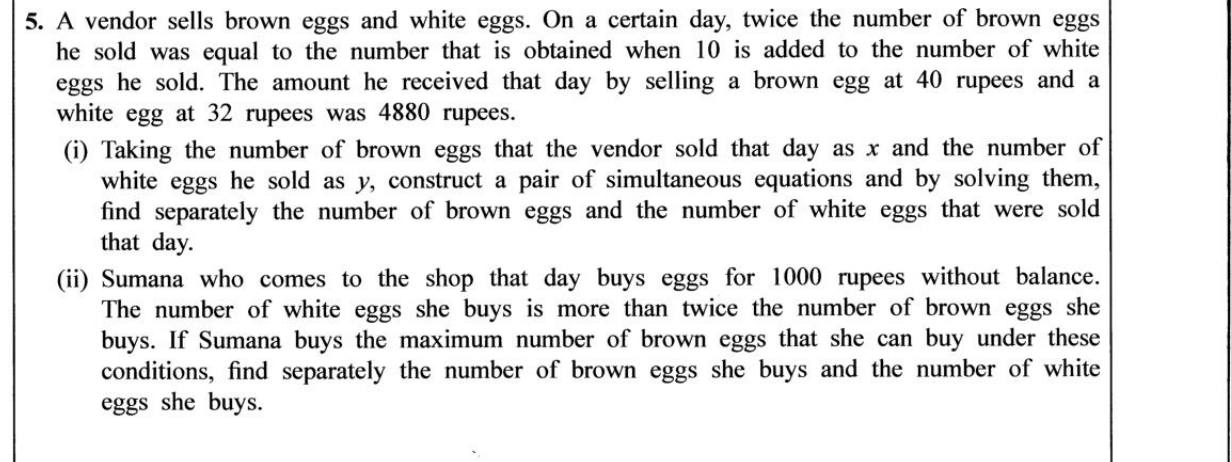
Kasun has Rs 200 at the canteen. A rotti costs Rs 40 and a plain tea Rs 20. He can buy many different mixes, but not just any: 40x + 20y ≤ 200. Every mix he can afford is a point (x, y), and together they make a region on a graph.

Inequalities with two variables

An inequality like x + y ≤ 5 has two unknowns. A solution is a pair (x, y), that is, a point.• (2, 1): 2 + 1 = 3 ≤ 5 ✓ a solution• (4, 3): 4 + 3 = 7 ✗ not a solutionThere are endless solutions, so we show them all at once as a region of the Cartesian plane.

The boundary line

Change the sign to = and draw that line. It splits the plane into two sides, and the region is one side.• ≤ or ≥: points on the line count, so draw a solid line.• < or >: points on the line do not count, so draw a broken (dashed) line.Then shade the side that satisfies the inequality.

Two simple regions

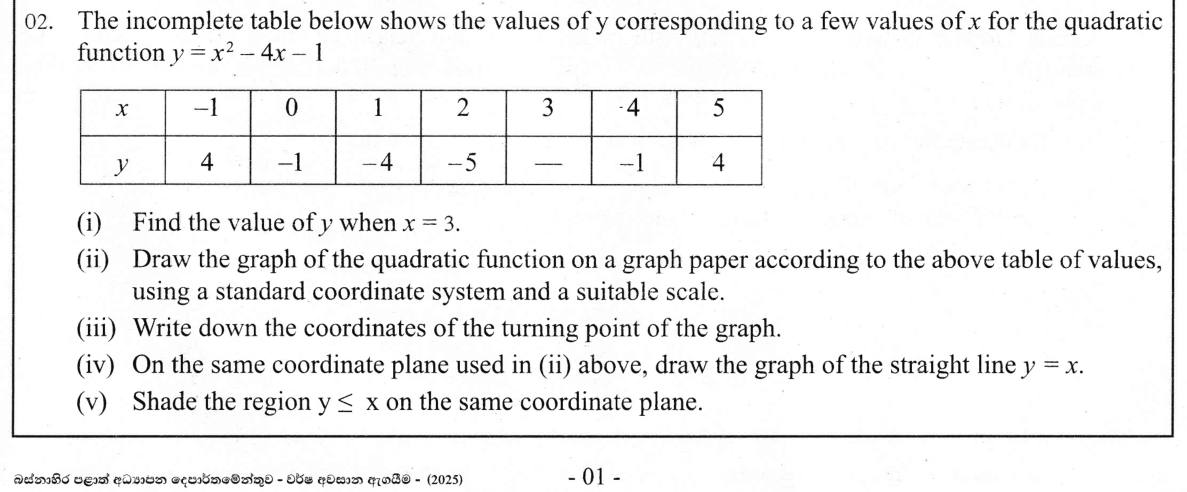
x ≥ 2: every point on or to the right of the solid line x = 2. y < 1: every point below the dashed line y = 1, which itself is left out.
xy−11234−112340x ≥ 2xy−11234−112340y < 1

Which side? Test a point

For a sloping line, pick a test point not on the line, usually the origin (0, 0).• If it makes the inequality true, shade the side containing it.• If false, shade the other side.If the line passes through (0, 0), test another point such as (1, 0).

✏️ Shading 2x + 3y ≤ 12

Show the region 2x + 3y ≤ 12 on a Cartesian plane.
xy−11234567−11234502x + 3y = 12
  1. 1Boundary 2x + 3y = 12. x = 0 gives y = 4; y = 0 gives x = 6.
  2. 2Join (0, 4) and (6, 0) with a solid line, because the sign is ≤.
  3. 3Test (0, 0): 0 ≤ 12 is true.
  4. 4Shade the side containing the origin.

✅ Line through (0, 4) and (6, 0); (0, 0) side

⚠️ Solid or dashed, up or down?

Two common slips:1. Drawing a solid line for < or >. Only ≤ and ≥ include the line.2. Guessing the side. 'y ≤ …' means below only when y stands alone with a + sign. For x − y < 2, the region is actually above y = x − 2. Always test a point.

Several inequalities together

When a question gives two, three or more inequalities, the answer is the region where all of them are true at once: the overlap.Draw each boundary line, decide each side, and shade only the common part. Its corners are where boundary lines meet.

✏️ A triangle of solutions

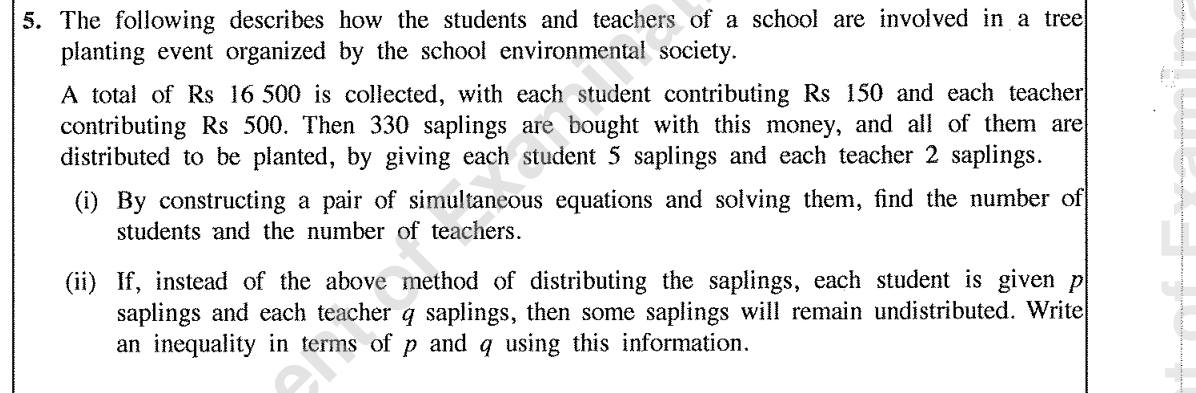
Shade the region x ≥ 1, y ≥ 1, x + y ≤ 5 and count the points with integer coordinates in it (boundary included).
xy−1123456−11234560x = 1y = 1x + y = 5
  1. 1x ≥ 1: right of the solid line x = 1. y ≥ 1: above the solid line y = 1.
  2. 2x + y ≤ 5: (0, 0) gives 0 ≤ 5, true, so below the line.
  3. 3Overlap: triangle with corners (1, 1), (4, 1), (1, 4).
  4. 4Integer points: 4 + 3 + 2 + 1 = 10.

✅ 10 points

Working backwards from a graph

Exams also show a shaded region and ask for its inequalities.1. Find each boundary's equation: x = a, y = b, or y = mx + c (m = gradient, c = y-intercept).2. Solid line → ≤ or ≥; dashed → < or >.3. Take a point inside the shaded region and choose the sign that makes it true.

⚠️ Forgetting a condition

In word problems, quantities like rotti or students can't be negative, so x ≥ 0 and y ≥ 0 are part of the answer even if not stated. When counting solutions, only use whole-number points, and check each one in every inequality, including points on solid boundaries.

📌 Remember

• A solution of a two-variable inequality is a point (x, y).• Boundary: replace the sign with =. ≤, ≥ → solid; <, > → dashed.• Test a point such as (0, 0) to choose the side.• Several inequalities → shade only the overlap.• From a graph: find each line's equation, then test a point inside.

🧾 Quick revision sheet

Solid or dashed for ≤ and ≥?Solid: the line is included.
Solid or dashed for < and >?Dashed: the line is not included.
How do you choose the side to shade?Test a point not on the line, usually (0, 0).
Region for x ≥ 2On or to the right of the vertical line x = 2.
Region for y < 1Below the horizontal dashed line y = 1.
Region for several inequalitiesThe overlap where all are true together.
Equation of a line from a graphy = mx + c: m is the gradient, c the y-intercept.

Now test yourself: 5 quick checks and 2 more worked examples

The full lesson checks your answers as you go, and Gedara Sir tracks which parts you've got.

Past paper questions on Inequalities

More Grade 11 notes