Short notes › Grade 11 · සිංහලෙන්

Grade 11 Pythagoras' Theorem: Short Notes

11 ශ්‍රේණිය · 17 පරිච්ඡේදය · පයිතගරස් ප්‍රමේයය

13%

of Grade 11 term tests include it (8 of 61)

76

marks in past papers (10 questions)

11 min

full lesson with quick checks

🎯 What you'll learn

  • State Pythagoras' theorem in terms of areas and of side lengths
  • Find an unknown side of a right-angled triangle
  • Use the converse to decide if a triangle is right-angled
  • Apply the theorem to chords, ladders, rectangles and algebra problems
  • Use the theorem as a reason in short proofs

The mason's string trick

A mason in Matale marks out a new house foundation. To get a perfect square corner he pegs a string 3 m along one side, 4 m along the other, and adjusts until the gap between the ends is exactly 5 m. Why does 3-4-5 always give a right angle? Pythagoras explains it.

The theorem

In a right-angled triangle, the side opposite the right angle is the hypotenuse: the longest side.Pythagoras' theorem: the area of the square drawn on the hypotenuse equals the sum of the areas of the squares drawn on the other two sides.With sides a, b and hypotenuse c: a² + b² = c².

See it with squares

Sides 3, 4 and 5: the squares have areas 9, 16 and 25, and 9 + 16 = 25.
91625abc

🧮 Two ways round

Finding the hypotenuse? Add the squares. Finding a shorter side? Subtract from the hypotenuse squared. Then take the square root.

c² = a² + b² | a² = c² − b²

✏️ Finding the hypotenuse

A right-angled triangle has shorter sides 9 cm and 12 cm. Find the hypotenuse.
  1. 1c² = 9² + 12² = 81 + 144 = 225
  2. 2c = √225 = 15

✅ 15 cm

⚠️ Find the hypotenuse first

Examiners often see students add the squares when the hypotenuse is already given, e.g. √(13² + 5²) instead of √(13² − 5²). Before calculating, mark the side opposite the right angle. If that is the side you know, subtract. Your answer must be shorter than the hypotenuse.

The converse: testing for a right angle

If the sides of a triangle satisfy a² + b² = c² (c the longest), then the angle opposite c is a right angle.That is the mason's trick: 3² + 4² = 5².Whole-number sets that work: 3, 4, 5; 5, 12, 13; 8, 15, 17; 7, 24, 25, and their multiples, like 6, 8, 10.

✏️ A chord in a circle

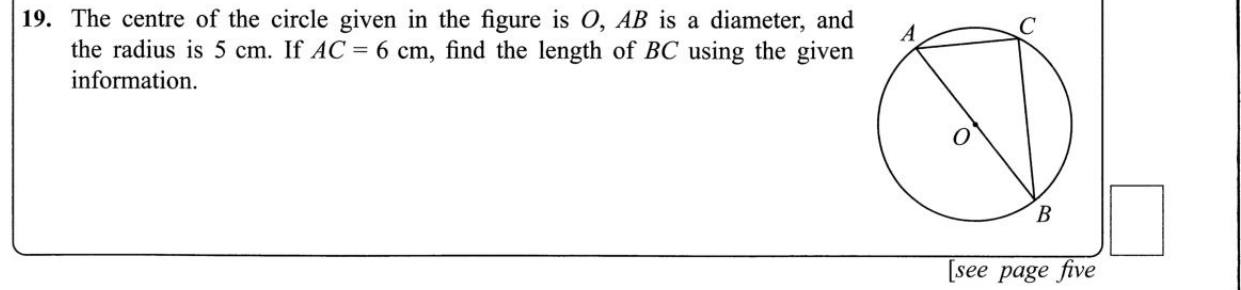
A circle has centre O and radius 13 cm. Chord AB is 5 cm from O (OM ⟂ AB). Find the length of AB.
OABM513
  1. 1△OMB has a right angle at M; OB = 13 is a radius, so it is the hypotenuse.
  2. 2MB² = 13² − 5² = 169 − 25 = 144, so MB = 12.
  3. 3The perpendicular from the centre bisects the chord: AB = 2 × 12 = 24.

✅ AB = 24 cm

⚠️ Stopping at half

In chord and isosceles-triangle questions, Pythagoras gives you half the length. Many candidates write 12 cm as the chord. Look back at what was asked: AB = AM + MB = 2 × MB. Draw the full figure and label what each number is.

📌 Remember

• The hypotenuse is opposite the right angle and is the longest side.• a² + b² = c²: add to find c, subtract to find a shorter side.• Converse: if a² + b² = c², the angle opposite c is 90°.• Look for hidden right triangles: radius to a chord, a perpendicular, a ladder, a diagonal.• In proofs, write 'Pythagoras' as the reason.

🧾 Quick revision sheet

Pythagoras' theoremIn a right triangle, a² + b² = c², c the hypotenuse.
Which side is the hypotenuse?The side opposite the right angle (the longest).
Theorem in area formSquare on the hypotenuse = sum of the squares on the other two sides.
Converse of PythagorasIf a² + b² = c², the angle opposite c is a right angle.
Common whole-number sets3, 4, 5; 5, 12, 13; 8, 15, 17; 7, 24, 25
Shorter side from hypotenuse c and side ba = √(c² − b²)
Diagonal of a 6 cm × 8 cm rectangle10 cm
Half-chord with radius r, distance d√(r² − d²); the chord is twice this.

Now test yourself: 4 quick checks and 3 more worked examples

The full lesson checks your answers as you go, and Gedara Sir tracks which parts you've got.

Past paper questions on Pythagoras' Theorem

More Grade 11 notes