Short notes › Grade 11 · සිංහලෙන්

Grade 11 Geometric Progression: Short Notes

11 ශ්‍රේණිය · 16 පරිච්ඡේදය · ගුණෝත්තර ශ්‍රේඪි

64%

of Grade 11 term tests include it (39 of 61)

227

marks in past papers (45 questions)

12 min

full lesson with quick checks

🎯 What you'll learn

  • Recognise a geometric progression and find its common ratio
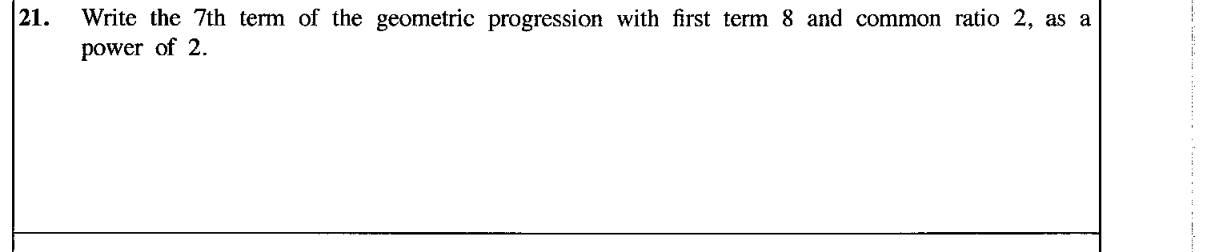
  • Find any term using Tₙ = arⁿ⁻¹
  • Find a, r or n when some terms are given
  • Find the sum of the first n terms using the Sₙ formula
  • Solve real-life problems that grow or shrink by a fixed ratio

The kottu shop goes viral

A new kottu shop in Galle gets 50 new followers on its page in week 1, 100 in week 2, 200 in week 3: double every week. If this continues, how many new followers in week 10? Not 500. It is 25 600. Numbers that multiply each step grow shockingly fast.

What is a geometric progression?

Each term is the one before it multiplied by the same number, the common ratio r.r = any term ÷ the term before it.• 3, 6, 12, 24, … r = 2• 80, 40, 20, 10, … r = ½• 2, −6, 18, −54, … r = −3Compare: an arithmetic progression adds the same number each time.

Multiply, multiply, multiply

With r = 2 each bar is double the last. Five steps take 1 to 16; ten steps would reach 512.
124816T₁T₂T₃T₄T₅×2×2×2×2

🧮 The nth term

a is the first term and r the common ratio. To reach the nth term you multiply by r only (n − 1) times, because the first term already has no r.

Tₙ = arⁿ⁻¹

✏️ Finding a far-away term

(i) Find the 8th term of 3, 6, 12, … (ii) In the hook, find the new followers in week 10.
  1. 1(i) a = 3, r = 6 ÷ 3 = 2, n = 8.
  2. 2T₈ = 3 × 2⁷ = 3 × 128 = 384.
  3. 3(ii) a = 50, r = 2, n = 10.
  4. 4T₁₀ = 50 × 2⁹ = 50 × 512 = 25 600.

✅ (i) 384 (ii) 25 600

⚠️ The power is n − 1, not n

A very common slip is T₈ = 3 × 2⁸ = 768. Check with a small case: T₂ = ar¹, so T₈ = ar⁷. Examiners also see students dividing the wrong way to find r: always take later term ÷ earlier term, so 16 ÷ 64 = 1/4, not 64 ÷ 16.

✏️ Which term is it?

Which term of the geometric progression 5, 10, 20, … is 640?
  1. 1a = 5, r = 2. Set Tₙ = 640: 5 × 2ⁿ⁻¹ = 640.
  2. 2Divide by 5: 2ⁿ⁻¹ = 128.
  3. 3128 = 2⁷, so n − 1 = 7.
  4. 4n = 8: 640 is the 8th term.

✅ 8th term

Three terms in a row

If x, y, z are consecutive terms of a GP, the ratio is the same both times:y ÷ x = z ÷ y, so y² = xz.Example: if x, 12, 36 are consecutive terms, then 12² = 36x, so 144 = 36x and x = 4.Check: 4, 12, 36 has r = 3 ✓

🧮 Sum of the first n terms

Both forms give the same answer (r ≠ 1). Use the first when r > 1 and the second when r < 1, so you avoid negative numbers.

Sₙ = a(rⁿ − 1)/(r − 1) or Sₙ = a(1 − rⁿ)/(1 − r)

⚠️ Mixing up Tₙ, Sₙ and the AP formulas

In several O/L years examiners found candidates who could not apply the GP sum formula, or used n/2[2a + (n − 1)d] from the AP chapter. Ask two questions first: add or multiply? (AP or GP) and one term or a total? (Tₙ or Sₙ). Then write the formula before substituting.

📌 Remember

• GP: multiply by the same r each time; r = later term ÷ earlier term.• Tₙ = arⁿ⁻¹ (power is n − 1).• Two terms given: divide them to remove a and find r.• Sₙ = a(rⁿ − 1)/(r − 1) for r > 1, or a(1 − rⁿ)/(1 − r) for r < 1.• Consecutive terms x, y, z: y² = xz.

🧾 Quick revision sheet

Common ratio rAny term ÷ the term before it
nth term of a GPTₙ = arⁿ⁻¹
Sum of first n terms (r > 1)Sₙ = a(rⁿ − 1)/(r − 1)
Sum of first n terms (r < 1)Sₙ = a(1 − rⁿ)/(1 − r)
x, y, z consecutive GP termsy² = xz
AP or GP? 7, 14, 28, 56GP with r = 2 (multiplies)
T₂ = 6, T₅ = 162. How do you find r?r³ = 162 ÷ 6 = 27, so r = 3

Now test yourself: 5 quick checks and 3 more worked examples

The full lesson checks your answers as you go, and Gedara Sir tracks which parts you've got.

Past paper questions on Geometric Progression

More Grade 11 notes