Short notes › Grade 11 · සිංහලෙන්

Grade 11 Equations: Short Notes

11 ශ්‍රේණිය · 2 වාරය · 13 පරිච්ඡේදය · සමීකරණ

72%

of Grade 11 term tests include it (44 of 61)

792

marks in past papers (80 questions)

12 min

full lesson with quick checks

🎯 What you'll learn

  • Solve simultaneous equations whose coefficients are unequal or fractional
  • Form and solve simultaneous equations from word problems
  • Solve quadratic equations by completing the square
  • Solve quadratic equations with the quadratic formula
  • Form quadratic equations from daily-life problems and choose the valid root

Concert night

Your school in Matale holds a concert. The ticket desk knows how many tickets were sold and how much money came in, but not how many were adult tickets. Then the art club wants a border of equal width round a photo so the framed picture has a set area. One needs two equations, the other a squared unknown. Both are this chapter.

Simultaneous equations: make one match

When neither unknown has the same coefficient in both equations:1. Multiply one or both equations so that one unknown gets the same numerical coefficient.2. Add if the signs are different, subtract if they are the same, to eliminate it.3. Solve, then substitute back to find the other unknown.4. Check in both original equations.Substitution also works when one unknown is easy to make the subject.

✏️ Unequal coefficients

Solve: 3x + 2y = 16 and 5x − 3y = 14.
  1. 1Make the y coefficients 6: multiply the first by 3 and the second by 2.
  2. 29x + 6y = 48 and 10x − 6y = 28.
  3. 3Signs differ, so add: 19x = 76, x = 4.
  4. 4Substitute: 12 + 2y = 16, so y = 2.
  5. 5Check: 5(4) − 3(2) = 14 ✓

✅ x = 4, y = 2

✏️ Books and pens

At a bookshop in Kegalle, 3 exercise books and 2 pens cost Rs. 490. 2 exercise books and 5 pens cost Rs. 510. Find the price of each.
  1. 1Let a book cost Rs. b and a pen Rs. p.
  2. 23b + 2p = 490 and 2b + 5p = 510.
  3. 3Multiply by 2 and 3: 6b + 4p = 980 and 6b + 15p = 1530.
  4. 4Subtract: 11p = 550, so p = 50.
  5. 53b + 100 = 490, so b = 130.

✅ Book Rs. 130, pen Rs. 50

⚠️ Signs when subtracting

Subtracting a whole equation changes every sign in it. From 6b + 4p = 980 take away 6b + 15p = 1530: you get −11p = −550, not 19p.Also, with fractions, multiply every term by the LCM, including the right-hand side. Then check your answer in both original equations; a slip shows up at once.

Quadratics that won't factorise

A quadratic equation has the form ax² + bx + c = 0 (a ≠ 0). It has up to two roots.In Grade 10 you solved them by factorising. But x² + 6x − 4 = 0 has no neat factors.Two methods always work:• completing the square• the quadratic formulaAnswers often contain a square root, so give them in surd form or to the decimal places asked.

🧮 The quadratic formula

For ax² + bx + c = 0. First rearrange so one side is 0, then read a, b and c with their signs. It comes from completing the square on ax² + bx + c = 0.

x = (−b ± √(b² − 4ac)) / 2a

From a story to a quadratic

1. Let x be the unknown and write it down with units.2. Express every other length or amount in terms of x.3. Use the given fact (area, cost, Pythagoras) to make an equation.4. Expand and rearrange to ax² + bx + c = 0.5. Solve, then reject roots that make no sense (a negative length, a fraction of a person).

⚠️ Keep only the sensible root

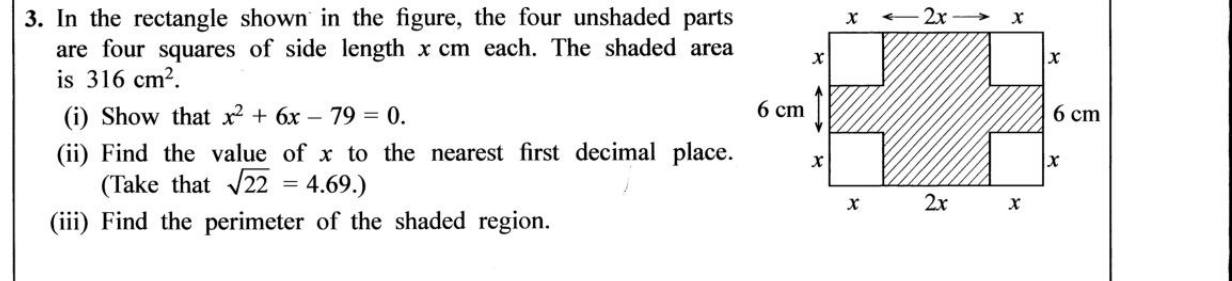
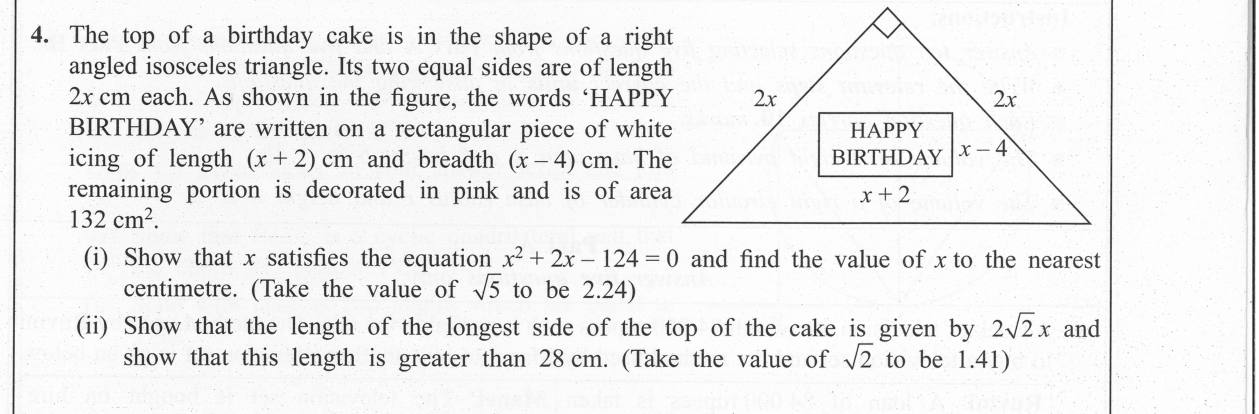
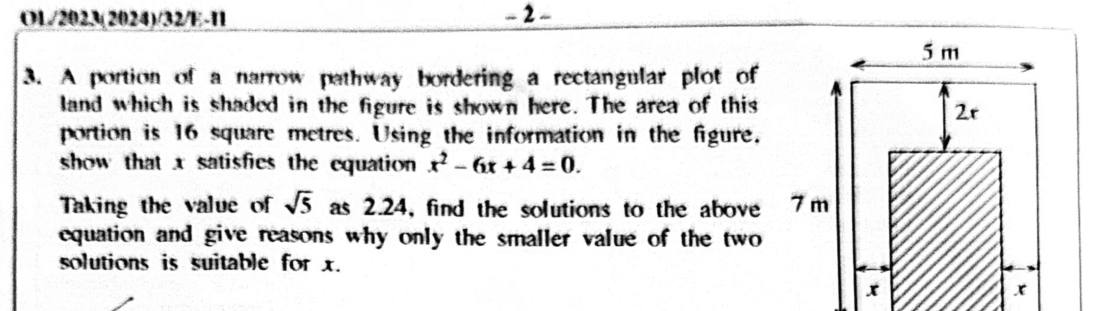
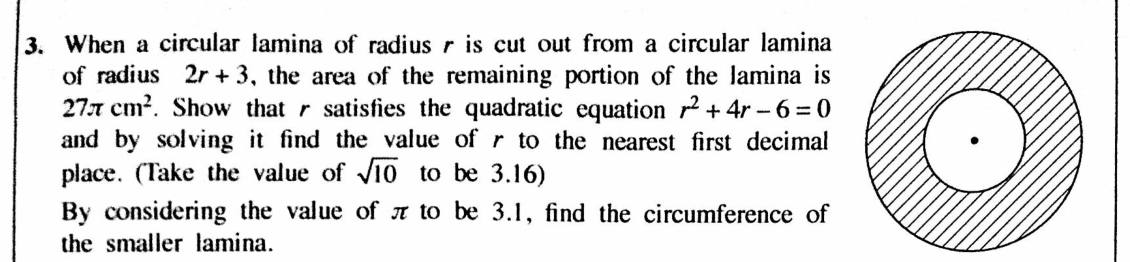
Examiners report two recurring errors:1. Not being able to multiply the two side expressions to form the area equation. Write length × width with brackets, then expand carefully.2. Leaving both roots, or picking the wrong one. A length, a number of students or a price must be positive (and a whole number when you count people). Say why you reject the other root.

📌 Remember

• Simultaneous equations: make one coefficient equal, then add or subtract; check in both equations.• Clear fractions by multiplying every term by the LCM.• Quadratics: rearrange to ax² + bx + c = 0 first.• Completing the square: add (b/2)² to both sides of x² + bx = −c.• Formula: x = (−b ± √(b² − 4ac)) / 2a. Reject roots that make no sense.

🧾 Quick revision sheet

How do you eliminate an unknown?Make its coefficients equal, then add (signs differ) or subtract (signs same).
General form of a quadratic equationax² + bx + c = 0, with a ≠ 0
Completing the square: what do you add to x² + bx?(b/2)², to both sides of the equation.
The quadratic formulax = (−b ± √(b² − 4ac)) / 2a
x² + 6x + 9 written as a square(x + 3)²
A root of a word problem is negative. What do you do?Reject it if a negative value makes no sense (length, people, price), and say why.

Now test yourself: 4 quick checks and 3 more worked examples

The full lesson checks your answers as you go, and Gedara Sir tracks which parts you've got.

Past paper questions on Equations

More Grade 11 notes