Short notes › Grade 11 · සිංහලෙන්

Grade 11 Graphs: Short Notes

11 ශ්‍රේණිය · 2 වාරය · 12 පරිච්ඡේදය · ප්‍රස්තාර

66%

of Grade 11 term tests include it (40 of 61)

400

marks in past papers (40 questions)

12 min

full lesson with quick checks

🎯 What you'll learn

  • Draw the graph of a quadratic function from a table of values
  • Read the turning point, maximum or minimum value and axis of symmetry
  • Find roots and intervals where y is positive, negative, increasing or decreasing
  • Write a quadratic in the form (x − a)² + b and read its properties
  • Describe a vertical shift and use a graph to solve equations and estimate square roots

The fountain's curve

Watch a water jet in the fountain at Viharamahadevi Park. It rises, turns at a highest point and falls back in a perfect, symmetric curve. That curve is the graph of a quadratic function. From one graph you can read the highest point, where it lands and much more.

Quadratic functions

A quadratic function has the form y = ax² + bx + c (a ≠ 0).Its graph is a smooth U-shaped curve called a parabola.• a > 0: opens upward ∪, so it has a minimum point.• a < 0: opens downward ∩, so it has a maximum point.The turning point is where the graph changes direction.

Drawing the graph

1. Complete the table of values: put each x into the function. Be careful with negatives: (−2)² = 4.2. Use the scale given, and plot each (x, y) point.3. Join the points with one smooth curve, not straight lines and not a sharp point at the bottom.The y-values are symmetric about the turning point, a handy check on your table.

Reading a graph

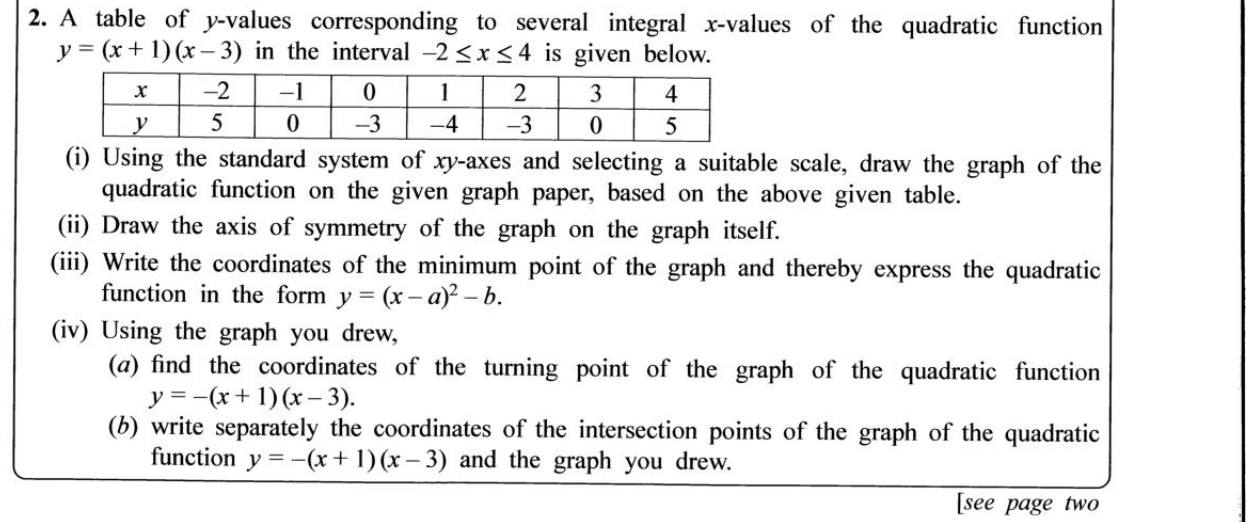
The graph of y = x² − 2x − 3. Dashed: the axis of symmetry x = 1. Red dot: the minimum point (1, −4). Amber dots: where the curve meets the x-axis, at x = −1 and x = 3.
xy−2−1234−4−224(1, −4)x = 1

Five things to read off

• Turning point: the lowest (or highest) point, as coordinates.• Minimum/maximum value: just its y-value, one number.• Axis of symmetry: the vertical line x = ... through the turning point.• Roots of ax² + bx + c = 0: x-values where the curve meets the x-axis (y = 0).• Intervals: where y is positive/negative, increasing/decreasing.

✏️ Read the graph

Use the graph of y = x² − 2x − 3 above.
  1. 1Minimum point (1, −4), so the minimum value is −4.
  2. 2Axis of symmetry: x = 1.
  3. 3Roots of x² − 2x − 3 = 0: x = −1 and x = 3.
  4. 4y is negative (below the x-axis) for −1 < x < 3.
  5. 5Reading left to right, y decreases for x < 1 and increases for x > 1.

✅ −4; x = 1; −1, 3

⚠️ Point or value? And no endpoints

Recurring exam slips:• Asked for the minimum value, writing (1, −4) or y = −4. The value is just −4.• Writing intervals with ≤. At x = −1 and x = 3, y = 0, so y < 0 for −1 < x < 3, with strict signs.• Misreading the roots: they are where y = 0, not where x = 0.

The function tells you without drawing

Write the function in completed-square form:• y = (x − a)² + b → minimum point (a, b), minimum value b, axis x = a.• y = b − (x − a)² → maximum point (a, b), maximum value b, axis x = a.Why? A square is never negative, so (x − a)² is smallest (0) when x = a.

✏️ Completing the square

Write y = x² + 6x + 4 in the form (x + p)² + q and state its turning point and minimum value.
  1. 1Halve the x coefficient: 6 ÷ 2 = 3, so use (x + 3)².
  2. 2(x + 3)² = x² + 6x + 9, which is 5 too many.
  3. 3y = (x + 3)² − 5
  4. 4Turning point (−3, −5); minimum value −5; axis x = −3.

✅ y = (x + 3)² − 5; (−3, −5)

⚠️ The sign inside the bracket flips

For y = (x + 3)² − 2 many students write the turning point as (3, −2). But the bracket is zero when x = −3, so the point is (−3, −2).And when completing the square, always expand your answer to check: (x + 3)² − 5 = x² + 6x + 9 − 5 = x² + 6x + 4 ✓

Shifting the graph

Adding a number k to the function moves the whole graph up by k (down if k is negative).y = (x − 1)² − 4 moved up 3 units becomes y = (x − 1)² − 1.• The turning point moves from (1, −4) to (1, −1).• The axis of symmetry stays x = 1.• The shape doesn't change.

Solving with a graph

The graph of y = ax² + bx + c solves equations:• Roots of ax² + bx + c = 0: read x where the curve cuts the x-axis.• Solve ax² + bx + c = k: draw the line y = k and read x where it crosses the curve.If the roots are not whole numbers, read them to one decimal place. This even lets you estimate a square root.

📌 Remember

• y = ax² + bx + c: a > 0 gives a minimum (∪), a < 0 a maximum (∩).• y = (x − a)² + b: turning point (a, b), axis x = a.• Minimum value = one number; turning point = coordinates.• Roots: where y = 0. Intervals use < (no endpoints).• Adding k shifts the graph up k; the axis stays the same.

🧾 Quick revision sheet

Shape of y = ax² + bx + c when a < 0Opens downward (∩), so it has a maximum point.
Turning point of y = (x − a)² + b(a, b), a minimum
Axis of symmetry of y = 3 − (x − 2)²x = 2 (maximum point (2, 3))
Where do you read the roots of ax² + bx + c = 0?Where the graph cuts the x-axis (y = 0).
Minimum value vs minimum pointValue: a number (e.g. −4). Point: coordinates (e.g. (1, −4)).
Complete the square: x² − 4x + 1(x − 2)² − 3
y = f(x) moved down 2 unitsy = f(x) − 2; turning point 2 units lower, same axis.

Now test yourself: 4 quick checks and 1 more worked examples

The full lesson checks your answers as you go, and Gedara Sir tracks which parts you've got.

Past paper questions on Graphs

More Grade 11 notes