Short notes › Grade 11 · සිංහලෙන්

Grade 11 Midpoint Theorem: Short Notes

11 ශ්‍රේණිය · 2 වාරය · 11 පරිච්ඡේදය · මධ්‍ය ලක්ෂ්‍යයේ ප්‍රමේයය

67%

of Grade 11 term tests include it (41 of 61)

348

marks in past papers (62 questions)

10 min

full lesson with quick checks

🎯 What you'll learn

  • State the midpoint theorem and its converse
  • Find lengths and perimeters using DE = ½ BC
  • Use DE ∥ BC to find angles
  • Use the converse to show a point is a midpoint
  • Write short proofs with reasons, such as showing a quadrilateral is a parallelogram

The carpenter's shortcut

A carpenter in Moratuwa is making a triangular roof truss. He nails a cross-beam from the middle of one rafter to the middle of the other. Without measuring, he already knows the beam is level with the base and exactly half its length. How? One neat theorem.

The midpoint theorem

D is the midpoint of AB and E is the midpoint of AC (matching ticks show equal parts). The amber line DE is parallel to BC (the arrows) and half as long.
ABCDE

Say it like a theorem

The line joining the midpoints of two sides of a triangle is parallel to the third side and equal to half of it.In △ABC, if AD = DB and AE = EC, thenDE ∥ BC and DE = ½ BC.Term tests often ask you to write this statement, so learn it word for word.

✏️ Lengths and perimeters

In △ABC, AB = 10 cm, AC = 12 cm and BC = 14 cm. D and E are the midpoints of AB and AC. Find (i) DE (ii) the perimeter of △ADE (iii) the perimeter of the trapezium BCED.
  1. 1(i) DE = ½ × BC = ½ × 14 = 7 cm (midpoint theorem)
  2. 2AD = DB = 5 cm and AE = EC = 6 cm
  3. 3(ii) Perimeter of △ADE = 5 + 6 + 7 = 18 cm (half of 36 cm)
  4. 4(iii) BCED = DB + BC + CE + ED = 5 + 14 + 6 + 7 = 32 cm

✅ (i) 7 cm (ii) 18 cm (iii) 32 cm

⚠️ Finish the perimeter

In an O/L paper, many candidates found DE correctly but then stopped, or forgot a side of the trapezium BCED. A trapezium has four sides: DB, BC, CE and ED. List them before adding. And remember DB and CE are halves of AB and AC, not the whole sides.

Join all three midpoints

Join the midpoints of all three sides of a triangle. By the midpoint theorem, each side of the small triangle is half of a side of the big one. So:• the perimeter of the midpoint triangle is half the original perimeter• the big triangle is split into 4 congruent triangles.

The converse

The straight line drawn through the midpoint of one side of a triangle, parallel to another side, bisects the third side.D is the midpoint of AB and the line through D is parallel to BC, so it meets AC at its midpoint E: AE = EC.
ABCDE

✏️ Using the converse

In △PQR, M is the midpoint of PQ. The line through M parallel to QR meets PR at N. If PR = 16 cm and QR = 10 cm, find PN and MN.
  1. 1M is the midpoint of PQ and MN ∥ QR, so N is the midpoint of PR (converse of the midpoint theorem).
  2. 2PN = ½ × 16 = 8 cm
  3. 3Now M and N are both midpoints, so MN = ½ QR = 5 cm (midpoint theorem).

✅ PN = 8 cm, MN = 5 cm

⚠️ Don't forget the 'parallel' half

Examiners report that many students use only DE = ½ BC and miss that DE ∥ BC. The parallel line gives you corresponding and alternate angles, and sometimes a right angle. Whenever you join two midpoints, write both facts down at once.

⚠️ Proofs need reasons

A proof that just lists 'DE ∥ BC, EF ∥ AB' loses marks. Each line needs its reason in brackets: (midpoint theorem), (converse of the midpoint theorem), (corresponding angles), (SAS)... Also say which triangle you are using: 'In △ABC, D and E are midpoints of AB and AC'.

📌 Remember

• Join midpoints of two sides → parallel to the third side and half of it.• Converse: through a midpoint, parallel to a side → bisects the third side.• Use both facts: lengths from ½, angles from ∥.• Midpoint triangle: half the perimeter, 4 congruent triangles.• In proofs, name the triangle and give a reason for each step.

🧾 Quick revision sheet

State the midpoint theoremThe line joining the midpoints of two sides of a triangle is parallel to the third side and half of it.
State the converse of the midpoint theoremA line through the midpoint of one side, parallel to another side, bisects the third side.
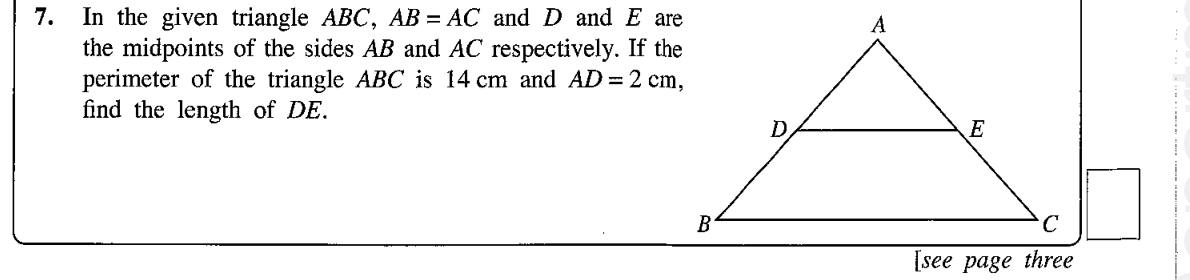
D, E midpoints of AB, AC. BC = 18 cm. DE = ?9 cm
Perimeter of the midpoint triangleHalf the perimeter of the original triangle
Joining the midpoints of a quadrilateral's sides gives…a parallelogram, with perimeter equal to the sum of the diagonals

Now test yourself: 5 quick checks and 1 more worked examples

The full lesson checks your answers as you go, and Gedara Sir tracks which parts you've got.

Past paper questions on Midpoint Theorem

Paper II Part B Q10 · 10 marks

Parallelograms II · Congruency · Midpoint Theorem · Equiangular Triangles

G.C.E. O/L 2025

Square with midpoints: rectangle, congruent triangles, midpoint theorem, equiangular triangles
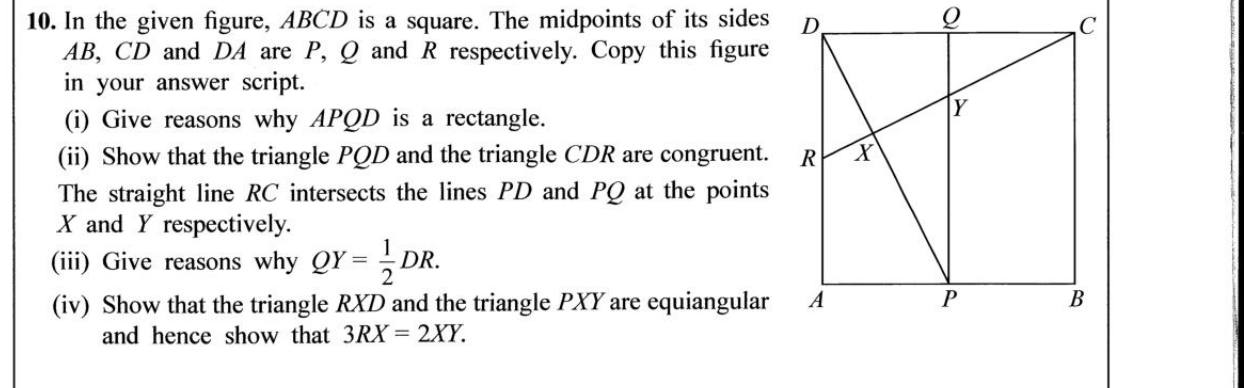
Paper II Part B Q10: Square with midpoints: rectangle, congruent triangles, midpoint theorem, equiangular triangles🔒 Answer & steps: try it free in Gedara Sir→
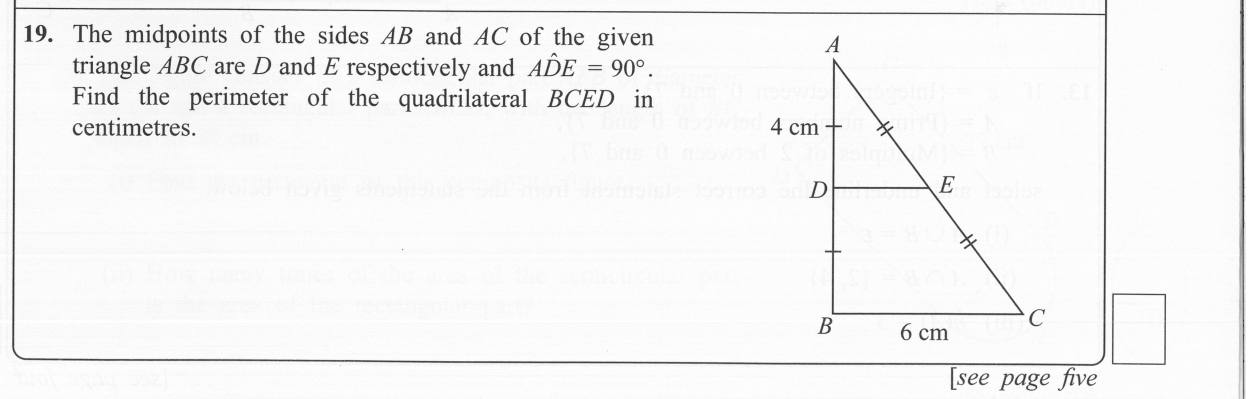
Paper II Part B Q12 · 10 marks

Midpoint Theorem · Congruency · Parallelograms II · Area of Plane Figures between Parallel Lines

G.C.E. O/L 2023

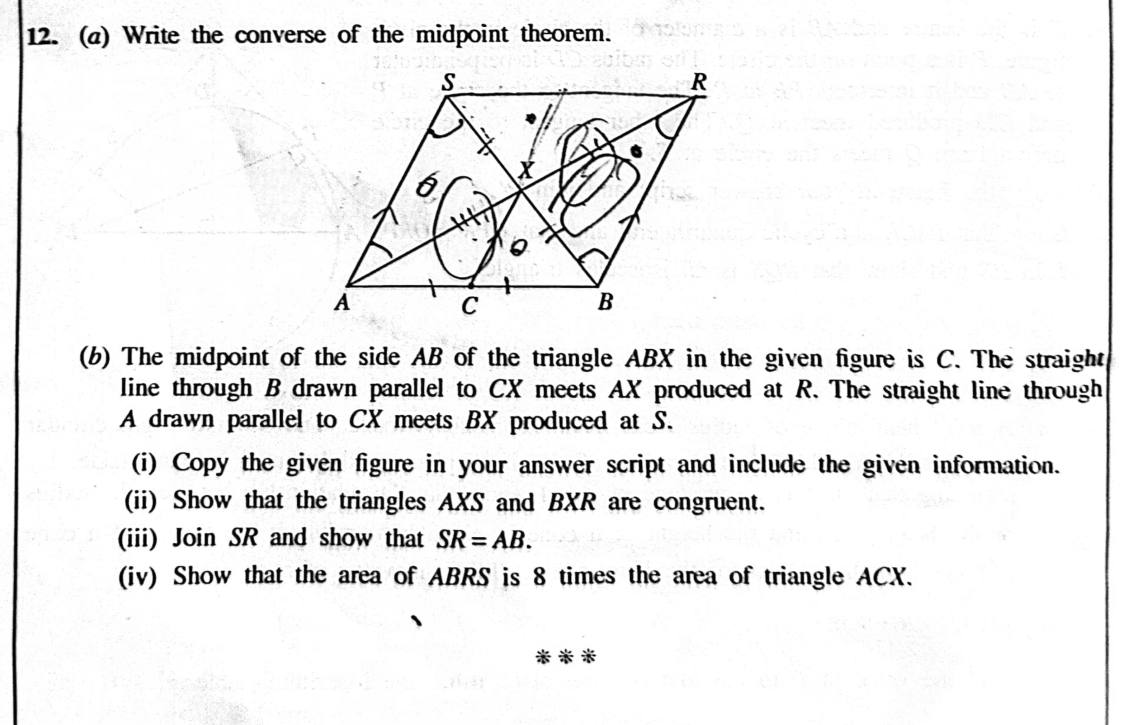
Converse of midpoint theorem, congruency, parallelogram and area ratio

Paper II Part B Q12: Converse of midpoint theorem, congruency, parallelogram and area ratio🔒 Answer & steps: try it free in Gedara Sir→
More Grade 11 notes