Short notes › Grade 11 · සිංහලෙන්

Grade 11 Area of Plane Figures between Parallel Lines: Short Notes

11 ශ්‍රේණිය · 1 වාරය · 8 පරිච්ඡේදය · සමාන්තර රේඛා අතර තල රූපවල වර්ගඵලය

56%

of Grade 11 term tests include it (34 of 61)

298

marks in past papers (45 questions)

11 min

full lesson with quick checks

🎯 What you'll learn

  • Use: parallelograms on the same base between the same parallels are equal in area
  • Use: a triangle is half the parallelogram on the same base between the same parallels
  • Use: triangles on the same base between the same parallels are equal in area, and the converse
  • Find areas, bases and heights, and area ratios of triangles with a common height
  • Write area proofs with full reasons

Same frontage, same land?

Near Kurunegala, a road and a straight canal run parallel. Two plots both have a 20 m frontage on the road and reach back to the canal. One is a neat rectangle; the other leans at a slant. The seller says the slanted one is bigger. Is he right? Geometry says the two are exactly equal.

'Between the same parallels'

A figure lies between two parallel lines when its base is on one line and its opposite side (or top vertex) is on the other.Then its perpendicular height is the distance between the lines, and that distance is the same everywhere.So figures on the same base between the same parallels have the same base and the same height.

Theorem 1: two parallelograms

ABCD and ABEF are on the same base AB and between the same parallels AB and DE. Area = base × height = AB × h for both, so their areas are equal.
hABCDEF

Theorem 2: triangle and parallelogram

△ABE and parallelogram ABCD are on the same base AB, between AB and DC. The triangle's area is ½ × AB × h, so it is half the parallelogram, wherever E sits on DC.
ABCDE

🧮 The key fact

Use it when a triangle and a parallelogram share a base and lie between the same parallels. Bonus: the two leftover triangles, △ADE and △BCE, together make the other half.

△ABE = ½ × ABCD

Theorem 3: two triangles

If CD ∥ AB, then △ABC and △ABD are on the same base AB between the same parallels, so △ABC = △ABD in area. Each is half of a parallelogram on AB.
ABCD

⚠️ Name the base and the parallels

In O/L papers many candidates could not see that a triangle is half the parallelogram, or wrote 'equal areas' without a reason. In every step, write the full reason: on the same base AB and between the same parallels AB and DC. If you can't name the base and both lines, the theorem doesn't apply yet.

✏️ A trapezium proof

ABCD is a trapezium with AB ∥ DC. Its diagonals AC and BD meet at O. Prove that △AOD and △BOC have equal areas.
ABCDO
  1. 1△ABD and △ABC are on the same base AB, between the parallels AB and DC.
  2. 2So area △ABD = area △ABC.
  3. 3Both contain △AOB. Subtract it from each side.
  4. 4△ABD − △AOB = △AOD and △ABC − △AOB = △BOC.
  5. 5Therefore △AOD = △BOC in area.

✅ △AOD = △BOC (proved)

The converse

It also works backwards: if two triangles on the same base, on the same side of it, have equal areas, then the line joining their top vertices is parallel to the base.Why? Equal areas on the same base means equal heights, so both tops are the same distance from the base.

Same height: areas follow the bases

△ABD and △ADC share the vertex A and the height h. So their areas are in the ratio of their bases: if BD : DC = 2 : 3, then △ABD : △ADC = 2 : 3. A median (D the midpoint) splits a triangle into two equal halves.
hABCD23

⚠️ Forgetting the ½

Asked for the base of a triangle of area 30 cm² and height 6 cm, many write 30 ÷ 6 = 5. But area = ½ × base × height, so 30 = ½ × b × 6 = 3b, giving b = 10 cm. For a parallelogram there is no ½: base = area ÷ height.

✏️ Putting it together

ABCD is a parallelogram of area 80 cm². P is a point on AB and Q is the midpoint of DC. Find (i) area △PDC (ii) area △APD + area △PBC (iii) area △PQC (iv) the distance between AB and DC if DC = 10 cm.
ABCDPQ
  1. 1(i) △PDC: same base DC, between DC ∥ AB, so ½ × 80 = 40 cm².
  2. 2(ii) The rest of the parallelogram: 80 − 40 = 40 cm².
  3. 3(iii) PQ is a median of △PDC, so △PQC = ½ × 40 = 20 cm².
  4. 4(iv) 80 = 10 × h, so h = 8 cm.

✅ (i) 40 cm² (ii) 40 cm² (iii) 20 cm² (iv) 8 cm

📌 Remember

• Parallelograms on the same base and between the same parallels are equal in area.• A triangle on the same base between the same parallels is half the parallelogram.• Triangles on the same base between the same parallels are equal in area; equal areas on the same side mean the tops are joined by a parallel.• Same height: area ratio = base ratio; a median halves a triangle.• Always state the base and the parallels as your reason.

🧾 Quick revision sheet

Parallelograms on the same base and between the same parallels……are equal in area.
Triangle and parallelogram on the same base, between the same parallelsTriangle = ½ × parallelogram
Triangles on the same base and between the same parallels……are equal in area.
Converse: equal-area triangles on the same base, same sideThe line joining their vertices is parallel to the base.
Area of a parallelogrambase × perpendicular height
What does a median do to a triangle's area?Splits it into two equal halves.
BD : DC = 2 : 3 on BC. △ABD : △ADC = ?2 : 3 (same height from A)

Now test yourself: 4 quick checks

The full lesson checks your answers as you go, and Gedara Sir tracks which parts you've got.

Past paper questions on Area of Plane Figures between Parallel Lines

Paper II Part B Q11 · 10 marks

Congruency · Parallelograms II · Area of Plane Figures between Parallel Lines

G.C.E. O/L 2022

🔁 Asked in 11 of 16 O/L papers

Parallelogram extension: congruent triangles, two parallelograms, equal areas
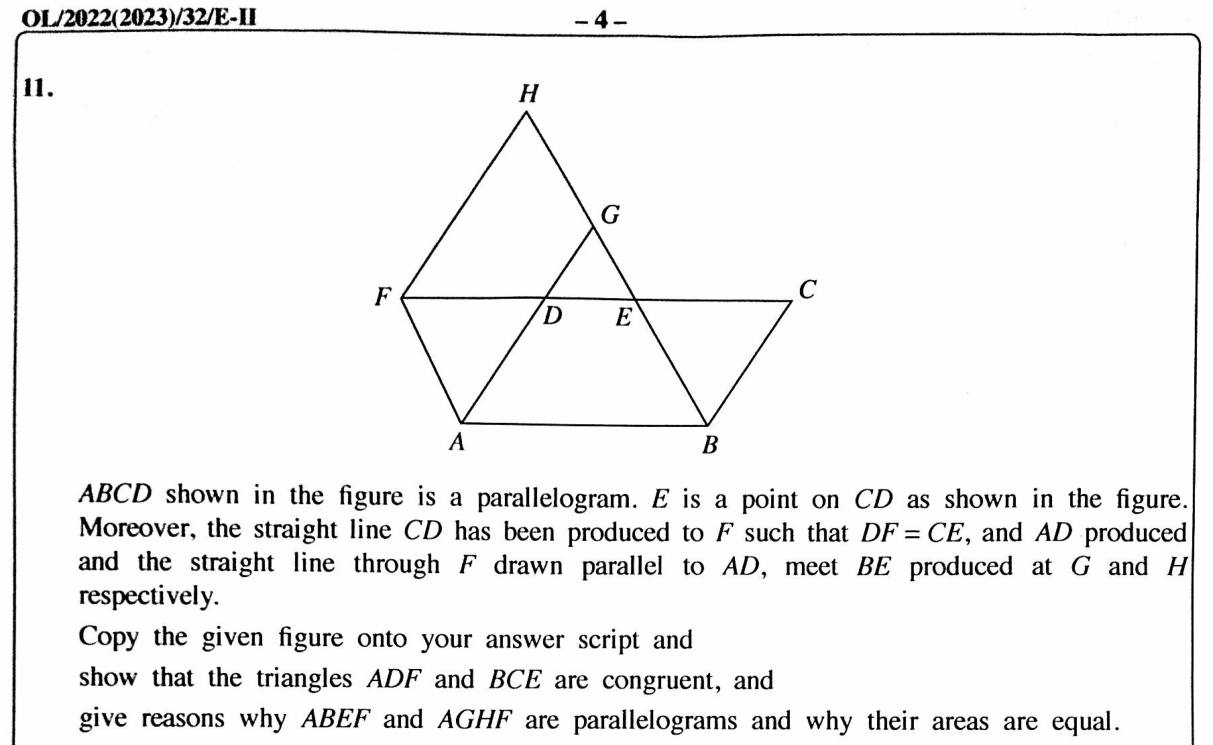
Paper II Part B Q11: Parallelogram extension: congruent triangles, two parallelograms, equal areas🔒 Answer & steps: try it free in Gedara Sir→

More Grade 11 notes