Short notes › Grade 9 · සිංහලෙන්

Grade 9 Angles Related to Straight Lines and Parallel Lines: Short Notes

9 ශ්‍රේණිය · 1 වාරය · 8 පරිච්ඡේදය · සරල රේඛා, සමාන්තර රේඛා ආශ්‍රිත කෝණ

95%

of Grade 9 term tests include it (38 of 40)

413

marks in past papers (98 questions)

11 min

full lesson with quick checks

🎯 What you'll learn

  • Use adjacent, complementary and supplementary angles
  • Use angles on a straight line, round a point and vertically opposite angles
  • Name corresponding, alternate and allied angles on a transversal
  • Find angles between parallel lines, giving reasons
  • Show that two lines are parallel using angle facts

The level crossing

At a level crossing near Maradana, a road cuts straight across two parallel rails. That makes eight angles. Measure just one of them and you can work out all the others without a protractor. This lesson shows you how.

Angle pairs: the words

• Adjacent angles share a vertex and an arm, and don't overlap.• Complementary angles add to 90° (30° and 60°).• Supplementary angles add to 180° (110° and 70°).So the complement of 35° is 55°, and its supplement is 145°.

Three facts about lines

• Angles on a straight line at a point add to 180°.• Angles round a point add to 360°.• When two straight lines cross, vertically opposite angles are equal.The last one is a theorem: each of the two angles makes 180° with the same angle between them, so they must be equal.

Two crossing lines

Opposite angles match: a = a, b = b. Neighbours are on a straight line, so a + b = 180°. Know one angle and you know all four.
aabba + b = 180°

✏️ Algebra on a straight line

Three angles on a straight line are 2x, 3x + 15° and 45°. Find x and the largest angle.
  1. 1They add to 180°: 2x + 3x + 15 + 45 = 180
  2. 25x + 60 = 180, so 5x = 120 and x = 24°
  3. 3Angles: 48°, 87°, 45°. Largest = 87°

✅ x = 24°, largest angle 87°

A transversal across parallel lines

l ∥ m (the arrows mean parallel). The line crossing them is a transversal. The amber angles are all equal: a = b = c. The red angle d makes 180° with a.
abcdlm

The three parallel-line rules

When a transversal cuts parallel lines:• Corresponding angles are equal (a and c: same position at each crossing, an F shape).• Alternate angles are equal (a and b: between the lines, opposite sides, a Z shape).• Allied (co-interior) angles add to 180° (a and d: between the lines, same side, a C shape).

✏️ One angle gives all eight

In the figure l ∥ m and a = 65°. Find b, c and d.
abcdlm
  1. 1b = a = 65° (alternate angles)
  2. 2c = a = 65° (corresponding angles)
  3. 3d = 180° − 65° = 115° (allied angles)

✅ b = 65°, c = 65°, d = 115°

⚠️ Mixing up the angle names

The most common error O/L examiners report here: calling corresponding angles alternate, or the reverse, and then using the wrong fact.Check two things: are both angles between the lines? Are they on the same side of the transversal? Also, the rules work only when the lines are parallel (look for arrows).

Proving lines are parallel

The rules also work backwards. Two lines cut by a transversal are parallel if:• a pair of corresponding angles are equal, or• a pair of alternate angles are equal, or• a pair of allied angles add to 180°.If none of these holds, the lines are not parallel; they will meet somewhere.

⚠️ Stopping halfway

Examiners note many candidates can't combine parallel-line facts with the angle sum of a triangle (180°) or the equal base angles of an isosceles triangle. Use one fact at a time and write each angle on the figure as you find it.And write the ° sign: a bare '45' has cost marks.

📌 Remember

• Straight line: 180°. Round a point: 360°. Vertically opposite angles are equal.• Parallel lines: corresponding equal (F), alternate equal (Z), allied add to 180° (C).• Any one of these the other way round proves lines are parallel.• For harder figures, draw an extra parallel line or use the triangle sum.• Give a reason for every angle, and write °.

🧾 Quick revision sheet

Complementary anglesTwo angles that add to 90°.
Supplementary anglesTwo angles that add to 180°.
Vertically opposite anglesFormed when two lines cross; they are equal.
Alternate angles (parallel lines)Between the lines, on opposite sides of the transversal: equal (Z shape).
Corresponding angles (parallel lines)Same position at each crossing: equal (F shape).
Allied (co-interior) anglesBetween the lines, same side of the transversal: add to 180° (C shape).
Angles round a pointAdd to 360°.

Now test yourself: 5 quick checks and 1 more worked examples

The full lesson checks your answers as you go, and Gedara Sir tracks which parts you've got.

Past paper questions on Angles Related to Straight Lines and Parallel Lines

Paper I Part A Q2 · 2 marks

Angles Related to Straight Lines and Parallel Lines · Triangles

G.C.E. O/L 2024

🔁 Asked in 6 of 16 O/L papers

Angle in a triangle using parallel lines and crossing lines

Paper I Part A Q2: Angle in a triangle using parallel lines and crossing lines🔒 Answer & steps: try it free in Gedara Sir→

Paper I Part A Q7 · 2 marks

Angles Related to Straight Lines and Parallel Lines · Angles of a Triangle

North Western Province Grade 9 Maths Term 2 Test 2025

🔁 Asked in 9 of 11 term-test papers🔥 7 years in a row🎓 In 6 of 16 O/L papers

Angle in a right triangle using a parallel line
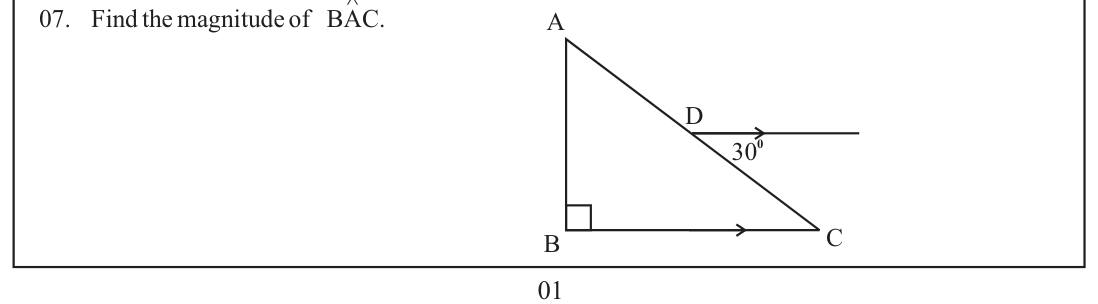
Paper I Part A Q7: Angle in a right triangle using a parallel line🔒 Answer & steps: try it free in Gedara Sir→

More Grade 9 notes

