Short notes › Grade 9 · සිංහලෙන්

Grade 9 Sets: Short Notes

9 ශ්‍රේණිය · 22 පරිච්ඡේදය · කුලක

48%

of Grade 9 term tests include it (19 of 40)

171

marks in past papers (29 questions)

10 min

full lesson with quick checks

🎯 What you'll learn

  • Write sets by listing and use ∈, ∉ and n(A)
  • Recognise finite, infinite, empty and equal sets
  • Find subsets and use 2ⁿ for the number of subsets
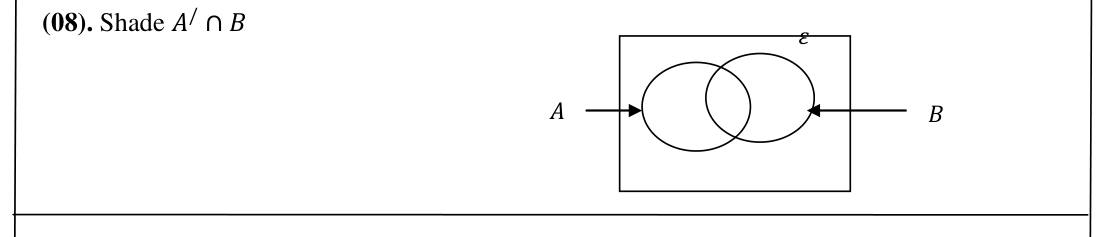
  • Draw and read Venn diagrams with ξ, A', A ∪ B and A ∩ B
  • Recognise disjoint sets and a set inside another

12 letters, 7 elements

Write the word ANURADHAPURA on the board: 12 letters. Now write the set of its letters: {A, N, U, R, D, H, P}. Only 7! A set lists each member once. That one idea, plus a few symbols and circles, is this whole chapter.

What is a set?

A set is a clearly defined collection of objects, called elements.• Write elements inside braces: V = {a, e, i, o, u}• Each element once; order doesn't matter.• e ∈ V means 'e is an element of V'; b ∉ V means it is not.• n(V) is the number of elements: n(V) = 5.'Tall students' is not a set: 'tall' isn't clearly defined.

Kinds of sets

• Finite: you can count all the elements: {factors of 20}.• Infinite: the elements never end: {multiples of 3} = {3, 6, 9, ...}.• Empty (null) set: no elements at all, written { } or ∅. Example: {even prime numbers greater than 2}.• Equal sets: exactly the same elements: {1, 2, 3} = {3, 1, 2}.

Subsets

B is a subset of A, written B ⊂ A, if every element of B is also in A.Subsets of {a, b}: { }, {a}, {b}, {a, b}. That's 4.• The empty set is a subset of every set.• Every set is a subset of itself.A set with n elements has 2ⁿ subsets.

Universal set and complement

The universal set ξ holds everything we are talking about, drawn as a rectangle. Sets inside it are drawn as circles: a Venn diagram.The complement A' is every element of ξ that is not in A.If ξ = {1, 2, ..., 6} and A = {2, 4, 6}, then A' = {1, 3, 5}.

A Venn diagram

ξ = {1, 2, ..., 10}, A = even numbers, B = multiples of 3. 6 is in both, so it goes in the overlap. 1, 5 and 7 are in neither, so they sit outside both circles but inside ξ.
ξAB24810396157

Union and intersection

• Union A ∪ B: elements in A or B or both. Join the lists, writing shared elements once.• Intersection A ∩ B: elements in both A and B: the overlap.From the diagram: A ∪ B = {2, 3, 4, 6, 8, 9, 10} and A ∩ B = {6}.

✏️ Reading the diagram

Use the Venn diagram of A (even numbers) and B (multiples of 3) in ξ = {1, ..., 10}. List B', (A ∪ B)' and A ∩ B'.
ξAB24810396157
  1. 1B' = everything outside circle B: {1, 2, 4, 5, 7, 8, 10}
  2. 2(A ∪ B)' = outside both circles: {1, 5, 7}
  3. 3A ∩ B' = in A but not in B: {2, 4, 8, 10}

✅ B' = {1, 2, 4, 5, 7, 8, 10}; (A ∪ B)' = {1, 5, 7}; A ∩ B' = {2, 4, 8, 10}

Disjoint sets and subsets

Left: A and B have no common elements, so they are disjoint: A ∩ B = ∅. Draw them as separate circles.Right: every element of Q is in P, so Q ⊂ P. Draw Q inside P. Then P ∩ Q = Q and P ∪ Q = P.
ξABξPQA ∩ B = ∅Q ⊂ P

⚠️ Repeats and the overlap

A common slip: writing a shared element twice in a union, like {2, 4, 6, 3, 6, 9}, or putting it in both circles instead of the overlap. A shared element goes in the overlap once.And don't mix them up: ∪ (a cup) collects more; ∩ (a cap) keeps only what is common.

⚠️ Empty is not zero

{0} is not the empty set: it has one element, the number 0. The empty set is { } or ∅, never {∅}.Also, when you list a complement, include the elements outside both circles. They are part of ξ too.

✏️ Term-test style

ξ = {1, 2, ..., 12}, P = {factors of 12}, Q = {odd numbers}. List P and Q, draw a Venn diagram, and find P ∩ Q, n(P ∪ Q) and (P ∪ Q)'.
ξPQ246125791113810
  1. 1P = {1, 2, 3, 4, 6, 12}, Q = {1, 3, 5, 7, 9, 11}
  2. 2Common: P ∩ Q = {1, 3}; write these in the overlap first.
  3. 3P ∪ Q = {1, 2, 3, 4, 5, 6, 7, 9, 11, 12}, so n(P ∪ Q) = 10.
  4. 4(P ∪ Q)' = {8, 10}

✅ P ∩ Q = {1, 3}; n(P ∪ Q) = 10; (P ∪ Q)' = {8, 10}

📌 Remember

• A set is a clearly defined collection; list each element once inside { }.• Finite, infinite, empty (∅ or { }), equal sets; n elements give 2ⁿ subsets.• ξ is the rectangle; A' is everything in ξ outside A.• A ∪ B: in A or B or both. A ∩ B: in both. Disjoint: A ∩ B = ∅.• Fill the overlap first, then the rest, then the outside.

🧾 Quick revision sheet

∈ and ∉∈: is an element of. ∉: is not an element of.
Empty setA set with no elements: { } or ∅. Not {0}.
Number of subsets of a set with n elements2ⁿ
A ∪ BUnion: elements in A or B or both.
A ∩ BIntersection: elements in both A and B.
A'Complement: elements of ξ that are not in A.
Disjoint setsSets with no common element: A ∩ B = ∅.

Now test yourself: 5 quick checks

The full lesson checks your answers as you go, and Gedara Sir tracks which parts you've got.

Past paper questions on Sets

More Grade 9 notes