Short notes › Grade 10 · සිංහලෙන්

Grade 10 Factors of Quadratic Expressions: Short Notes

10 ශ්‍රේණිය · 7 පරිච්ඡේදය · වර්ගජ ප්‍රකාශනවල සාධක

85%

of Grade 10 term tests include it (46 of 54)

350

marks in past papers (67 questions)

9 min

full lesson with quick checks

🎯 What you'll learn

  • Factorise x² + bx + c using the product and sum of two numbers
  • Choose the signs of the two numbers correctly
  • Factorise ax² + bx + c by splitting the middle term
  • Take out a common factor or −1 before factorising
  • Check a factorisation by expanding

A carrot bed in Nuwara Eliya

A farmer in Nuwara Eliya marks out a rectangular carrot bed with area x² + 7x + 12 square metres. What are its length and breadth? Factorising the expression gives the answer: (x + 3) m and (x + 4) m. Let's learn how to find them.

Factorising undoes expanding

Expand: (x + 3)(x + 4) = x² + 4x + 3x + 12 = x² + 7x + 12.Look closely:• 3 + 4 = 7, the coefficient of x• 3 × 4 = 12, the constant termAn expression like x² + 7x + 12 has three terms, so it is a trinomial quadratic expression. Factorising means going backwards: from x² + 7x + 12 to (x + 3)(x + 4).

The bed as four pieces

Split the bed into four parts: x², 4x, 3x and 12. Together they make the whole area, and the sides are (x + 3) and (x + 4).
x4x3x²4x3x12(x + 3)(x + 4) = x² + 7x + 12

The rule for x² + bx + c

Find two numbers that• multiply to give c, and• add to give b.Signs help you search:• c positive, b positive: both numbers +• c positive, b negative: both numbers −• c negative: one +, one −; the bigger one takes the sign of b

✏️ Two quick ones

Factorise (i) x² − 9x + 20 (ii) x² + 2x − 15
  1. 1(i) Product +20, sum −9: both negative. −4 × −5 = 20 and −4 + −5 = −9.
  2. 2So x² − 9x + 20 = (x − 4)(x − 5).
  3. 3(ii) Product −15, sum +2: opposite signs, bigger one +. +5 × −3 = −15 and 5 − 3 = 2.
  4. 4So x² + 2x − 15 = (x + 5)(x − 3). Expand to check.

✅ (i) (x − 4)(x − 5) (ii) (x + 5)(x − 3)

⚠️ Can't find the pair? List them all

In O/L papers many candidates could not find two numbers with product −10 and sum 3, and almost a third scored zero. Don't guess: list every factor pair of the product with signs, and add each pair.1, −10 → −9−1, 10 → 92, −5 → −3−2, 5 → 3 ✓

When x² has a coefficient

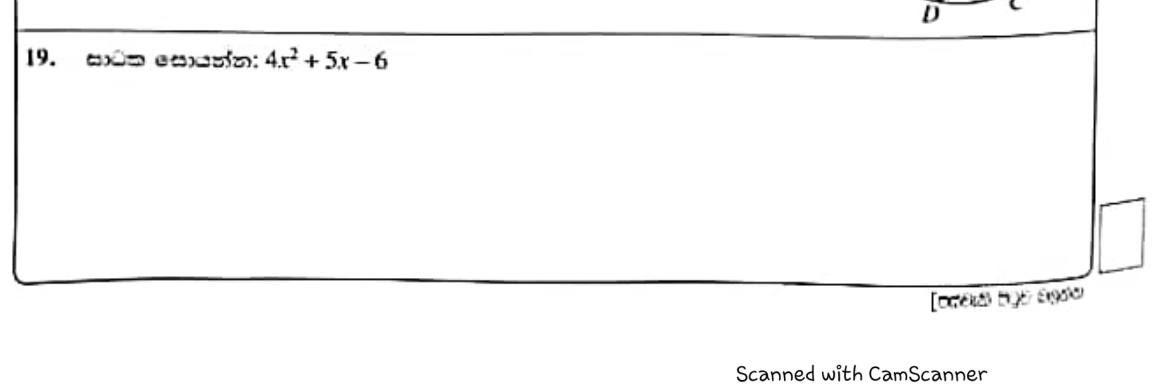
For ax² + bx + c (like 2x² + 7x + 3):1. Multiply a × c (2 × 3 = 6).2. Find two numbers with product a × c and sum b (6 and 1).3. Split the middle term with them: 2x² + 6x + x + 3.4. Factorise in pairs: 2x(x + 3) + 1(x + 3).5. Take out the common bracket: (x + 3)(2x + 1).

✏️ A term-test favourite

Factorise 3x² − 5x − 2.
  1. 1a × c = 3 × (−2) = −6. Need product −6, sum −5: that is −6 and +1.
  2. 2Split: 3x² − 6x + x − 2.
  3. 3Pairs: 3x(x − 2) + 1(x − 2).
  4. 4Common bracket: (x − 2)(3x + 1).
  5. 5Check: 3x² + x − 6x − 2 = 3x² − 5x − 2 ✓

✅ (x − 2)(3x + 1)

⚠️ Sign slip in the second pair

In 2x² + 4x − 3x − 6, the second pair is −3x − 6. Taking out −3 gives −3(x + 2), not −3(x − 2), because −3 × +2 = −6.If your two brackets don't match, check this sign first. The brackets must be identical before you can take one out.

Common factor first, always

If every term shares a factor, take it out first:2x² − 8x − 24 = 2(x² − 4x − 12) = 2(x − 6)(x + 2)If the x² term is negative, take out −1:−x² + x + 6 = −(x² − x − 6) = −(x − 3)(x + 2)Then factorise what is left inside the bracket completely.

🧮 The key idea

Find p and q, split bx into px + qx, then factorise in pairs. When a = 1 the answer is simply (x + p)(x + q).

ax² + bx + c : p + q = b , p × q = a × c

📌 Remember

• x² + bx + c: two numbers with product c and sum b.• ax² + bx + c: product a × c and sum b, split the middle term, factorise in pairs.• Take out any common factor (or −1) first.• The two brackets must match before you take one out.• Always expand your answer to check.

🧾 Quick revision sheet

Factorising x² + bx + cFind two numbers: product c, sum b.
Factorising ax² + bx + cProduct a × c, sum b; split the middle term; factorise in pairs.
c negative: what about the signs?One number +, one −; the bigger one has the sign of b.
c positive, b negative: signs?Both numbers are negative.
x² − 8x + 15(x − 3)(x − 5)
First step if all terms share a factor?Take the common factor out first.
3x² + 2x − 5(3x + 5)(x − 1)
How to check a factorisation?Expand the brackets; you must get the original expression.

Now test yourself: 4 quick checks and 1 more worked examples

The full lesson checks your answers as you go, and Gedara Sir tracks which parts you've got.

Past paper questions on Factors of Quadratic Expressions

More Grade 10 notes