Short notes › Grade 10 · සිංහලෙන්

Grade 10 Parallelograms II: Short Notes

10 ශ්‍රේණිය · 2 වාරය · 16 පරිච්ඡේදය · සමාන්තරාස්‍ර II

65%

of Grade 10 term tests include it (35 of 54)

374

marks in past papers (43 questions)

11 min

full lesson with quick checks

🎯 What you'll learn

  • State the four conditions that make a quadrilateral a parallelogram
  • Use equal opposite sides or equal opposite angles to show a parallelogram
  • Use diagonals that bisect each other to show a parallelogram
  • Use one pair of opposite sides that are equal and parallel
  • Write a short rider proof with a reason for every step

The folding shop gate

At closing time a Pettah shop owner pulls a folding steel grille across the shop front. As it stretches, the diamond shapes in the grille get wider and flatter, yet every one of them stays a parallelogram. Nobody measures any angles. So what guarantees it? That's this chapter.

Turning the facts around

In Parallelograms I you learnt: if ABCD is a parallelogram, then its opposite sides are equal, opposite angles are equal and diagonals bisect each other.Now we go the other way. We are given facts about a quadrilateral and must prove it is a parallelogram. You don't need to prove these theorems, but you must use them in riders.

Four ways to be sure

A quadrilateral is a parallelogram if:1. both pairs of opposite sides are equal2. both pairs of opposite angles are equal3. the diagonals bisect each other4. one pair of opposite sides is equal and parallel
1234

⚠️ It must be the same pair

Condition 4 needs one pair of opposite sides to be both equal and parallel. 'AB ∥ DC and AD = BC' is not enough: an isosceles trapezium has exactly that.In the exam, examiners often see 'DQ = BP' written with no proof that DQ ∥ BP. Show both facts for the same pair, each with a reason.

✏️ Making the sides match

In quadrilateral ABCD, AB = (3x + 2) cm, DC = (5x − 6) cm, AD = (2y + 1) cm and BC = (y + 7) cm. Find x and y so that ABCD is a parallelogram.
  1. 1Use condition 1: both pairs of opposite sides equal.
  2. 2AB = DC: 3x + 2 = 5x − 6, so 2x = 8 and x = 4.
  3. 3AD = BC: 2y + 1 = y + 7, so y = 6.
  4. 4Check: AB = DC = 14 cm and AD = BC = 13 cm.

✅ x = 4, y = 6

Writing a rider proof

1. Mark everything you are given on the figure.2. Decide which of the four conditions you will finish with.3. Often you first prove two triangles congruent to get the equal sides or angles you need.4. Write each statement with its reason in brackets: (given), (opposite sides of a parallelogram), (alternate angles).5. End by naming the condition you used.

✏️ Points on a diagonal

ABCD is a parallelogram with diagonals meeting at O. P and Q are on AC with AP = CQ. Prove that DPBQ is a parallelogram.
ABCDPQO
  1. 1OA = OC and OB = OD (diagonals of parallelogram ABCD bisect each other).
  2. 2AP = CQ (given).
  3. 3OP = OA − AP = OC − CQ = OQ.
  4. 4PQ and BD are the diagonals of DPBQ, and O bisects both.
  5. 5The diagonals of DPBQ bisect each other, so it is a parallelogram.

✅ DPBQ is a parallelogram (diagonals bisect each other)

⚠️ Congruence needs the right reasons

Examiners report students who spot the right congruent triangles but lose marks on the reasons. For S.A.S., the angle must lie between the two sides you used. Write where each fact comes from: (given), (D is the midpoint), (vertically opposite angles). Then use the corresponding parts to get the sides or angles you need.

📌 Remember

A quadrilateral is a parallelogram if:• both pairs of opposite sides are equal, or• both pairs of opposite angles are equal, or• its diagonals bisect each other, or• one pair of opposite sides is equal and parallel.In riders: congruent triangles first, a reason for every line, then name the condition.

🧾 Quick revision sheet

Sides condition for a parallelogramBoth pairs of opposite sides are equal.
Angles condition for a parallelogramBoth pairs of opposite angles are equal.
Diagonals condition for a parallelogramThe diagonals bisect each other.
One-pair condition for a parallelogramThe same pair of opposite sides is both equal and parallel.
AB ∥ DC and AD = BC. Parallelogram?Not necessarily: it could be an isosceles trapezium.
Adjacent angles of a parallelogramThey are co-interior angles, so they add up to 180°.

Now test yourself: 5 quick checks and 1 more worked examples

The full lesson checks your answers as you go, and Gedara Sir tracks which parts you've got.

Past paper questions on Parallelograms II

Paper II Part B Q10 · 10 marks

Parallelograms II · Congruency · Midpoint Theorem · Equiangular Triangles

G.C.E. O/L 2025

Square with midpoints: rectangle, congruent triangles, midpoint theorem, equiangular triangles
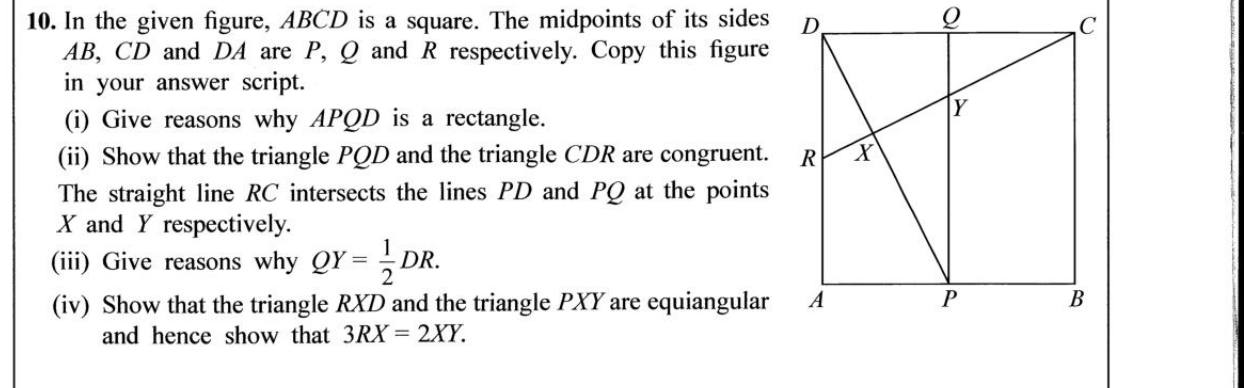
Paper II Part B Q10: Square with midpoints: rectangle, congruent triangles, midpoint theorem, equiangular triangles🔒 Answer & steps: try it free in Gedara Sir→
Paper II Part B Q8 · 10 marks

Congruency · Parallelograms II · Equiangular Triangles

G.C.E. O/L 2024

🔁 Asked in 11 of 16 O/L papers

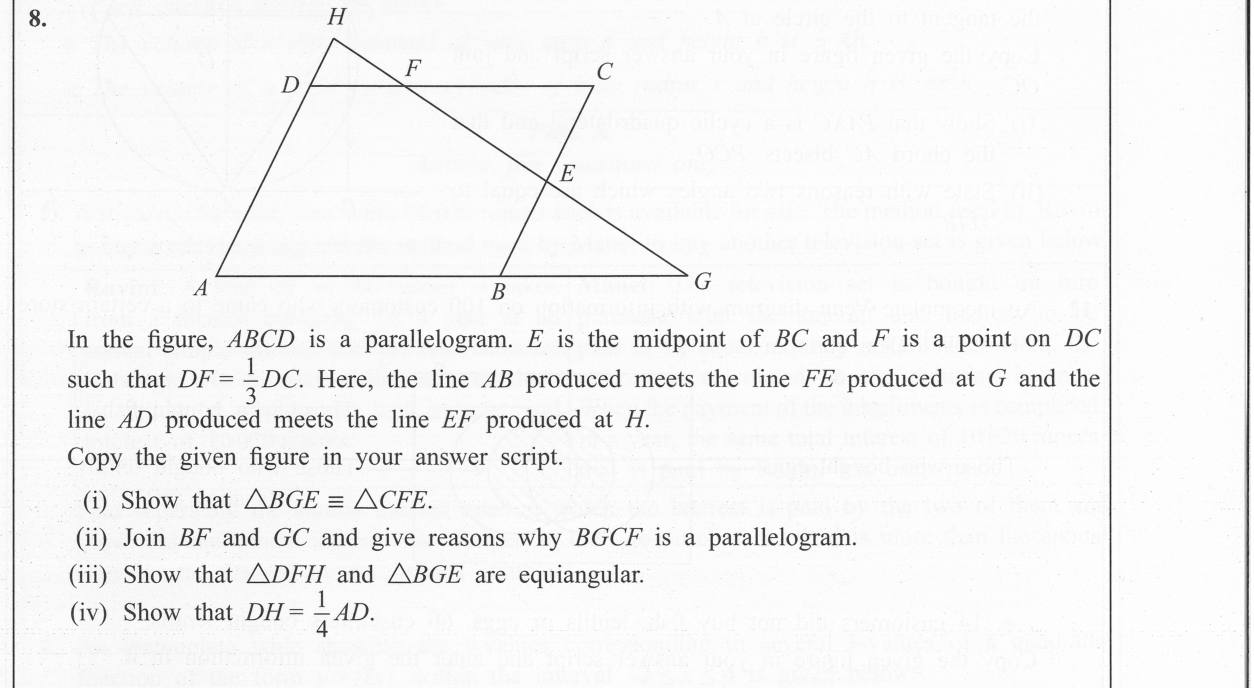
Parallelogram: congruent triangles, a new parallelogram, equiangular triangles, a ratio

Paper II Part B Q8: Parallelogram: congruent triangles, a new parallelogram, equiangular triangles, a ratio🔒 Answer & steps: try it free in Gedara Sir→
Paper II Part B Q12 · 10 marks

Midpoint Theorem · Congruency · Parallelograms II · Area of Plane Figures between Parallel Lines

G.C.E. O/L 2023

🔁 Asked in 10 of 16 O/L papers

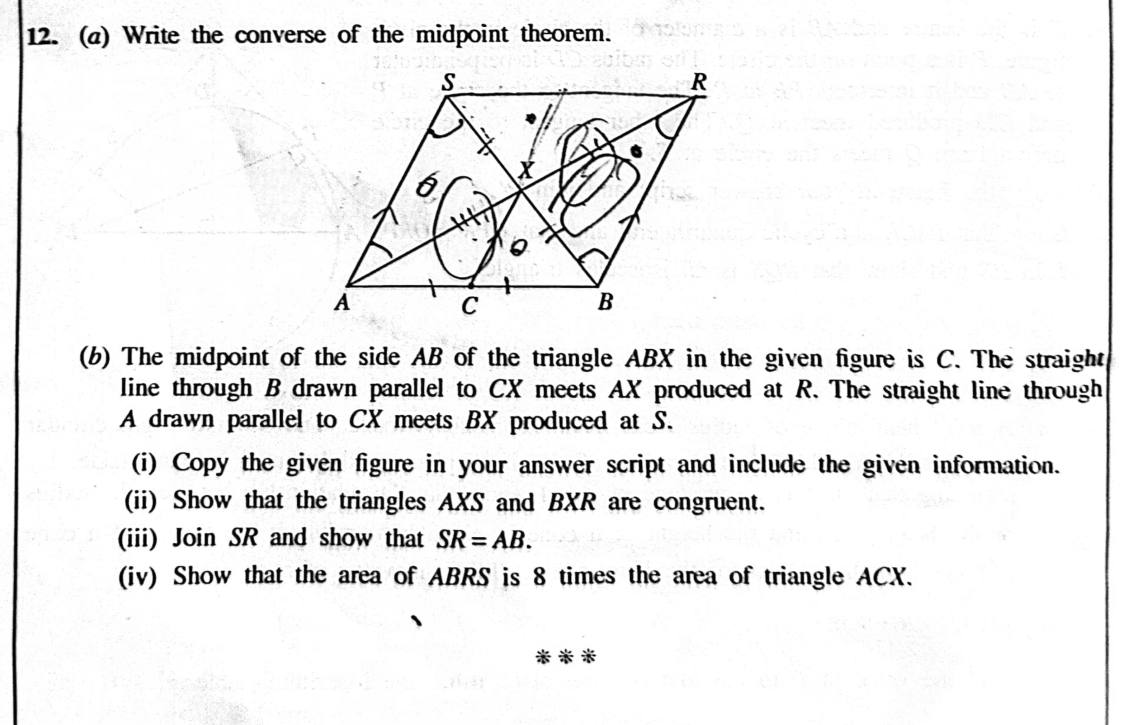
Converse of midpoint theorem, congruency, parallelogram and area ratio

Paper II Part B Q12: Converse of midpoint theorem, congruency, parallelogram and area ratio🔒 Answer & steps: try it free in Gedara Sir→

Paper II Part B Q11 · 10 marks

Congruency · Parallelograms II · Area of Plane Figures between Parallel Lines

G.C.E. O/L 2022

🔁 Asked in 11 of 16 O/L papers

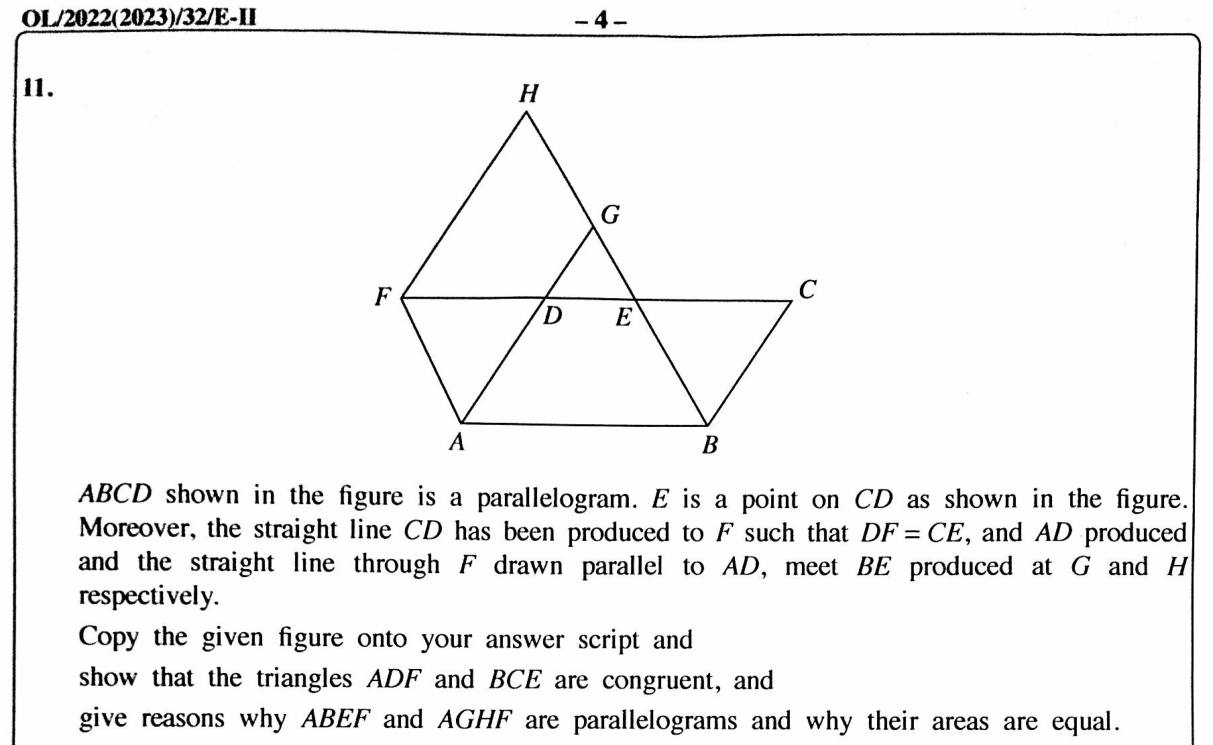
Parallelogram extension: congruent triangles, two parallelograms, equal areas

Paper II Part B Q11: Parallelogram extension: congruent triangles, two parallelograms, equal areas🔒 Answer & steps: try it free in Gedara Sir→

More Grade 10 notes