Short notes › Grade 11 · සිංහලෙන්

Grade 11 Constructions: Short Notes

11 ශ්‍රේණිය · 23 පරිච්ඡේදය · නිර්මාණ

48%

of Grade 11 term tests include it (29 of 61)

290

marks in past papers (29 questions)

11 min

full lesson with quick checks

🎯 What you'll learn

  • Use the perpendicular bisector and angle bisector as loci to place a centre
  • Construct the circumcircle, incircle and an excircle of a triangle
  • Construct the tangent at a point on a circle
  • Construct the two tangents from an external point and give the reason
  • Construct a circle that touches a line at a given point and passes through another point

The biggest round flower bed

A town council in Matale has a triangular traffic island and wants the biggest round flower bed that touches all three edges. Where does the centre go, and how wide can it be? No guessing allowed: just a straight edge, a pair of compasses and today's constructions.

Two loci do all the work

• Points equidistant from two points A and B lie on the perpendicular bisector of AB.• Points equidistant from two lines lie on the bisector of the angle between them.A centre must satisfy two conditions, so construct two loci and take the point where they meet.Use only a straight edge and compasses, and leave your construction arcs visible.

Circumcircle: through all three vertices

The circumcircle passes through A, B and C.Its centre is equally far from A, B and C, so it lies on the perpendicular bisectors of the sides.1. Construct the perpendicular bisectors of two sides.2. They meet at O, the circumcentre.3. Draw the circle with centre O and radius OA.For a right-angled triangle, O is the midpoint of the hypotenuse.

Circumcircle

The dashed amber lines are perpendicular bisectors of AB and BC. They cross at O, and OB is the radius.
ABCO

✏️ A right-angled triangle

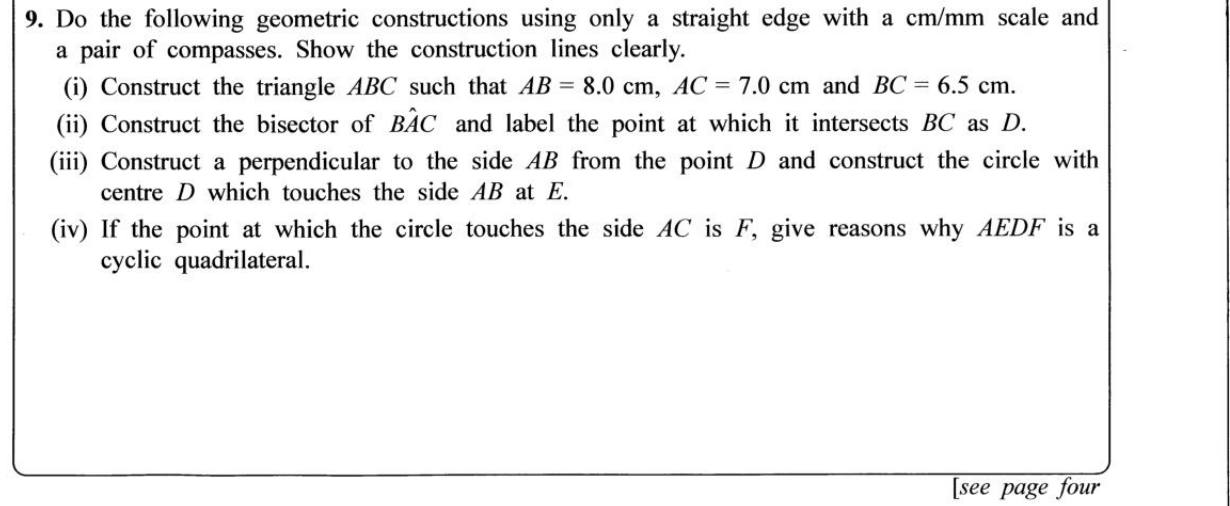
Construct △ABC with AB = 6 cm, BC = 8 cm and AC = 10 cm, then its circumcircle. Find the radius without measuring.
  1. 1Draw AC = 10 cm. Arcs of 6 cm from A and 8 cm from C meet at B.
  2. 2Construct the perpendicular bisectors of AB and BC. They meet at O.
  3. 36² + 8² = 100 = 10², so ∠ABC = 90° and AC is the hypotenuse.
  4. 4O is the midpoint of AC, so the radius = 10 ÷ 2 = 5 cm.

✅ 5 cm

Incircle: touching all three sides

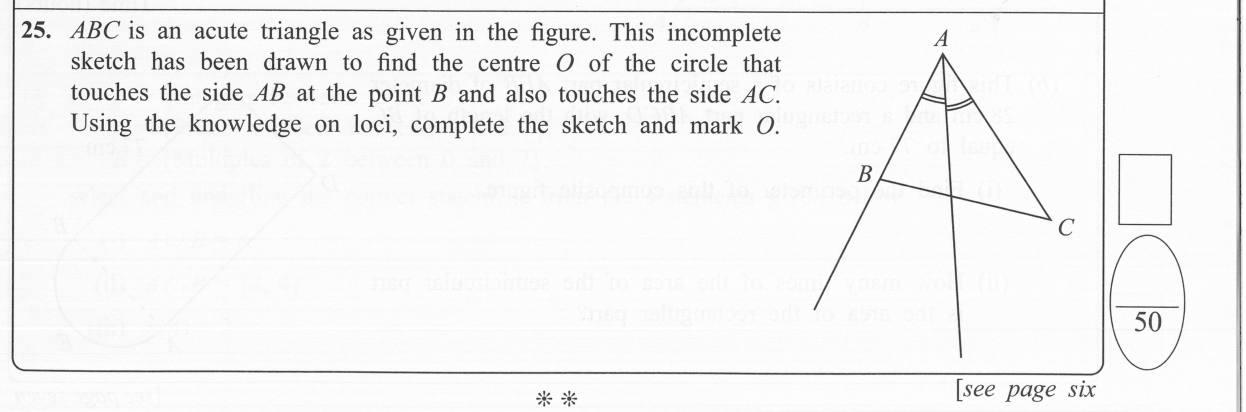
The incircle lies inside the triangle and touches all three sides: the flower bed!Its centre is equally far from the sides (lines), so it lies on the angle bisectors.1. Bisect two angles; they meet at I, the incentre.2. Construct the perpendicular from I to one side, meeting it at N.3. Radius = IN. Draw the circle.

Incircle

Bisectors of ∠A and ∠B meet at I. The perpendicular IN gives the exact radius.
ABCIN

Excircle: outside the triangle

An excircle touches one side, say BC, and the other two sides produced.1. Produce AB and AC beyond B and C.2. Bisect the two exterior angles at B and C. They meet at the centre E.3. Drop a perpendicular from E to BC (or a produced side) for the radius.Every triangle has three excircles, one opposite each vertex.

⚠️ Bisectors mixed up, radius guessed

Examiners keep seeing:• An angle bisector used when the question says 'equidistant from two points' (it should be a perpendicular bisector), and vice versa.• The incircle radius found by trial. Construct the perpendicular from the centre to a side.• A protractor used. Only straight edge and compasses are allowed.

Tangent at a point on the circle

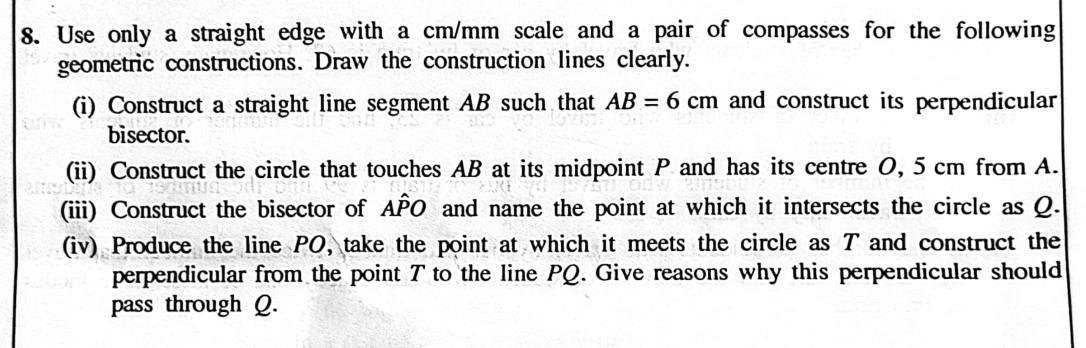
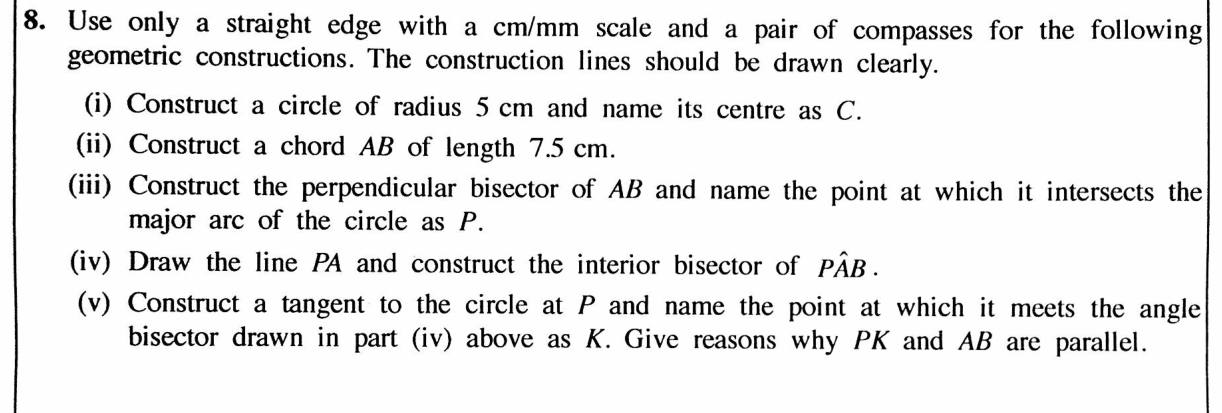
A tangent is perpendicular to the radius at the point of contact.To draw the tangent at T:1. Join OT and produce it beyond T.2. Construct the perpendicular to OT at T.That line touches the circle only at T.

✏️ Tangents from an external point

A circle has centre O and radius 5 cm. P is 13 cm from O. Construct the tangents from P and find their length.
OPMT₁T₂
  1. 1Join OP. Construct its perpendicular bisector to find the midpoint M.
  2. 2Draw the circle with centre M and radius MO. It cuts the given circle at T₁ and T₂.
  3. 3Join PT₁ and PT₂: these are the tangents.
  4. 4Reason: ∠OT₁P is an angle in a semicircle, so it is 90°. PT₁ is perpendicular to the radius.
  5. 5PT₁² = 13² − 5² = 144, so PT₁ = PT₂ = 12 cm.

✅ 12 cm

⚠️ Don't draw tangents by eye

The most repeated O/L slip in this chapter: students can't construct tangents from an external point, so they slide a ruler until it 'just touches'. That earns no construction marks. Always bisect OP, draw the circle on OP as diameter, and state the reason: the angle in a semicircle is 90°.

📌 Remember

• Equidistant from two points → perpendicular bisector. From two lines → angle bisector.• Circumcircle: perpendicular bisectors of sides. Incircle: angle bisectors, radius by a perpendicular.• Excircle: bisectors of two exterior angles.• Tangent ⊥ radius at the point of contact.• Tangents from P: circle on OP as diameter; angle in a semicircle = 90°.

🧾 Quick revision sheet

Locus of points equidistant from two points A and BThe perpendicular bisector of AB.
Locus of points equidistant from two intersecting linesThe bisector of the angle between the lines.
Centre of the circumcircleWhere the perpendicular bisectors of the sides meet.
Centre of the incircleWhere the interior angle bisectors meet.
Angle between a tangent and the radius at the point of contact90°
Key step for tangents from an external point PBisect OP and draw the circle with OP as diameter.
Centre of an excircleWhere the bisectors of two exterior angles meet.

Now test yourself: 4 quick checks and 1 more worked examples

The full lesson checks your answers as you go, and Gedara Sir tracks which parts you've got.

Past paper questions on Constructions

More Grade 11 notes