Short notes › Grade 11 · සිංහලෙන්

Grade 11 Probability: Short Notes

11 ශ්‍රේණිය · 25 පරිච්ඡේදය · සම්භාවිතාව

49%

of Grade 11 term tests include it (30 of 61)

308

marks in past papers (32 questions)

12 min

full lesson with quick checks

🎯 What you'll learn

  • Use P(A′) = 1 − P(A) and the rules for mutually exclusive and independent events
  • Find probabilities from a Venn diagram
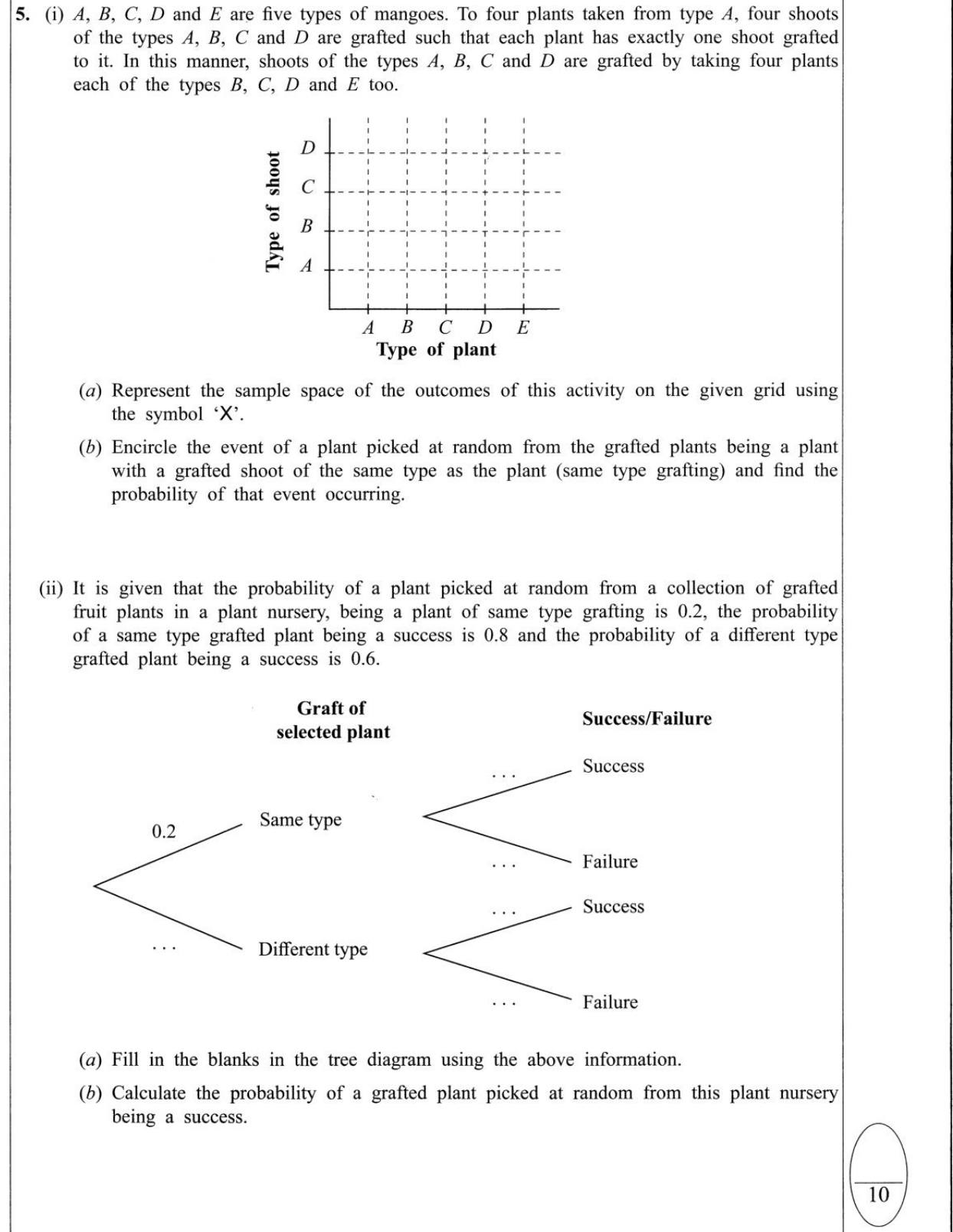
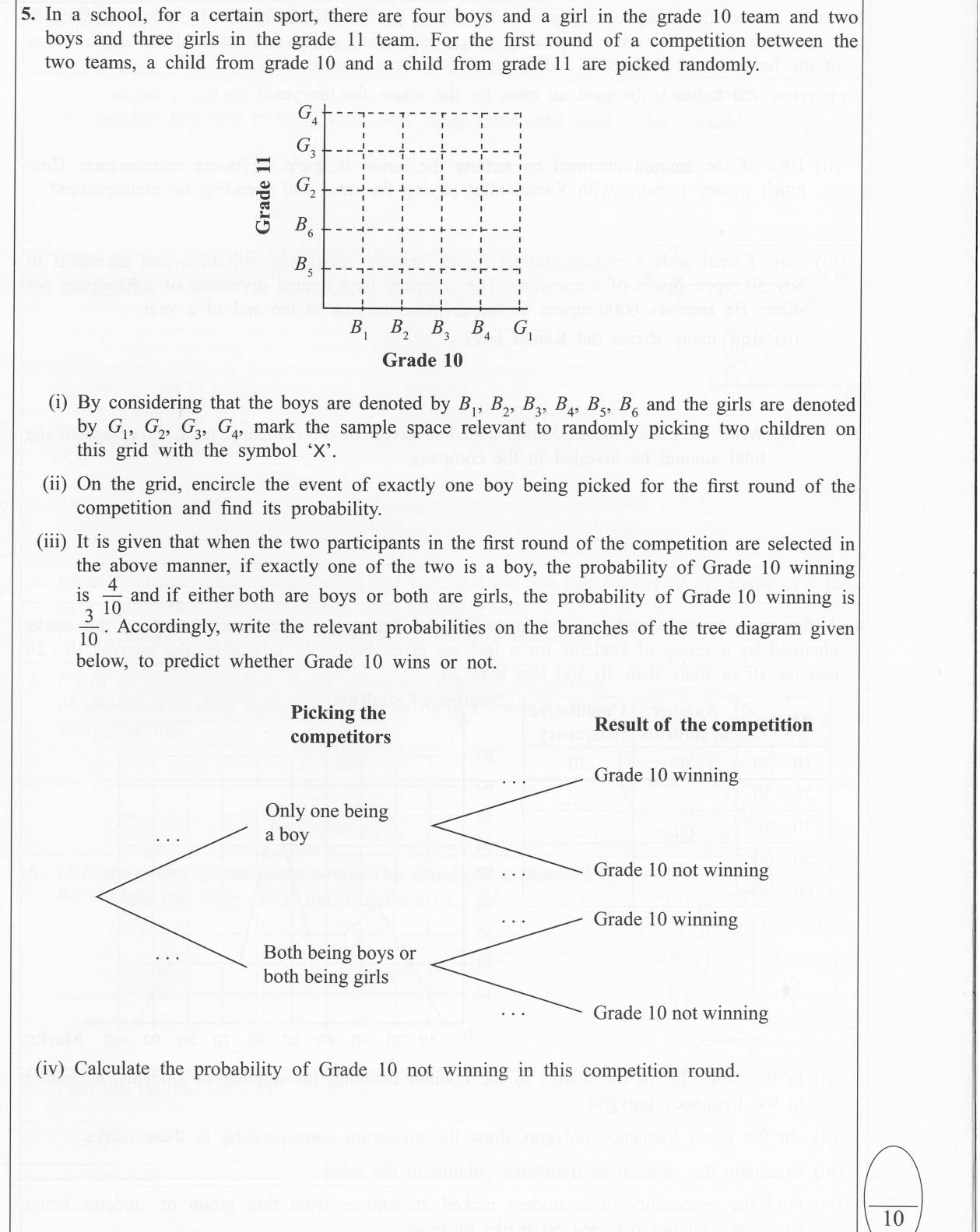
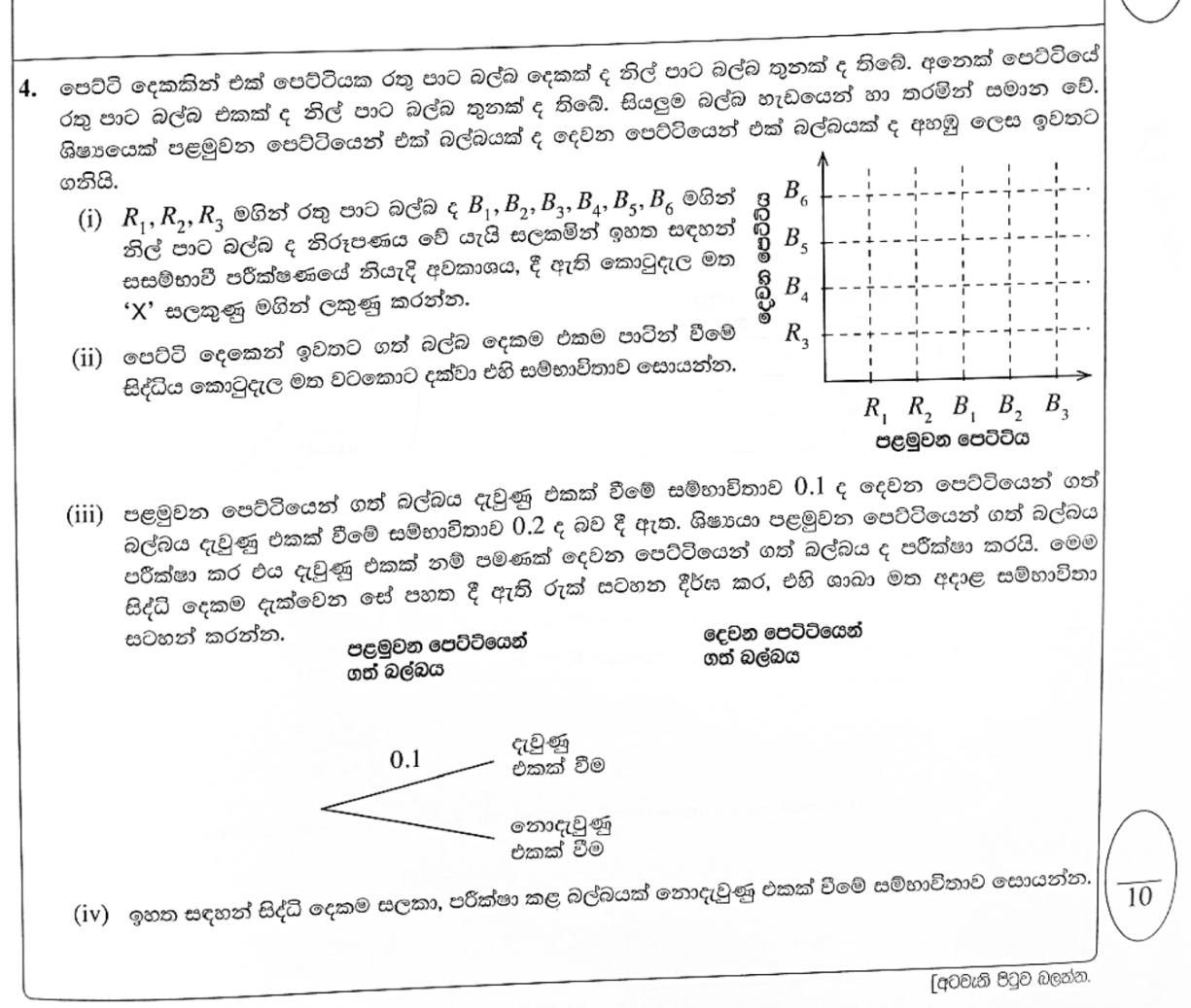
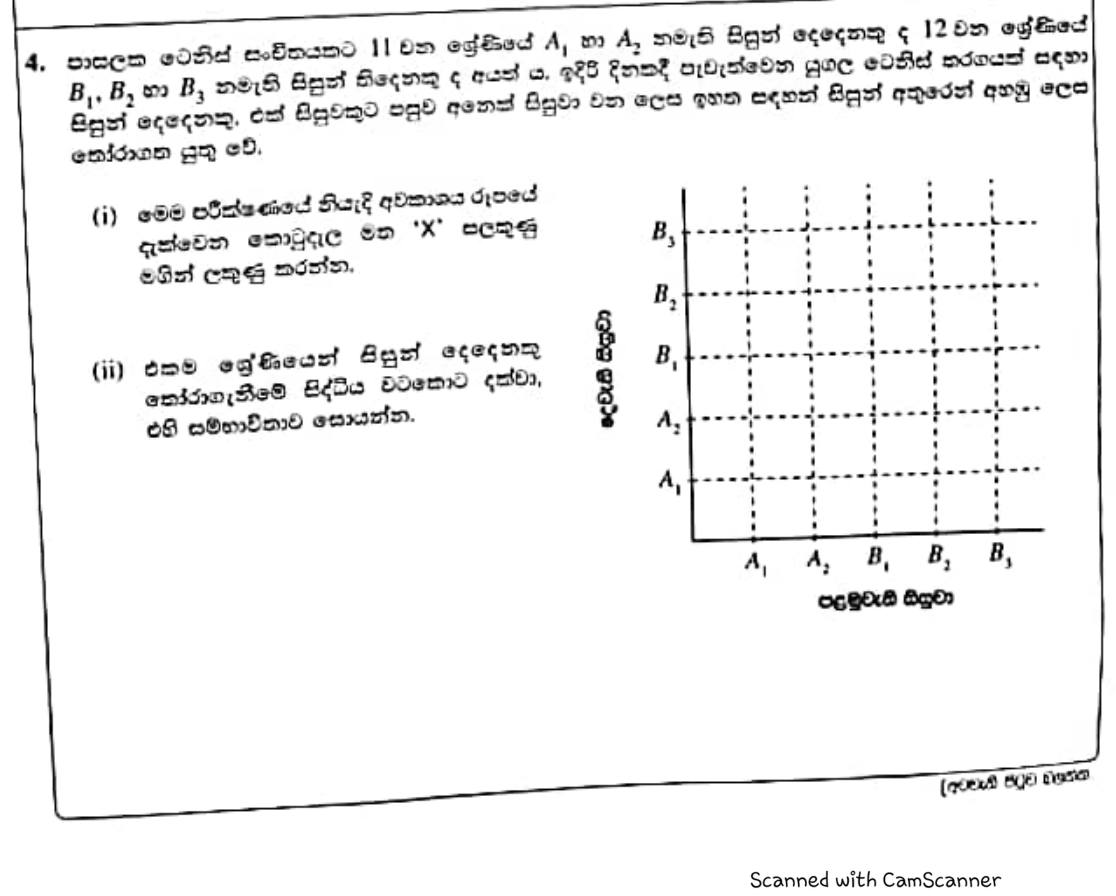
  • Show a sample space on a grid and enclose an event
  • Handle draws with and without replacement
  • Draw and use tree diagrams: multiply along branches, add separate paths

Dry and on time?

It's July in Kandy. There's a 30% chance of rain this afternoon, and the tuition bus is late one day in five. What is the chance that you get rained on and the bus is late? A simple diagram turns this guesswork into an exact number.

The basics

For equally likely outcomes:P(A) = number of outcomes in A ÷ total number of outcomes• 0 ≤ P(A) ≤ 1• Complement: P(A′) = 1 − P(A) ('A does not happen')• Mutually exclusive events cannot happen together: P(A ∩ B) = 0, so P(A ∪ B) = P(A) + P(B).• In general: P(A ∪ B) = P(A) + P(B) − P(A ∩ B).

⚠️ Mutually exclusive means 'no overlap'

This is one of the lowest-scoring ideas in O/L papers (only about 1 in 4 got it). If A and B are mutually exclusive, P(A ∩ B) = 0; just add. And when the question says not or neither, finish with 1 − ...; underline 'not' when you read it.

A sample space on a grid

Roll two dice. Across: the first die; up: the second die. Each dot is one outcome, so there are 6 × 6 = 36 equally likely outcomes. To show an event, enclose its dots in one closed curve. Here the ringed dots are 'the total is 9'.
112233445566

✏️ Reading the grid

Two fair dice are rolled. Find (i) P(the total is 9) (ii) P(both dice show the same number).
  1. 1Total 9: (3, 6), (4, 5), (5, 4), (6, 3), which is 4 outcomes.
  2. 2(i) P = 4/36 = 1/9
  3. 3Same number: the diagonal (1, 1), (2, 2) … (6, 6), which is 6 outcomes.
  4. 4(ii) P = 6/36 = 1/6

✅ (i) 1/9 (ii) 1/6

✏️ Without replacement

A bag has 2 red marbles (R₁, R₂) and 1 blue marble (B). Two are taken out one after the other, without replacement. Find P(both red).
  1. 1On a 3 × 3 grid, cross out the diagonal (R₁, R₁), (R₂, R₂), (B, B): the same marble can't be taken twice.
  2. 2That leaves 9 − 3 = 6 outcomes.
  3. 3Both red: (R₁, R₂) and (R₂, R₁), which is 2 outcomes.
  4. 4P(both red) = 2/6 = 1/3

✅ 1/3

⚠️ Grid slips

Examiners see two grid mistakes again and again:1. Not deciding first whether it is with or without replacement. Without replacement, the diagonal is not possible.2. Ticking the event's points one by one. Mark the event by enclosing all its points in one closed curve.

Tree diagrams

A tree diagram shows events that happen in stages.• Write the probability on each branch. Branches from one point add up to 1.• Multiply along a path to get 'this and then that'.• Add the results of different paths to get 'either path'.If the events are independent, the second-stage branches are the same on every path.

⚠️ Tree diagram traps

• Adding along a path instead of multiplying.• Forgetting to add the separate paths for 'one of each'.• Without replacement, keeping the old denominator (2/5 instead of 2/4).• Drawing more branches after a path has ended (e.g. after 'not selected', nothing more happens).

📌 Remember

• P(A′) = 1 − P(A); watch for 'not' and 'neither'.• Mutually exclusive: P(A ∩ B) = 0, so add. Independent: multiply.• Grid: one dot per outcome; enclose the event in one closed curve.• Without replacement: no diagonal on the grid; denominators drop on the tree.• Tree: multiply along a path, add separate paths; each fork adds to 1.

🧾 Quick revision sheet

P(A′) = ?1 − P(A)
Mutually exclusive eventsCannot happen together: P(A ∩ B) = 0 and P(A ∪ B) = P(A) + P(B)
Independent eventsOne does not affect the other: P(A ∩ B) = P(A) × P(B)
Number of outcomes when two dice are rolled6 × 6 = 36
General addition ruleP(A ∪ B) = P(A) + P(B) − P(A ∩ B)
Tree diagram: 'and' along a path?Multiply the branch probabilities
Tree diagram: several paths?Add the results of the paths

Now test yourself: 5 quick checks and 2 more worked examples

The full lesson checks your answers as you go, and Gedara Sir tracks which parts you've got.

Past paper questions on Probability

More Grade 11 notes