Short notes › Grade 9 · සිංහලෙන්

Grade 9 Factors of Algebraic Expressions: Short Notes

9 ශ්‍රේණිය · 7 පරිච්ඡේදය · වීජීය ප්‍රකාශනවල සාධක

98%

of Grade 9 term tests include it (39 of 40)

333

marks in past papers (76 questions)

11 min

full lesson with quick checks

🎯 What you'll learn

  • Factorise by taking out the highest common factor
  • Factorise four-term expressions by grouping
  • Factorise trinomials of the form x² + bx + c
  • Factorise a difference of two squares and use it in arithmetic
  • Factorise completely by combining methods

Packing it neatly

At a Pettah wholesale shop, 6 boxes of 12 soap bars plus 6 boxes of 8 is the same as 6 boxes of 20: 6 × 12 + 6 × 8 = 6 × (12 + 8). Pulling out what is shared and putting the rest in a bracket makes sums shorter. In algebra this is called factorising.

What factorising means

Expanding turns a product into a sum: 3(x + 2) = 3x + 6.Factorising does the opposite: it writes a sum as a product of factors.3x + 6 = 3(x + 2)You can always check a factorisation by expanding it back.

✏️ Take out the HCF

Factorise 6x² + 9x.
  1. 1Numbers: the HCF of 6 and 9 is 3.
  2. 2Letters: both terms contain x, so the HCF is 3x.
  3. 3Divide each term by 3x: 6x² ÷ 3x = 2x, 9x ÷ 3x = 3.
  4. 46x² + 9x = 3x(2x + 3)

✅ 3x(2x + 3)

Four terms: group in pairs

When four terms have no common factor, group them in pairs.xy − 2x + 5y − 10= x(y − 2) + 5(y − 2)Now (y − 2) is a common factor of both parts:= (y − 2)(x + 5)The two brackets must match before you can take them out.

⚠️ Watch the sign in the second pair

Examiners note students who can't finish grouping. In −4q + 12, taking out +4 gives 4(−q + 3), which doesn't match (q − 3). Take out −4 instead: −4(q − 3). If the brackets still differ, try swapping the middle terms.

A trinomial as a rectangle

x² + 7x + 12 is the area of an (x + 3) by (x + 4) rectangle. The two strips 3x + 4x give 7x, and the corner 3 × 4 = 12.
x4x3x²4x3x12

Factorising x² + bx + c

Find two numbers that multiply to c and add to b.x² + 7x + 12: 3 × 4 = 12, 3 + 4 = 7.Split the middle term: x² + 3x + 4x + 12= x(x + 3) + 4(x + 3) = (x + 3)(x + 4).If c is negative, the two numbers have opposite signs.

✏️ With a negative constant

Factorise x² − 2x − 15.
  1. 1Need product −15 and sum −2.
  2. 2Try pairs: −5 × 3 = −15 and −5 + 3 = −2 ✓
  3. 3x² − 5x + 3x − 15 = x(x − 5) + 3(x − 5)
  4. 4= (x − 5)(x + 3)

✅ (x − 5)(x + 3)

🧮 Difference of two squares

Use it when an expression is one perfect square minus another. Know your squares: 49 = 7², 9a² = (3a)², 25b² = (5b)².

a² − b² = (a + b)(a − b)

⚠️ Common factor first

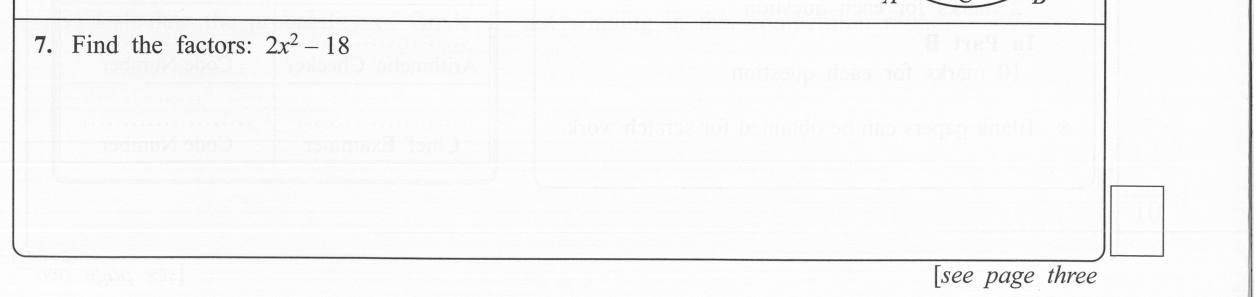
In real papers students take the 2 out of 2x² − 18 and stop at 2(x² − 9), or try squares on 2x² − 18 directly. Always: 1. take out the HCF, 2. look inside the bracket for a square difference or a trinomial.2x² − 18 = 2(x² − 9) = 2(x + 3)(x − 3).

📌 Remember

• Factorising writes a sum as a product; check by expanding.• Always take out the HCF first.• Four terms: group in pairs until the brackets match.• x² + bx + c: two numbers with product c and sum b.• a² − b² = (a + b)(a − b).

🧾 Quick revision sheet

First step in any factorisationTake out the highest common factor (HCF).
a² − b²(a + b)(a − b)
x² + bx + c: which two numbers?Product c, sum b.
Factorise x² + 7x + 12(x + 3)(x + 4)
Factorise ax + ay + bx + by(x + y)(a + b)
If c is negative in x² + bx + c…the two numbers have opposite signs.
How do you check a factorisation?Expand the brackets; you should get the original expression.

Now test yourself: 5 quick checks and 2 more worked examples

The full lesson checks your answers as you go, and Gedara Sir tracks which parts you've got.

Past paper questions on Factors of Algebraic Expressions

More Grade 9 notes