Short notes › Grade 9 · සිංහලෙන්

Grade 9 Direct Proportion: Short Notes

9 ශ්‍රේණිය · 10 පරිච්ඡේදය · අනුලෝම සමානුපාත

55%

of Grade 9 term tests include it (22 of 40)

149

marks in past papers (33 questions)

9 min

full lesson with quick checks

🎯 What you'll learn

  • Tell a ratio from a proportion, and spot when two quantities are directly proportional
  • Solve direct proportion problems by the unitary method
  • Solve them using equal ratios a : b = c : d
  • Convert between rupees and foreign currencies
  • Write a direct proportion as y = kx and use it

Kavum for the whole family

It's Avurudu. Achchi's recipe makes 20 kavum with 500 g of rice flour, but this year 50 people are coming. How much flour? And your cousin in Dubai is sending dirhams: how many rupees is that? Both questions are direct proportion.

Ratio or proportion?

A ratio compares two quantities of the same kind: Nimal is 10 and Kamal is 15, so their ages are 10 : 15 = 2 : 3.A proportion links quantities of different kinds: 3 pens cost Rs. 60.Two quantities are in direct proportion when one is multiplied by a number and the other is multiplied by the same number. Double the pens, double the cost.

Data pack: Rs. 40 per GB

x is the number of GB and y is the cost in rupees. y ÷ x is always 40, and the points lie on a straight line through 0. That is the picture of direct proportion.
140280312041600xyy = 40x

✏️ Unitary method: find one first

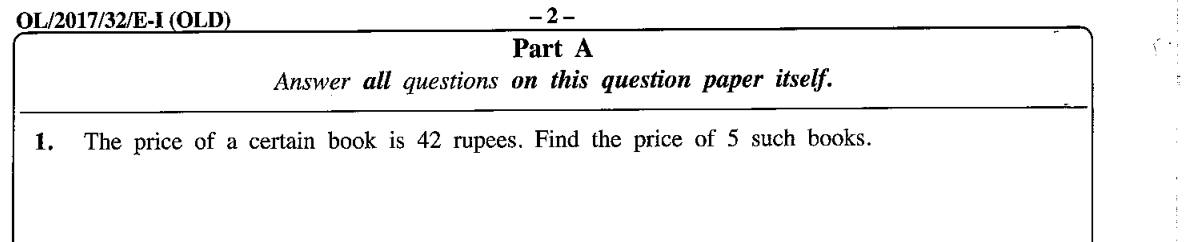
5 exercise books cost Rs. 450. Find the cost of 8 books.
  1. 1Cost of 1 book = 450 ÷ 5 = Rs. 90
  2. 2Cost of 8 books = 90 × 8 = Rs. 720

✅ Rs. 720

🧮 Equal ratios

In a direct proportion the ratio of matching values stays the same. Write the three values you know, put the unknown as x, and solve.

x₁ : y₁ = x₂ : y₂ ⇔ x₁/y₁ = x₂/y₂

✏️ Achchi's kavum

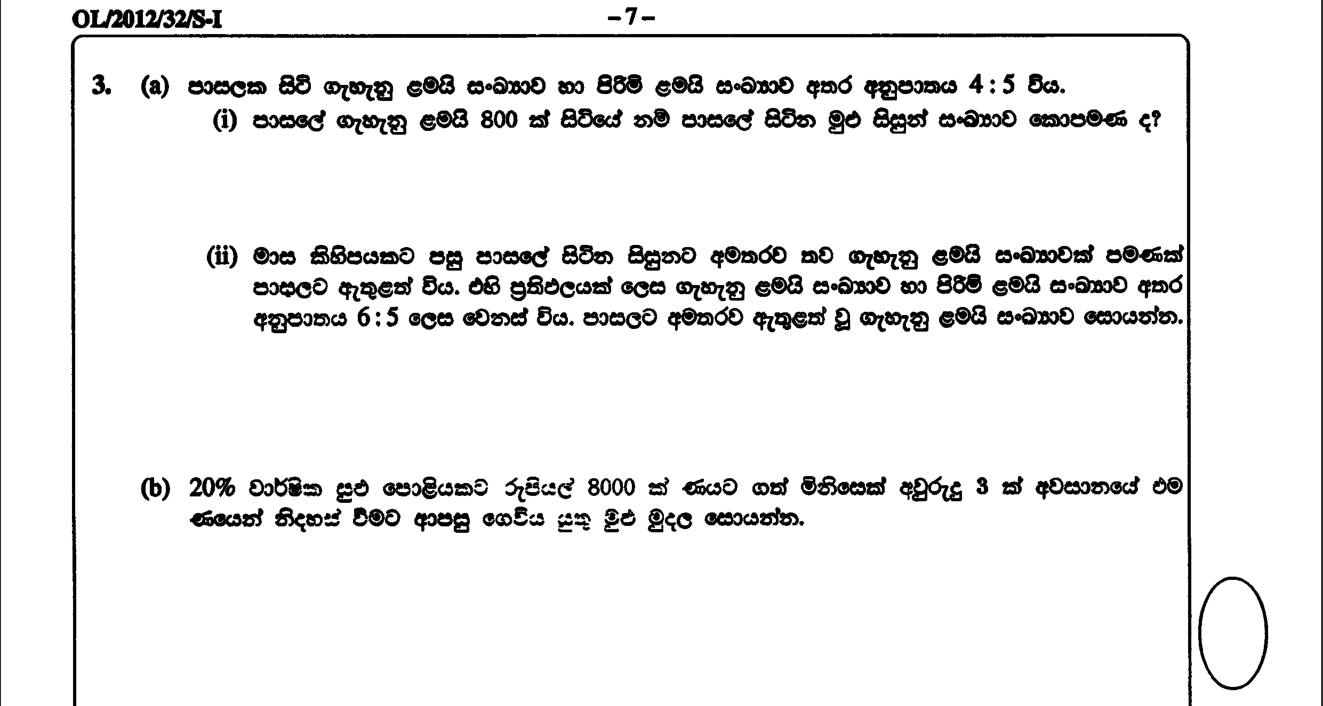
20 kavum need 500 g of rice flour. How much flour is needed for 50 kavum?
  1. 1Let the flour needed be x g. Kavum : flour stays the same.
  2. 220 : 500 = 50 : x, so 20/500 = 50/x
  3. 320x = 500 × 50 = 25 000, so x = 1 250
  4. 4Flour needed = 1 250 g = 1.25 kg

✅ 1.25 kg

⚠️ Units and upside-down ratios

O/L examiners have refused answers like '720' when the question wanted Rs. 720. Always write the unit.Also keep the same order on both sides: if you write books : rupees on the left, write books : rupees on the right. 5 : 450 = 8 : x is right; 5 : 450 = x : 8 is not.

Foreign currency

Money in rupees and in another currency are directly proportional. The exchange rate tells you the value of one unit.If 1 US$ = Rs. 300:• dollars → rupees: multiply by 300• rupees → dollars: divide by 300Ask yourself: should the number get bigger or smaller?

The algebra: y = kx

If y is directly proportional to x, we write y ∝ x.Then y = kx, where k is a constant: the value of y when x = 1.For the data pack, k = 40, so y = 40x.Find k from one known pair: k = y ÷ x. Then use y = kx for any other value.

⚠️ Not everything that grows is direct

'Both go up' is not enough. Check that the ratio stays the same: y ÷ x must be the same number every time.Also watch out for a part of the whole: if 2/3 of a tank fills in 12 minutes, work out 1/3 first (6 minutes), then the whole tank. Examiners say many students skip this unitary step.

📌 Remember

• Direct proportion: multiply one quantity by a number and the other is multiplied by the same number.• Unitary method: find the value of one, then multiply.• Equal ratios: x₁ : y₁ = x₂ : y₂, same order on both sides.• Currency: to rupees multiply by the rate; from rupees divide.• y ∝ x means y = kx; find k = y ÷ x. Always write the unit.

🧾 Quick revision sheet

Ratio vs proportionRatio: same kind of quantity (age : age). Proportion: different kinds (pens and rupees).
When are two quantities directly proportional?When one is multiplied by a number, the other is multiplied by the same number; y ÷ x stays constant.
The unitary methodFind the value for one unit, then multiply by the number of units you need.
y ∝ x in algebray = kx, where k is a constant (k = y ÷ x).
1 US$ = Rs. 300. Change Rs. 6 000 to dollars.6 000 ÷ 300 = 20 dollars
Graph of a direct proportionA straight line through the origin (0, 0).

Now test yourself: 5 quick checks and 2 more worked examples

The full lesson checks your answers as you go, and Gedara Sir tracks which parts you've got.

Past paper questions on Direct Proportion

More Grade 9 notes