Short notes › Grade 9 · සිංහලෙන්

Grade 9 Indices: Short Notes

9 ශ්‍රේණිය · 12 පරිච්ඡේදය · දර්ශක

70%

of Grade 9 term tests include it (28 of 40)

134

marks in past papers (40 questions)

10 min

full lesson with quick checks

🎯 What you'll learn

  • Name the base and index of a power and find its value
  • Multiply and divide powers with the same base
  • Find a power of a power, of a product and of a quotient
  • Use the zero index and negative indices
  • Simplify expressions and give the answer with a positive index

The Avurudu forward

You send an Avurudu greeting to 5 friends. Each of them forwards it to 5 more, and so on. In the 4th round, 5 × 5 × 5 × 5 = 625 new people get it. Writing 5⁴ instead is shorter, and with a few simple laws you can work with powers like this in seconds.

Base and index

2⁵ means 2 × 2 × 2 × 2 × 2 = 32.2 is the base, 5 is the index, and 2⁵ is a power of 2.Watch the brackets:(−3)² = (−3) × (−3) = 9−3² = −(3 × 3) = −9(−2)³ = −8 (an odd index keeps the minus sign)

Multiplying and dividing

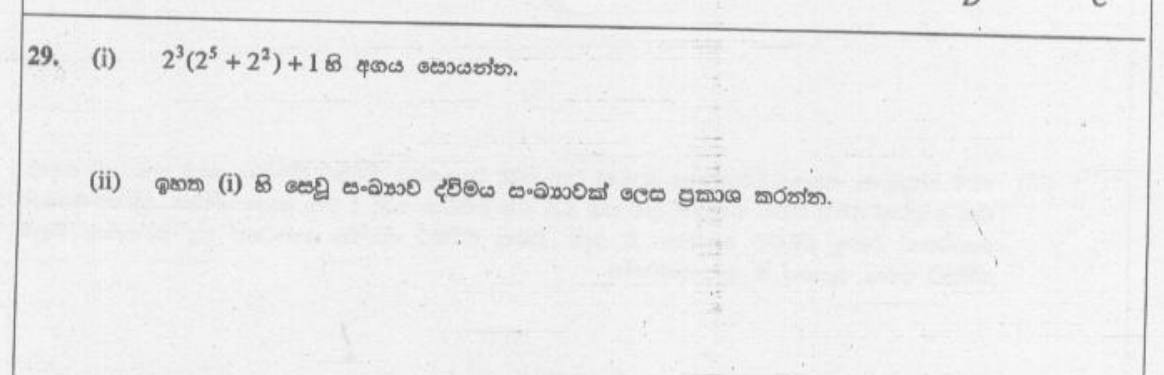
Same base? Then:Multiply → add the indices: aᵐ × aⁿ = aᵐ⁺ⁿWhy: 2³ × 2² = (2 × 2 × 2) × (2 × 2) = 2⁵Divide → subtract the indices: aᵐ ÷ aⁿ = aᵐ⁻ⁿWhy: 2⁵ ÷ 2² = (2 × 2 × 2 × 2 × 2)/(2 × 2) = 2³Numbers in front (coefficients) are multiplied or divided as usual.

✏️ Using the first two laws

Simplify (i) 3x² × 4x⁵ (ii) 12a⁶b⁴ ÷ 4a²b
  1. 1(i) Numbers: 3 × 4 = 12. Powers of x: x²⁺⁵ = x⁷. Answer 12x⁷.
  2. 2(ii) Numbers: 12 ÷ 4 = 3.
  3. 3a⁶⁻² = a⁴ and b⁴⁻¹ = b³ (b means b¹).
  4. 4Answer 3a⁴b³.

✅ (i) 12x⁷ (ii) 3a⁴b³

Powers of powers, products and quotients

Power of a power → multiply the indices: (aᵐ)ⁿ = aᵐⁿWhy: (x²)³ = x² × x² × x² = x⁶Power of a product: (ab)ⁿ = aⁿbⁿ, so every factor inside gets the index.Power of a quotient: (a/b)ⁿ = aⁿ/bⁿ

✏️ Brackets with an index

Simplify (i) (x³)⁴ (ii) (2a²)³ (iii) (3x/y²)²
  1. 1(i) (x³)⁴ = x¹² (3 × 4 = 12)
  2. 2(ii) (2a²)³ = 2³ × (a²)³ = 8a⁶
  3. 3(iii) (3x)² = 9x² on top and (y²)² = y⁴ below, giving 9x²/y⁴.

✅ (i) x¹² (ii) 8a⁶ (iii) 9x²/y⁴

⚠️ Add or multiply?

Examiners often see (x²)³ written as x⁵. That adds the indices, but a power of a power multiplies them: x⁶.Another common slip: (2a²)³ = 2a⁶. The 2 is inside the bracket too, so it must be cubed: 8a⁶.Tip: x² × x³ = x⁵ (add), but (x²)³ = x⁶ (multiply).

The zero index

Divide a power by itself: a³ ÷ a³ = a³⁻³ = a⁰.But anything divided by itself is 1. So:a⁰ = 1 (for any a ≠ 0)7⁰ = 1, x⁰ = 1, (25ab)⁰ = 1Careful: 3x⁰ = 3 × 1 = 3, but (3x)⁰ = 1.

Negative indices

a² ÷ a⁵ = a²⁻⁵ = a⁻³. Cancelling also gives (a × a)/(a × a × a × a × a) = 1/a³.So a negative index means 'one over':a⁻ⁿ = 1/aⁿ and 1/a⁻ⁿ = aⁿ2⁻³ = 1/2³ = 1/8(2/3)⁻² = (3/2)² = 9/4'Positive index form': 5x⁻² = 5/x²

⚠️ Minus signs that aren't there

2⁻³ is not −8 and not −6. It is 1/8, a small positive number.And x⁰ is 1, not 0.In past papers, students multiplying (a⁻²)³ wrote a⁶ instead of a⁻⁶: keep track of the sign of every index, (−2) × 3 = −6.

📌 Remember

• Same base: multiply → add indices; divide → subtract indices.• (aᵐ)ⁿ = aᵐⁿ; (ab)ⁿ = aⁿbⁿ; (a/b)ⁿ = aⁿ/bⁿ.• a⁰ = 1.• a⁻ⁿ = 1/aⁿ: a negative index means 'one over', not a negative number.• To combine numbers like 9 × 3⁵, first write them with the same base.

🧾 Quick revision sheet

aᵐ × aⁿ = ?aᵐ⁺ⁿ (add the indices)
aᵐ ÷ aⁿ = ?aᵐ⁻ⁿ (subtract the indices)
(aᵐ)ⁿ = ?aᵐⁿ (multiply the indices)
(ab)ⁿ = ?aⁿbⁿ
a⁰ = ?1 (when a ≠ 0)
a⁻ⁿ = ?1/aⁿ
In 2⁵, which is the base and which is the index?Base 2, index 5

Now test yourself: 5 quick checks and 2 more worked examples

The full lesson checks your answers as you go, and Gedara Sir tracks which parts you've got.

Past paper questions on Indices

More Grade 9 notes