Short notes › Grade 9 · සිංහලෙන්

Grade 9 Graphs: Short Notes

9 ශ්‍රේණිය · 20 පරිච්ඡේදය · ප්‍රස්තාර

68%

of Grade 9 term tests include it (27 of 40)

313

marks in past papers (41 questions)

10 min

full lesson with quick checks

🎯 What you'll learn

  • Plot points and draw the graph of y = mx + c from a table of values
  • Read the gradient and intercept from an equation or a graph
  • Find the gradient from two points and write the line's equation
  • Use parallel lines, lines through the origin, and lines x = a and y = b

Filling the school tank

A water tank at a Polonnaruwa school already holds 20 litres, and a pipe adds 5 litres every minute. After x minutes it holds y = 5x + 20 litres. Draw this and you get a perfectly straight line, and its steepness and starting point can be read straight from the equation.

Coordinates: across, then up

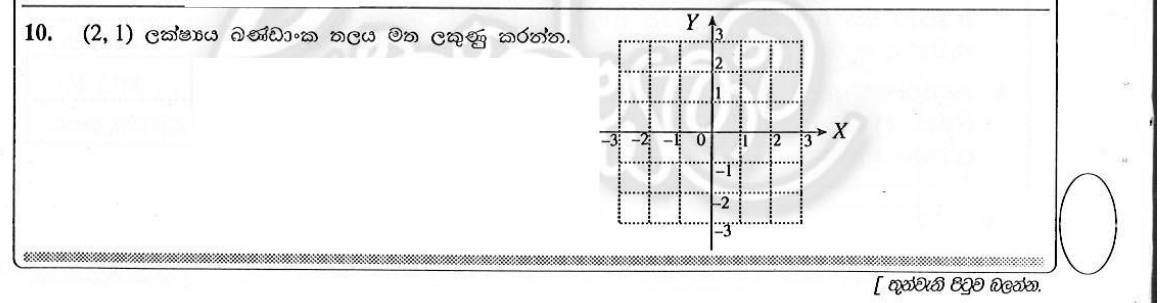
A point is written (x, y). The x-coordinate comes first: move along the x-axis, then up or down for y.• (3, −2): 3 right, 2 down• (−2, 3): 2 left, 3 upThese are different points. Right and up are positive; left and down are negative.

From a table to a line

For y = 2x − 1, choose some x values and work out y:x: −1, 0, 1, 2, 3y: −3, −1, 1, 3, 5Plot the points (−1, −3), (0, −1), (1, 1), (2, 3), (3, 5). They lie on one straight line. Any equation of the form y = mx + c gives a straight-line graph.

Reading y = 2x − 1

The line crosses the y-axis at (0, −1). For every 1 step right, it goes 2 steps up (amber triangle).
xy−2−11234−4−3−2−1123456021(0, −1)

Gradient and intercept

In y = mx + c:• m is the gradient: how much y changes when x increases by 1. Gradient = vertical change ÷ horizontal change. Positive m slopes up to the right; negative m slopes down.• c is the intercept: where the line cuts the y-axis, at the point (0, c).For y = 2x − 1: gradient 2, intercept −1.

✏️ Read m and c

Write the gradient and intercept of (i) y = −3x + 4 (ii) 2y = 4x + 6
  1. 1(i) Already y = mx + c: m = −3, c = 4.
  2. 2(ii) y must stand alone first. Divide by 2: y = 2x + 3.
  3. 3So m = 2, c = 3 (not 4 and 6).

✅ (i) m = −3, c = 4 (ii) m = 2, c = 3

✏️ Gradient from two points

A line passes through (1, 3) and (4, 9), and cuts the y-axis at (0, 1). Find its gradient and its equation.
  1. 1Vertical change: 9 − 3 = 6. Horizontal change: 4 − 1 = 3.
  2. 2Gradient m = 6 ÷ 3 = 2.
  3. 3Intercept c = 1, so y = 2x + 1.
  4. 4Check with (4, 9): 2 × 4 + 1 = 9 ✓

✅ m = 2; y = 2x + 1

Parallel lines and the origin

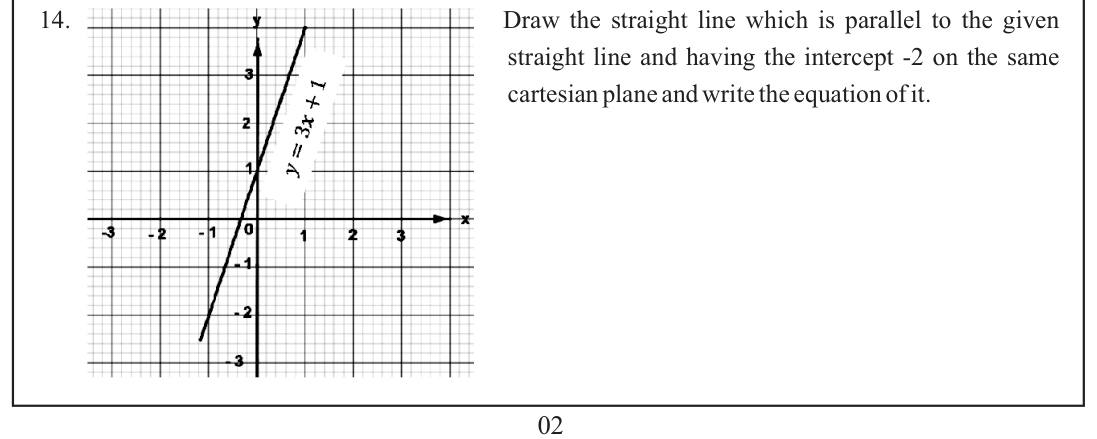
• Parallel lines have the same gradient. y = 3x + 2 and y = 3x − 5 are parallel.• If c = 0, the line passes through the origin (0, 0): y = mx.So the line through the origin parallel to y = 3x + 2 is y = 3x.• Lines with the same c meet on the y-axis.

Vertical and horizontal lines

x = 3 is vertical: every point has x = 3. y = −2 is horizontal (gradient 0). They meet at (3, −2).
xy−3−2−112345−4−3−2−112340x = 3y = −2(3, −2)

⚠️ Swapped coordinates

In an O/L question about plotting a point, about a quarter of candidates went wrong, mostly by swapping x and y or going the wrong way on an axis. Say it as you plot: "x across first, then y up or down". A negative x means left; a negative y means down.

⚠️ Gradient and intercept traps

• From a graph, count units on the scale, not squares, especially when the two axes have different scales.• A line going down to the right has a negative gradient.• The intercept c is where the line cuts the y-axis (x = 0), not the x-axis.• Make y alone before reading m and c.

📌 Remember

• (x, y): x across first, then y. Right and up are positive.• y = mx + c is a straight line: m is the gradient, c the y-intercept.• Gradient = vertical change ÷ horizontal change; down to the right is negative.• Parallel lines have equal gradients; y = mx passes through the origin.• x = a is vertical, y = b is horizontal.

🧾 Quick revision sheet

In y = mx + c, what is m?The gradient.
In y = mx + c, what is c?The y-intercept: the line meets the y-axis at (0, c).
Gradient from two points(difference in y) ÷ (difference in x)
Parallel linesHave the same gradient.
Line through the originy = mx (c = 0)
Graph of x = 3A vertical line through (3, 0).
Graph of y = −2A horizontal line through (0, −2); gradient 0.
Gradient and intercept of 3y = 6x − 9y = 2x − 3: m = 2, c = −3

Now test yourself: 4 quick checks and 1 more worked examples

The full lesson checks your answers as you go, and Gedara Sir tracks which parts you've got.

Past paper questions on Graphs

More Grade 9 notes