Short notes › Grade 10 · සිංහලෙන්

Grade 10 Arithmetic Progressions: Short Notes

10 ශ්‍රේණිය · 23 පරිච්ඡේදය · සමාන්තර ශ්‍රේඪි

70%

of Grade 10 term tests include it (38 of 54)

376

marks in past papers (42 questions)

11 min

full lesson with quick checks

🎯 What you'll learn

  • Recognise an AP and find its first term and common difference
  • Find any term with Tₙ = a + (n − 1)d
  • Decide which term a number is, or show it is not a term
  • Find a and d from two given terms
  • Find sums with Sₙ = n/2 [2a + (n − 1)d] and solve word problems

The till box plan

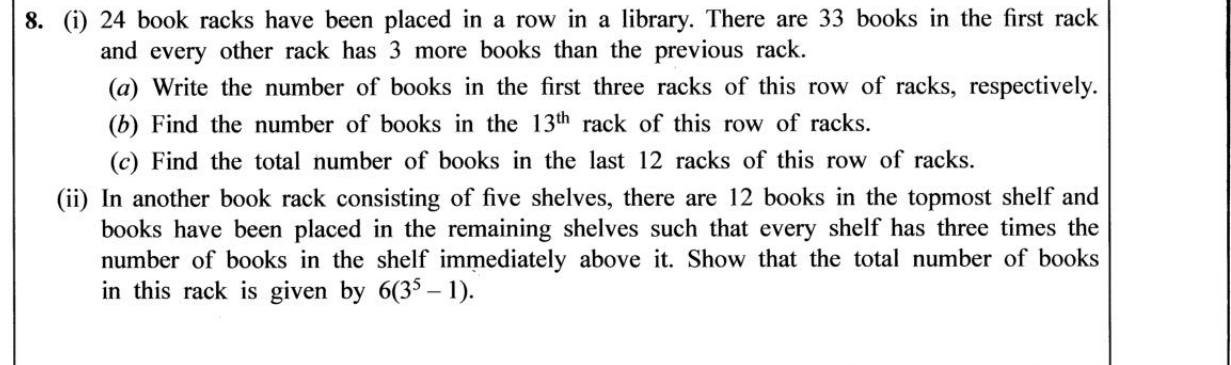
Nethmi in Galle drops Rs 50 into her till box in the first week and Rs 10 more every week after that. How much does she add in week 20, and how much has she saved by then? Adding twenty numbers by hand is slow. Arithmetic progressions do it in two lines.

What is an arithmetic progression?

A list of numbers where you add the same amount each time to get the next term.• The first term is a.• The fixed amount is the common difference d = any term − the term before it.3, 7, 11, 15, … : a = 3, d = 420, 17, 14, … : a = 20, d = −3 (decreasing)2, 4, 8, 16 is not an AP: the differences change.

Counting the jumps

Start at a and add d each step. To reach the 5th term you make only 4 jumps, so T₅ = a + 4d. In general the nth term needs (n − 1) jumps.
T₁T₂+dT₃+dT₄+dT₅+daa+4d

🧮 The nth term

Use it to find any term without listing them all, or to find which term has a given value. Here a is the first term and d the common difference.

Tₙ = a + (n − 1)d

✏️ The 20th term

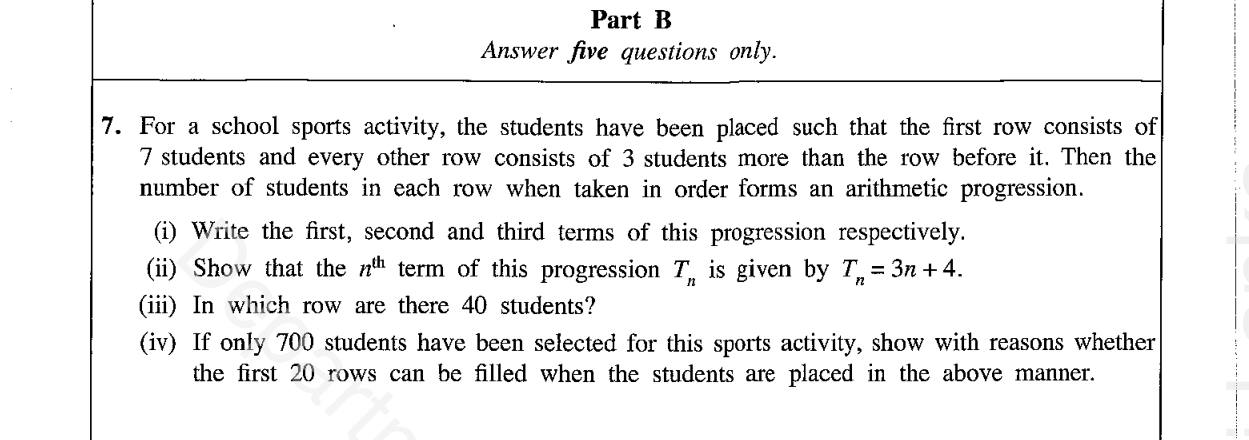
Find the 20th term of 7, 11, 15, …
  1. 1a = 7, d = 11 − 7 = 4, n = 20.
  2. 2T₂₀ = 7 + (20 − 1) × 4 = 7 + 76
  3. 3T₂₀ = 83

✅ 83

Which term is it?

To find which term equals a number, set Tₙ = that number and solve for n.• If n is a positive whole number, it is that term.• If n is a fraction, the number is not a term of the progression. Exams often ask you to show this.

✏️ Is it in the list?

For 7, 11, 15, …: (i) which term is 143? (ii) Is 100 a term?
  1. 1(i) 7 + (n − 1) × 4 = 143, so (n − 1) × 4 = 136.
  2. 2n − 1 = 34, so n = 35: the 35th term.
  3. 3(ii) 7 + (n − 1) × 4 = 100 gives n − 1 = 23.25.
  4. 4n = 24.25 is not a whole number, so 100 is not a term.

✅ (i) 35th term (ii) No

⚠️ Undo in the right order

Examiners see students who know Tₙ = a + (n − 1)d but undo it wrongly when finding n. Work backwards step by step: subtract a, then divide by d, then add 1.For a decreasing progression, keep the minus sign: d = 46 − 50 = −4, not 4.

Adding the terms quickly

Add 1 + 2 + … + 100. Write it forwards and backwards and add the pairs: 1 + 100, 2 + 99, 3 + 98… Every pair is 101 and there are 100 pairs, so twice the sum is 100 × 101.Sum = 100 × 101 ÷ 2 = 5050.The same trick works for any AP: (number of terms ÷ 2) × (first + last).

🧮 Sum of the first n terms

Use the first form when you know a and d. Use the second when you know the first term a and the last term l.

Sₙ = n/2 [2a + (n − 1)d] or Sₙ = n/2 (a + l)

⚠️ Term or total?

Two common slips:1. Giving the 20th term when the question asks for the total of 20 terms. 'How many in week 20?' is Tₙ; 'how many altogether?' is Sₙ.2. Simplifying the bracket wrongly. Inside [2a + (n − 1)d], work out (n − 1)d first, add 2a, and only then multiply by n/2.

📌 Remember

• An AP adds the same common difference d each time: d = Tₙ − Tₙ₋₁.• nth term: Tₙ = a + (n − 1)d.• To find which term: set Tₙ = value; a fraction for n means it is not a term.• Sum: Sₙ = n/2 [2a + (n − 1)d] = n/2 (a + l).• Read carefully: one term (Tₙ) or a total (Sₙ)?

🧾 Quick revision sheet

Common difference dAny term minus the term before it.
nth term of an APTₙ = a + (n − 1)d
Sum of the first n terms (using d)Sₙ = n/2 [2a + (n − 1)d]
Sum of the first n terms (using the last term l)Sₙ = n/2 (a + l)
How do you show a number is NOT a term?Solve Tₙ = number; n comes out as a fraction (not a whole number).
d of 20, 17, 14, …−3
Given Sₙ, how do you get the first term and the 2nd term?a = S₁, and T₂ = S₂ − S₁.
1 + 2 + 3 + … + 1005050

Now test yourself: 6 quick checks and 3 more worked examples

The full lesson checks your answers as you go, and Gedara Sir tracks which parts you've got.

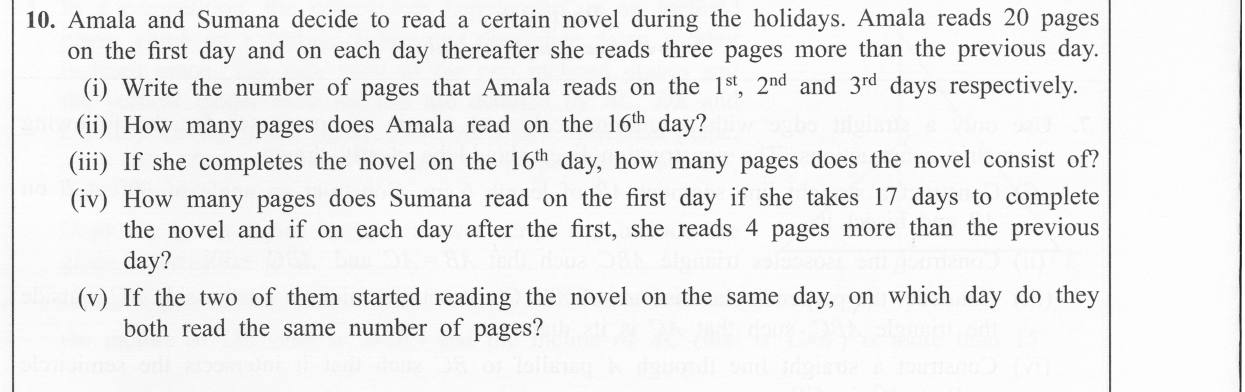
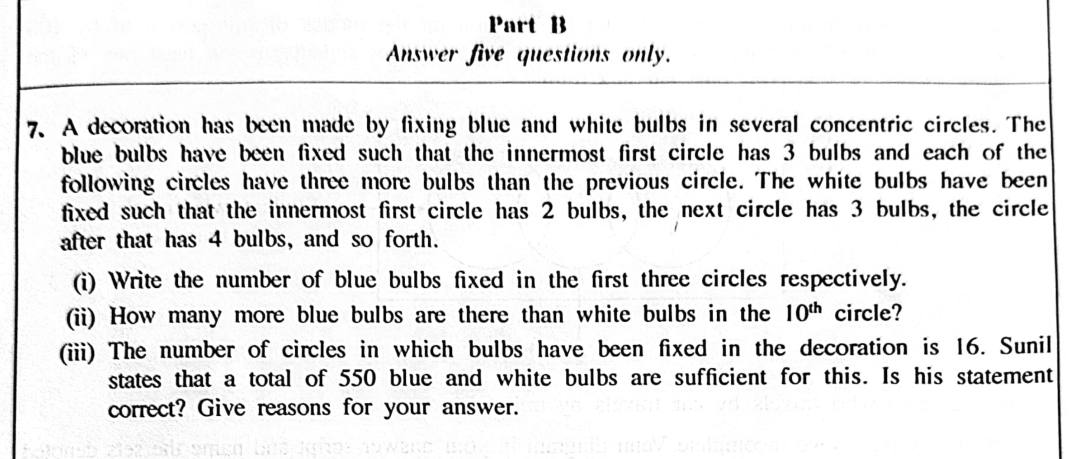
Past paper questions on Arithmetic Progressions

More Grade 10 notes