Short notes › Grade 10 · සිංහලෙන්

Grade 10 Parallelograms I: Short Notes

10 ශ්‍රේණිය · 15 පරිච්ඡේදය · සමාන්තරාස්‍ර I

78%

of Grade 10 term tests include it (42 of 54)

332

marks in past papers (78 questions)

10 min

full lesson with quick checks

🎯 What you'll learn

  • Prove that opposite sides and opposite angles of a parallelogram are equal
  • Use the fact that a diagonal splits a parallelogram into two congruent triangles
  • Use the fact that the diagonals of a parallelogram bisect each other
  • Know the extra diagonal properties of a rectangle, rhombus and square
  • Find unknown sides and angles and write short rider proofs with reasons

The three-wheeler jack

A three-wheeler driver in Kurunegala gets a flat tyre. He slides a scissor jack under the frame and turns the handle. The jack's four steel arms always form a parallelogram, a rhombus in fact. As one diagonal gets longer, the other gets shorter and the vehicle rises. Why does the shape behave so reliably? That's this lesson.

What is a parallelogram?

A parallelogram is a quadrilateral whose both pairs of opposite sides are parallel.In ABCD: AB ∥ DC and AD ∥ BC.Because of the parallel lines, any two adjacent angles are allied (co-interior) angles, so they add up to 180°:∠A + ∠B = 180°, ∠B + ∠C = 180°, and so on.

Everything a parallelogram gives you

Arrows show the parallel sides. The diagonals AC and BD meet at O: the marks show AO = OC and BO = OD.
ABCDO

🧮 Theorem: sides and angles

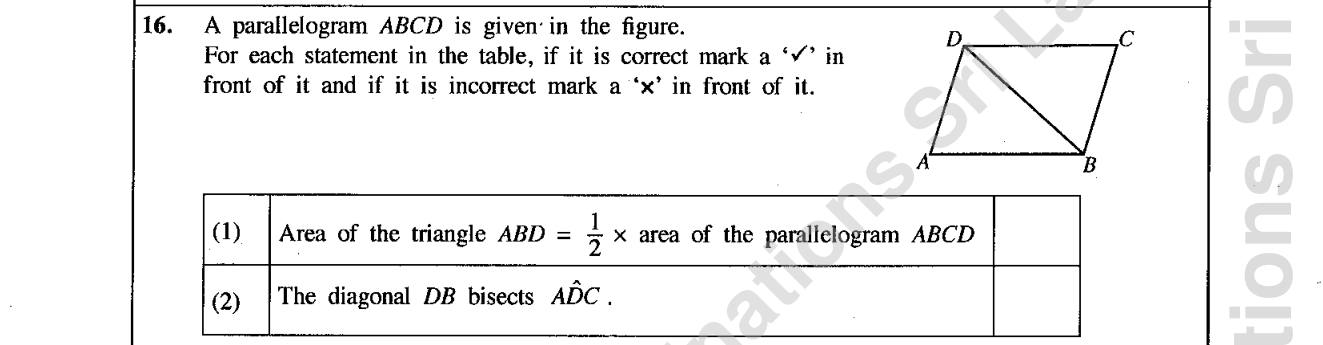
In any parallelogram ABCD the opposite sides are equal and the opposite angles are equal. Also, each diagonal divides it into two congruent triangles, so each triangle has half the area.

AB = DC, AD = BC; ∠A = ∠C, ∠B = ∠D

Why it is true: the formal proof

Join the diagonal AC. In △ABC and △CDA:• ∠BAC = ∠DCA (alternate angles, AB ∥ DC)• ∠BCA = ∠DAC (alternate angles, AD ∥ BC)• AC is common.So △ABC ≡ △CDA (AAS).Corresponding parts are equal: AB = CD, BC = DA and ∠B = ∠D. Joining BD instead gives ∠A = ∠C.

✏️ Finding the angles

In parallelogram PQRS, ∠P = (3x + 10)° and ∠R = (5x − 30)°. Find x, and then all four angles.
  1. 1∠P and ∠R are opposite angles, so they are equal.
  2. 23x + 10 = 5x − 30, so 40 = 2x and x = 20.
  3. 3∠P = ∠R = 3 × 20 + 10 = 70°.
  4. 4Adjacent angles add to 180°: ∠Q = ∠S = 180° − 70° = 110°.

✅ x = 20; ∠P = ∠R = 70°, ∠Q = ∠S = 110°

⚠️ Outside angle ≠ inside angle

When a side is produced, the angle marked outside the parallelogram is an exterior angle. Students often copy it straight to the opposite corner.First find the interior angle on the straight line: 180° − (exterior angle). Only then use 'opposite angles are equal'. For an exterior angle of 65°, the opposite interior angle is 115°, not 65°.

🧮 Theorem: the diagonals

The diagonals of a parallelogram bisect each other: they cut each other exactly in half at O.Proof idea: △AOB ≡ △COD (AAS), using ∠OAB = ∠OCD and ∠OBA = ∠ODC (alternate angles) and AB = CD (opposite sides).

AO = OC, BO = OD

✏️ Halves of the diagonals

In parallelogram ABCD the diagonals meet at O. AC = 18 cm, BD = 12 cm and AB = 10 cm. Find the perimeter of triangle AOB.
  1. 1Diagonals bisect each other: AO = 18 ÷ 2 = 9 cm.
  2. 2BO = 12 ÷ 2 = 6 cm.
  3. 3Perimeter = AO + BO + AB = 9 + 6 + 10 = 25 cm.

✅ 25 cm

⚠️ Diagonals don't do everything

In O/L papers many candidates thought a parallelogram's diagonal bisects its angles. It does not, unless the parallelogram is a rhombus.In a general parallelogram the diagonals are not equal and not perpendicular. They only bisect each other. Don't read extra facts off a neat-looking figure.

Special parallelograms

1: A rectangle is a parallelogram with right angles; its diagonals are equal.2: A rhombus has all sides equal; its diagonals meet at 90° and bisect its angles.A square has all these properties.
12

⚠️ Every step needs a reason

In a 2018 O/L proof question only 7% scored well. Examiners said many wrote correct-looking lines with no reasons, or did not know which congruence case they had used.Write each fact as: fact (reason). Then name the case: SSS, SAS, AAS or RHS. Use results proved in earlier parts.

📌 Remember

• Parallelogram: both pairs of opposite sides parallel.• Opposite sides equal; opposite angles equal; adjacent angles add to 180°.• Each diagonal splits it into two congruent triangles of equal area.• Diagonals bisect each other (but are not equal or perpendicular in general).• Rectangle: equal diagonals. Rhombus: diagonals perpendicular and bisect the angles.

🧾 Quick revision sheet

What is a parallelogram?A quadrilateral with both pairs of opposite sides parallel.
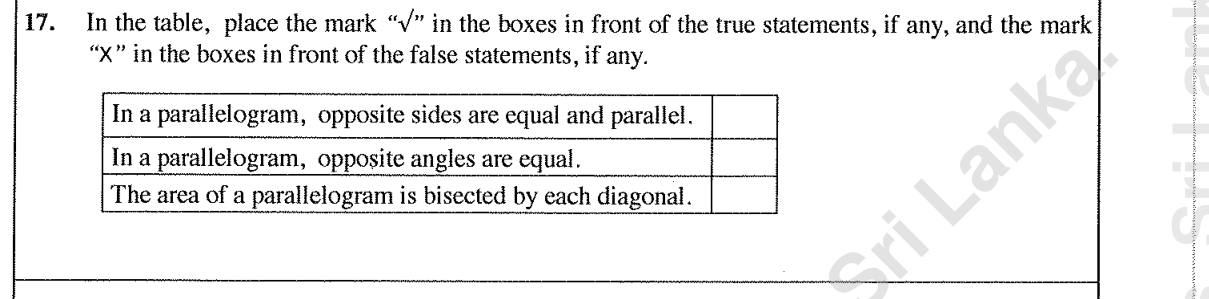
Sides and angles of a parallelogramOpposite sides are equal and opposite angles are equal.
Two adjacent angles of a parallelogram add up to…180° (they are allied angles).
What does one diagonal do to a parallelogram?Splits it into two congruent triangles, each with half the area.
The two diagonals of a parallelogram…bisect each other.
Diagonals of a rectangleEqual in length, and they bisect each other.
Diagonals of a rhombusBisect each other at right angles and bisect the angles of the rhombus.

Now test yourself: 4 quick checks and 1 more worked examples

The full lesson checks your answers as you go, and Gedara Sir tracks which parts you've got.

Past paper questions on Parallelograms I

More Grade 10 notes