Short notes › Grade 11 · සිංහලෙන්

Grade 11 Percentages: Short Notes

11 ශ්‍රේණිය · 9 පරිච්ඡේදය · ප්‍රතිශත

67%

of Grade 11 term tests include it (41 of 61)

466

marks in past papers (49 questions)

12 min

full lesson with quick checks

🎯 What you'll learn

  • Find the loan, interest and instalment when interest is charged on the whole loan
  • Use month units to find interest on a reducing balance
  • Find the monthly instalment, or the annual interest rate, of an instalment plan
  • Find compound interest year by year and with A = P(1 + r/100)ⁿ
  • Compare simple and compound interest schemes and choose the better one

Cash or easy payment?

A Galle electronics shop sells a TV for Rs. 60 000 cash, or Rs. 15 000 down and six monthly instalments of Rs. 7 850. The poster says 'easy payment', but what interest rate are you really paying? By the end of this lesson you'll be able to work it out.

The words you need

• Down payment: paid at the start.• Loan = cash price − down payment. Interest is charged only on this.• Instalment: the equal amount paid each month.Two ways to charge interest:1. On the whole loan for the whole period (simple interest).2. On the reducing balance: only on what you still owe each month.

✏️ Interest on the whole loan

Nimal borrows Rs. 45 000 for a sewing machine at 12% annual simple interest, charged on the whole loan. He repays loan and interest in 6 equal monthly instalments. Find each instalment.
  1. 16 months = 6/12 of a year.
  2. 2Interest = 45 000 × 12/100 × 6/12 = Rs. 2 700
  3. 3Total to repay = 45 000 + 2 700 = Rs. 47 700
  4. 4Instalment = 47 700 ÷ 6 = Rs. 7 950

✅ Rs. 7 950

Reducing balance: fairer interest

If a loan is repaid in 6 months, split it into 6 equal parts.Month 1 you owe all 6 parts, month 2 only 5, then 4, 3, 2, 1.So interest is charged on 6 + 5 + 4 + 3 + 2 + 1 = 21 month units: one part borrowed for one month.For n instalments: month units = n(n + 1)/2.

21 month units

Each block is one part owed for one month. The balance shrinks every month, so you pay interest on 21 blocks, not 6 × 6 = 36.
6152433425166 + 5 + 4 + 3 + 2 + 1 = 21

🧮 Reducing-balance interest

L is the loan, n the number of monthly instalments and r the annual rate. L/n is one part. Instalment = (L + I) ÷ n.

I = (L/n) × r/100 × 1/12 × n(n + 1)/2

✏️ Finding the instalment

A Rs. 36 000 loan is repaid in 12 equal monthly instalments, with 10% annual interest on the reducing balance. Find each instalment.
  1. 1One part = 36 000 ÷ 12 = Rs. 3 000
  2. 2Month units = 12 + 11 + … + 1 = 12 × 13/2 = 78
  3. 3Interest on one unit = 3 000 × 10/100 × 1/12 = Rs. 25
  4. 4Total interest = 78 × 25 = Rs. 1 950
  5. 5Instalment = (36 000 + 1 950) ÷ 12 = Rs. 3 162.50

✅ Rs. 3 162.50

⚠️ Wrong loan, wrong method

Common slips in term tests:• Using the cash price as the loan. Subtract the down payment first.• Charging interest on the whole loan when the question says reducing balance.• Forgetting 1/12: the rate is annual but each unit is one month.Read the question again and underline 'reducing balance'.

Simple vs compound interest

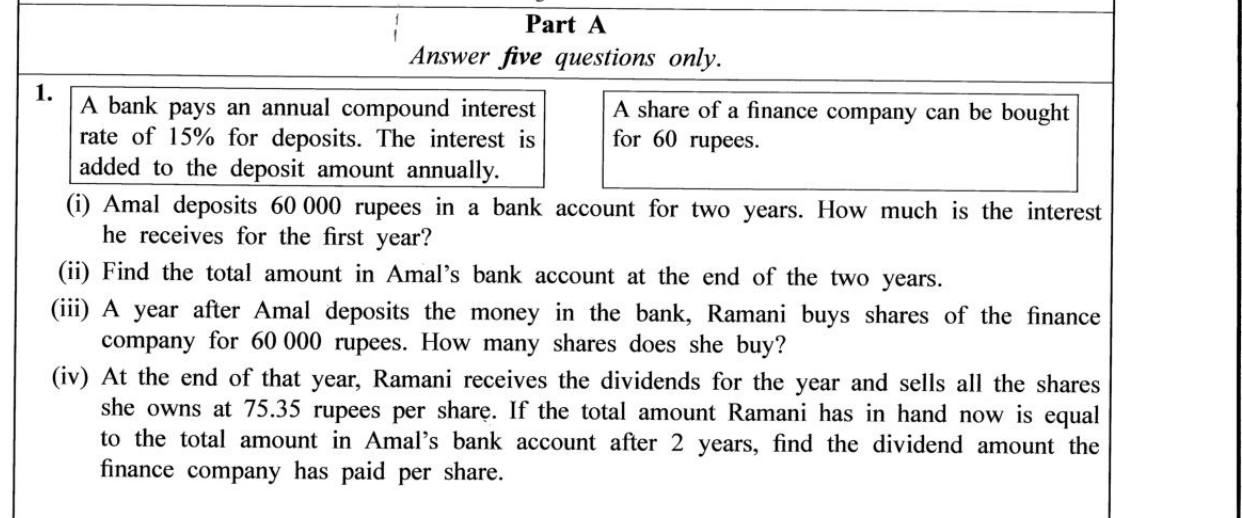
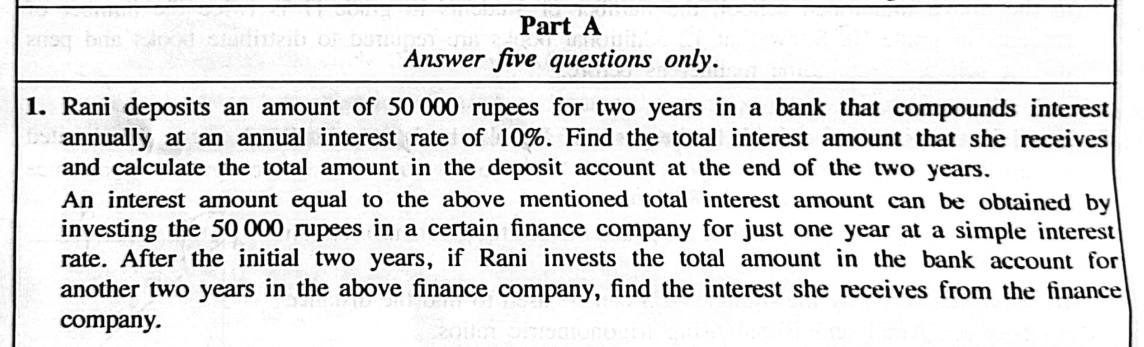
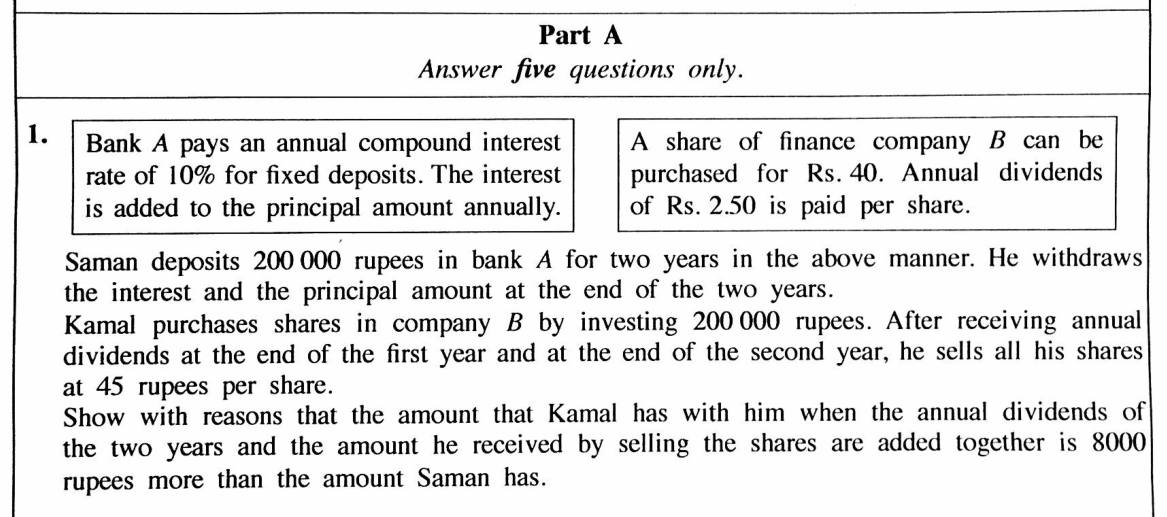
Simple interest: the same amount every year, always on the original sum.Compound interest: each year's interest is added to the sum, so next year's interest is on a bigger amount.Rs. 10 000 at 10% for 2 years:• Simple: 1 000 + 1 000 = Rs. 2 000• Compound: 1 000 + 1 100 = Rs. 2 100

🧮 Compound amount

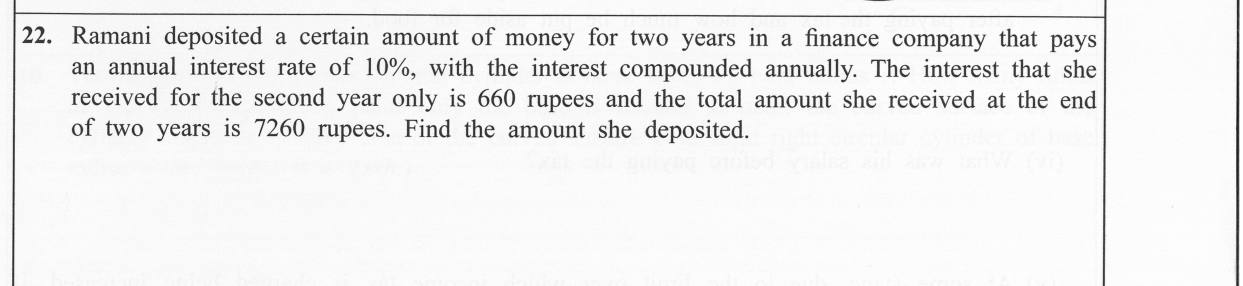
P is the principal, r the annual rate and n the number of years. Compound interest = A − P. You may also work year by year, which is what the formula does.

A = P(1 + r/100)ⁿ

⚠️ Compound is not simple twice

O/L examiners report students who take the same interest for both years. In year 2 the interest is on the new amount.Going backwards is also tricky: if Rs. 12 100 is the amount after 2 years at 10% compound, P = 12 100 ÷ 1.1 ÷ 1.1 = Rs. 10 000. Don't just subtract 20%.

📌 Remember

• Loan = cash price − down payment.• Whole loan: I = L × r/100 × months/12.• Reducing balance: month units = n(n + 1)/2; I = one part × units × r/100 × 1/12.• Compound: A = P(1 + r/100)ⁿ, or work year by year.• To compare schemes, find the final amount for each.

🧾 Quick revision sheet

Loan in an instalment planCash price − down payment
Month units for n monthly instalmentsn(n + 1)/2, e.g. 12 instalments → 78
What is 'interest on the reducing balance'?Interest each month only on the part of the loan still unpaid.
Compound amount formulaA = P(1 + r/100)ⁿ
Simple vs compound interestSimple: same interest each year. Compound: interest is added on, so it grows each year.
Rs. 10 000 at 10% compound for 2 yearsRs. 12 100 (interest Rs. 2 100)

Now test yourself: 4 quick checks and 2 more worked examples

The full lesson checks your answers as you go, and Gedara Sir tracks which parts you've got.

Past paper questions on Percentages

More Grade 11 notes