Short notes › Grade 11 · සිංහලෙන්

Grade 11 Share Market: Short Notes

11 ශ්‍රේණිය · 10 පරිච්ඡේදය · කොටස් වෙළෙඳ පොළ

62%

of Grade 11 term tests include it (38 of 61)

392

marks in past papers (40 questions)

10 min

full lesson with quick checks

🎯 What you'll learn

  • Explain shares, shareholders, market price and dividends
  • Find the number of shares bought and the annual dividend income
  • Calculate capital gain or loss and the sale value
  • Write income as a percentage of the investment
  • Compare shares with bank interest and solve reinvestment problems

Own a piece of a company

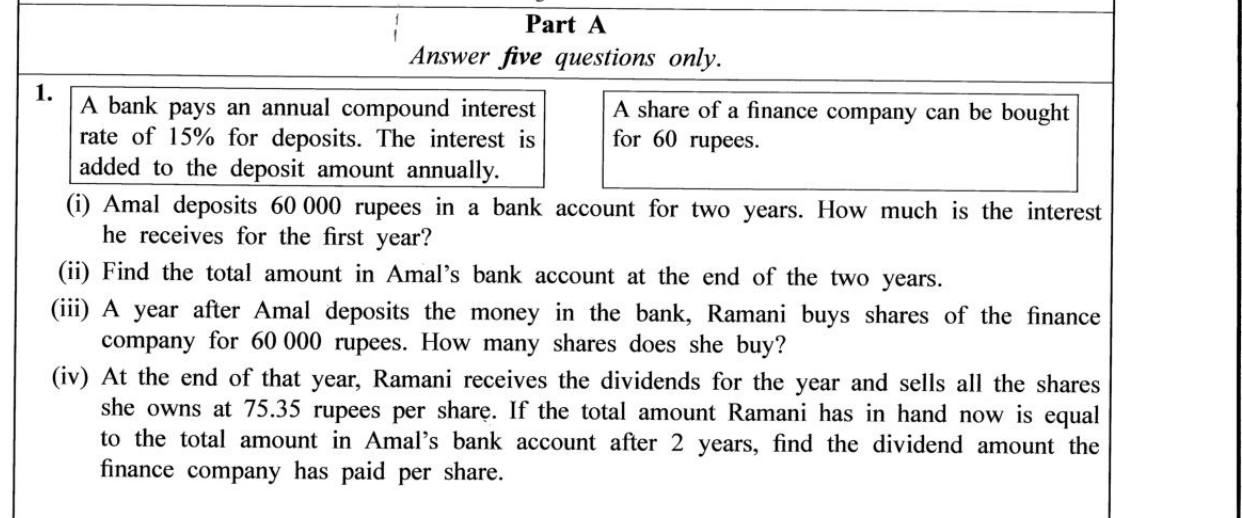
Ruwan in Kandy has saved Rs. 120 000. A tea company listed on the Colombo Stock Exchange sells shares at Rs. 30 each and paid Rs. 2 per share as dividend last year. Should he buy, or keep the money in the bank? This chapter gives you the maths to decide.

What is a share?

A company raises money by dividing its capital into many equal parts called shares. If you buy shares you become a shareholder: you own a small part of the company.Shares of listed companies are bought and sold at the stock exchange. The price on a given day is the market price. It goes up and down with demand.

Two ways shares earn money

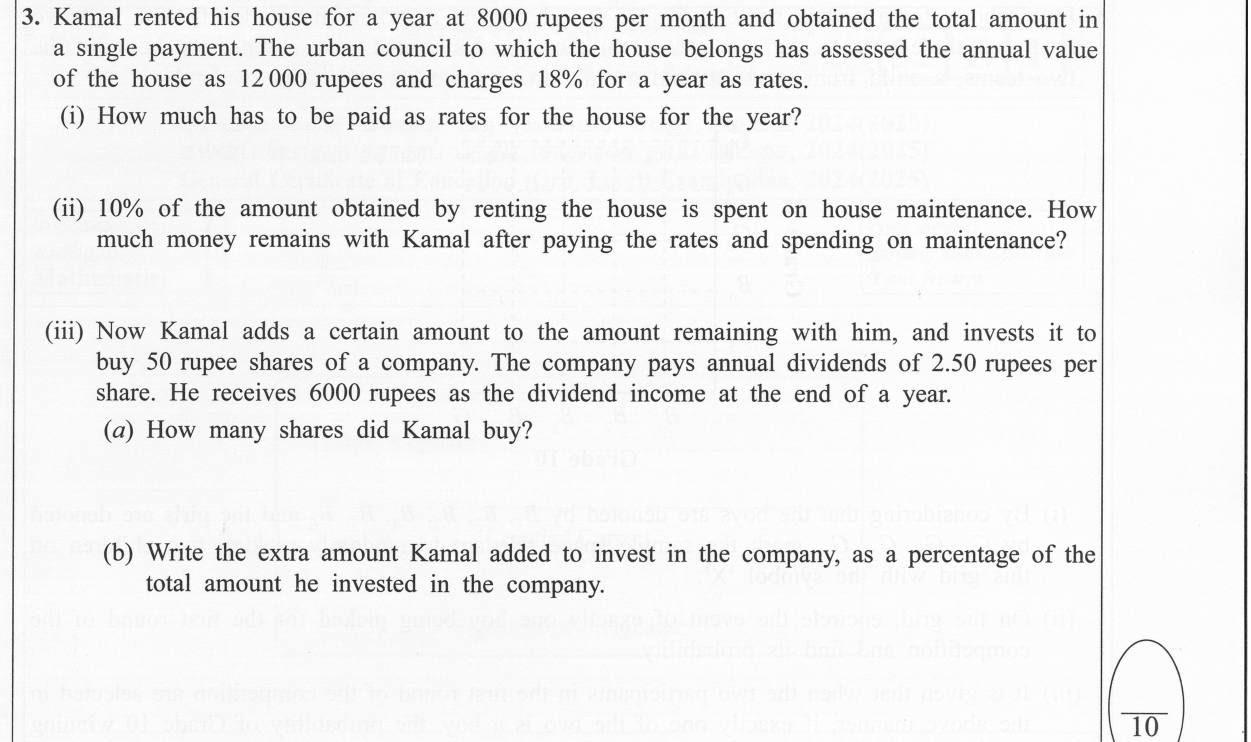
1. Dividend: each year the company shares part of its profit, as so many rupees per share. Annual dividend income = number of shares × dividend per share.2. Capital gain: if you sell for more than you paid, the extra is a capital gain. If you sell for less, it is a capital loss.Capital gain = (selling price − buying price) × number of shares.

🧮 The key formulas

N = number of shares, I = amount invested, P = market price when buying, d = dividend per share, D = annual dividend income, S = selling price per share, G = capital gain.

N = I ÷ P D = N × d G = N × (S − P)

✏️ Shares and dividend

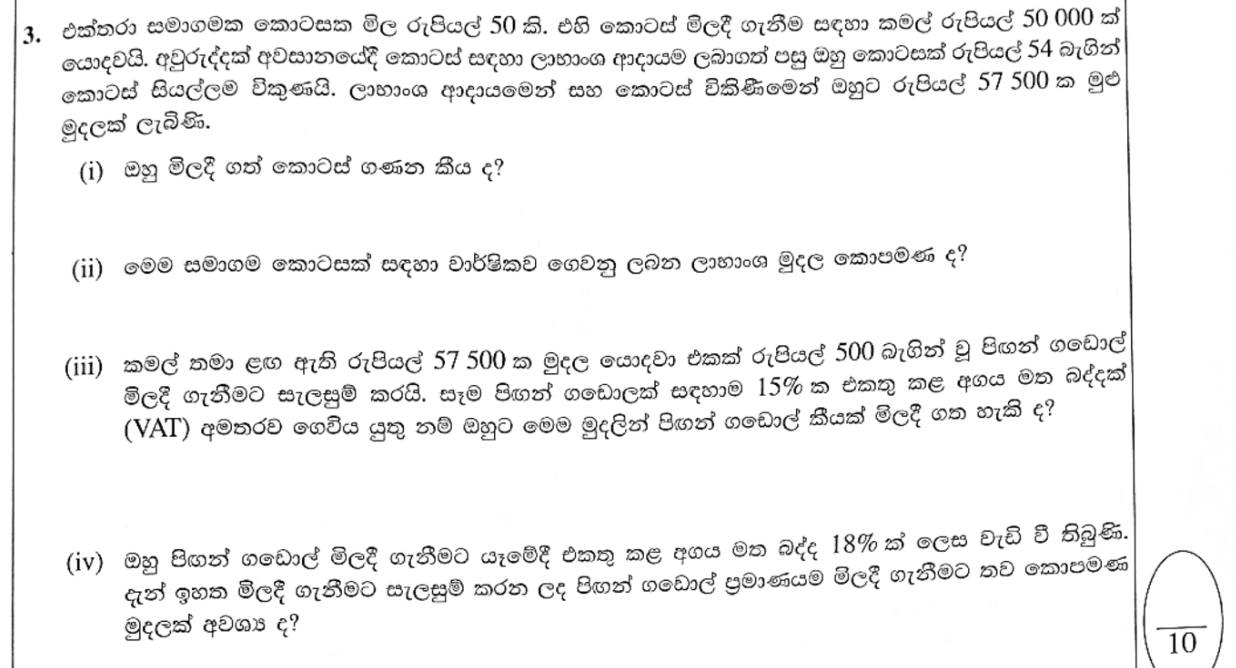
Nimali invests Rs. 48 000 in a company whose shares sell at Rs. 24. The company pays an annual dividend of Rs. 3 per share. Find (i) the number of shares (ii) her annual dividend income (iii) that income as a percentage of her investment.
  1. 1(i) Shares = 48 000 ÷ 24 = 2000.
  2. 2(ii) Dividend income = 2000 × Rs. 3 = Rs. 6000.
  3. 3(iii) 6000 ÷ 48 000 × 100% = 12.5%.

✅ (i) 2000 (ii) Rs. 6000 (iii) 12.5%

⚠️ Number of shares first

Examiners note that many students skip finding the number of shares and multiply the dividend per share by the money invested (75 000 × 2.50), or divide by the wrong price. Dividends are paid per share, so always find N = investment ÷ market price first.

✏️ Selling at a profit

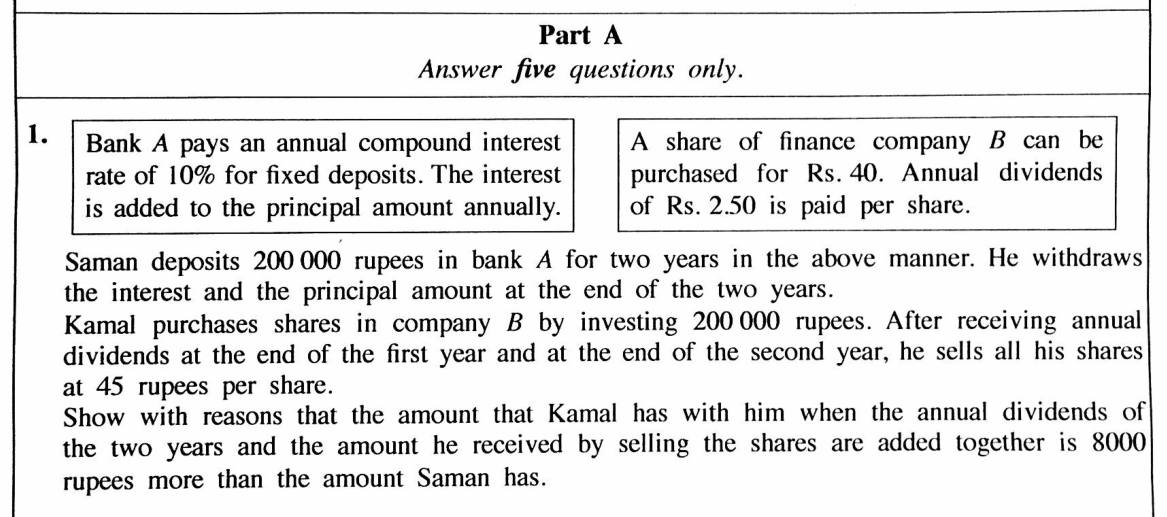
Kasun buys 1500 shares at Rs. 40 each. A year later he sells them all at Rs. 46 each. Find his capital gain and write it as a percentage of the money he invested.
  1. 1Investment = 1500 × 40 = Rs. 60 000.
  2. 2Gain per share = 46 − 40 = Rs. 6.
  3. 3Capital gain = 1500 × 6 = Rs. 9000.
  4. 4Percentage = 9000 ÷ 60 000 × 100% = 15%.

✅ Rs. 9000, which is 15%

⚠️ Sale value is not the gain

1500 × 46 = Rs. 69 000 is the sale value: the money he receives. The capital gain is only the extra: 69 000 − 60 000 = Rs. 9000. Read the question carefully: 'income from selling', 'capital gain' and 'selling price per share' are three different answers.

Shares or the bank?

To compare, find the total return for the same period:shares: dividend + capital gainbank: interestAs a percentage: return ÷ amount invested × 100%.Remember that shares carry risk: the price can fall, and dividends are not promised. Bank interest is fixed.

📌 Remember

• Number of shares = investment ÷ market price. Find this first.• Dividend income = number of shares × dividend per share.• Capital gain = number of shares × (selling price − buying price).• Return % = (dividend + gain) ÷ investment × 100%.• Sale value, capital gain and price per share are different things.

🧾 Quick revision sheet

ShareholderA person who owns shares, and so owns part of a company.
Market priceThe price of one share at the stock exchange on a given day.
Number of shares boughtInvestment ÷ market price
Annual dividend incomeNumber of shares × dividend per share
Capital gain(Selling price − buying price) × number of shares
Capital lossWhen shares are sold for less than they cost.
Dividend as a % of investmentDividend income ÷ investment × 100%

Now test yourself: 4 quick checks and 2 more worked examples

The full lesson checks your answers as you go, and Gedara Sir tracks which parts you've got.

Past paper questions on Share Market

More Grade 11 notes