Short notes › Grade 9 · සිංහලෙන්

Grade 9 Round off and Scientific Notation: Short Notes

9 ශ්‍රේණිය · 1 පරිච්ඡේදය · වටැයීම හා විද්‍යාත්මක අංකනය

75%

of Grade 9 term tests include it (30 of 40)

176

marks in past papers (66 questions)

10 min

full lesson with quick checks

🎯 What you'll learn

  • Round whole numbers to the nearest 10, 100 or 1000
  • Round decimals to the nearest whole number, one or two decimal places
  • Find the least and greatest numbers that round to a given value
  • Write large and small numbers in scientific notation, A × 10ⁿ
  • Change numbers in scientific notation back to ordinary form

Too many zeros

The news says 'about 35 000 fans' at the Pallekele cricket stadium, not 34 812. A science book says the Sun is 150 000 000 km away, and a dust speck is 0.000 05 m wide. Rounding keeps numbers simple, and scientific notation tames all those zeros.

Rounding whole numbers

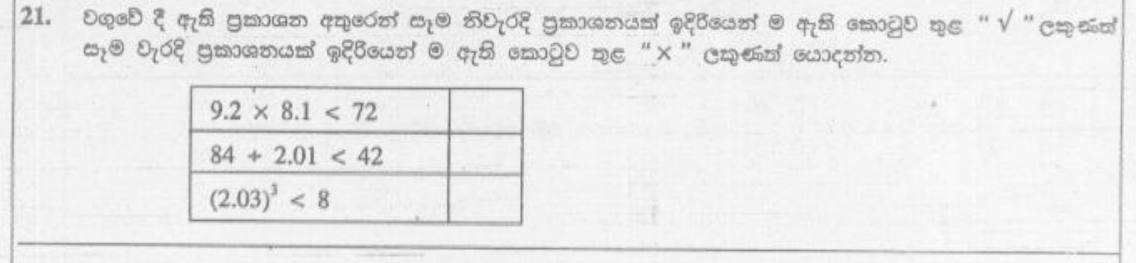
Look at the digit just to the right of the place you are rounding to.• 5 or more: round up.• 4 or less: round down.Then replace the digits after that place with zeros.2455 to the nearest hundred: the tens digit is 5, so 2455 → 2500.2455 to the nearest ten: the units digit is 5, so → 2460.

Rounding decimals

Same rule, same 'look one place to the right'. Take 7.348:• nearest whole number: 7.348 → 7• one decimal place: 7.348 → 7.3 (next digit 4)• two decimal places: 7.348 → 7.35 (next digit 8)After the decimal point, just drop the extra digits. Don't put zeros in their place.

⚠️ Round once, from the original

2.449 to one decimal place: some students go 2.449 → 2.45 → 2.5. Wrong! Look only at the digit after the first decimal place in the original number: it's 4, so the answer is 2.4.Also keep a needed zero: 3.97 to one decimal place is 4.0, not 4. The 0 shows it is accurate to one decimal place.

What could the number have been?

A whole number rounded to the nearest 10 gives 70. What could it be?• Smallest: 65 (65 rounds up to 70; 64 goes to 60)• Greatest: 74 (75 would round up to 80)So it is one of 65, 66, …, 74. The range goes half a step each side of 70.

⚠️ The top end is tricky

For 'the greatest whole number that rounds to 50 (nearest 10)', many answer 55. But 55 rounds up to 60. The greatest is 54. Likewise 44 rounds to 40, so the least is 45.Always test your answer: round it and see if you really get the given value.

Scientific notation

Write a number as A × 10ⁿ, where 1 ≤ A < 10 and n is a whole number (it can be negative).• Big number, n positive: 150 000 000 = 1.5 × 10⁸ (the point moves 8 places left)• Small number, n negative: 0.000 32 = 3.2 × 10⁻⁴ (the point moves 4 places right)Count the places the decimal point moves to get a number between 1 and 10.

Count the hops

The point hops 4 places right to sit after the 3. Moving right for a small number gives a negative index: 10⁻⁴.
00003212340.00032 = 3.2 × 10⁻⁴

✏️ Writing in scientific notation

Write in scientific notation: (i) 4 650 000 (ii) 0.0807
  1. 1(i) Put the point after the first non-zero digit: 4.65.
  2. 2From 4 650 000. to 4.650000 the point moved 6 places left: 4.65 × 10⁶.
  3. 3(ii) A = 8.07. From 0.0807 to 8.07 the point moved 2 places right.
  4. 4Small number, so the index is negative: 8.07 × 10⁻².

✅ (i) 4.65 × 10⁶ (ii) 8.07 × 10⁻²

✏️ Back to ordinary form

Write as ordinary numbers: (i) 6.07 × 10⁵ (ii) 2.4 × 10⁻³
  1. 1(i) × 10⁵: move the point 5 places right, filling with zeros.
  2. 26.07 → 607 000
  3. 3(ii) × 10⁻³ means ÷ 1000: move the point 3 places left.
  4. 42.4 → 0.0024

✅ (i) 607 000 (ii) 0.0024

⚠️ Wrong A, wrong direction

45 × 10³ equals 45 000, but it is not scientific notation: A must be at least 1 and less than 10. Write 4.5 × 10⁴.Examiners also see the point moved the wrong way. Quick check: a big number has a positive index; a number less than 1 has a negative index.

📌 Remember

• Look one place to the right: 5 or more rounds up, 4 or less rounds down.• Round once, from the original number; keep needed zeros like 4.0.• To the nearest 10, 70 comes from 65 up to 74.• Scientific notation: A × 10ⁿ with 1 ≤ A < 10.• Big numbers: positive n. Numbers less than 1: negative n.

🧾 Quick revision sheet

Rounding ruleNext digit 5 or more: round up. 4 or less: round down.
2455 to the nearest hundred2500
3.97 to one decimal place4.0 (keep the zero)
Whole numbers that round to 50 (nearest 10)45 to 54
Scientific notation formA × 10ⁿ, with 1 ≤ A < 10 and n an integer.
Sign of n for a number less than 1Negative, e.g. 0.0024 = 2.4 × 10⁻³
1.5 × 10⁸ in ordinary form150 000 000

Now test yourself: 6 quick checks and 1 more worked examples

The full lesson checks your answers as you go, and Gedara Sir tracks which parts you've got.

Past paper questions on Round off and Scientific Notation

More Grade 9 notes